



-
 Written By:
Alex Herrera
Written By:
Alex Herrera
-
 Edited By:
Phyllis Rodriguez, PMHNP-BC
Edited By:
Phyllis Rodriguez, PMHNP-BC
-
 Clinically Reviewed By:
Dr. Ash Bhatt, MD, MRO
Clinically Reviewed By:
Dr. Ash Bhatt, MD, MRO
Key Takeaways1. Structured Care Works Best When It Fits Your Life I’ve seen too many people fail in treatment because the treatment setting didn’t honor their real-world obligations. A partial hospitalization program lets you show up for your family, maintain your professional reputation, and still get the intensive clinical intervention you need. 2. The Bridge Between Crisis Care and Independence Matters I position our PHP as a bridge for crisis inpatient care, but often superior to traditional outpatient care for many patients. When someone stabilizes medically, the real work begins: learning to apply therapy skills in their actual environment. That’s what PHP does beautifully. 3. Recovery Success Depends on Meeting People Where They Are Every patient I see is different, and our clinical assessment process is a thoughtful conversation about who you are, what you need, and how we can design treatment that actually works for your life, providing personalization. |
Understanding the Balance: Why a Partial Hospitalization Program Matters
A partial hospitalization program (PHP) is a hospital-based form of outpatient drug rehab that offers services similar to an inpatient program, but without requiring you to live at the treatment facility. This is the critical distinction that makes PHP transformative for so many people.
Think of it this way: you get intensive clinical treatment during the day while maintaining your home, family, and work life. It’s not a compromise, it’s a sophisticated approach designed specifically for people who are medically stable enough to go home at night, but need serious structure during the day to overcome addiction or mental health challenges.
| The PHP Advantage: Intensive clinical support during the day, independence and responsibility in the evening and nights. It’s treatment that works around your life, not despite it. |
The result? A level of care that bridges the gap between full-time hospitalization and traditional outpatient treatment, offering the structure you need with the flexibility your circumstances require.
| Quick Answers from Dr. Norman Chazin “What I emphasize to patients is that PHP is not a compromise between inpatient and outpatient care, it’s a clinically intentional level of treatment. It provides the structure needed for stabilization while allowing individuals to remain engaged in their real lives, which is critical for long-term success.” |
What Daily Structure Looks Like in a Partial Hospitalization Program Schedule
Understanding what a typical day involves can help demystify PHP and show how it maintains therapeutic intensity while preserving your independence.
A Sample Day in PHP
| 8:00–9:00 AM: | Arrival and medical/psychiatric assessment check-in |
| 9:00–10:30 AM: | Individual therapy (1-on-1 clinical counseling) |
| 10:30–11:30 AM: | Group therapy focusing on coping skills or addiction education |
| 11:30 AM–12:30 PM: | Lunch break and peer support time |
| 12:30–2:00 PM: | Psychoeducational sessions or skill-building workshops |
| 2:00–3:30 PM: | Intensive group work or holistic therapies (art, music, yoga) |
| 3:30–4:00 PM: | Discharge planning, medication management, and evening assignments |
| Evening: | Return home to family, work commitments, and personal responsibilities |
What to Expect: The Initial Assessment
Your PHP typically begins with a diagnostic interview performed by a licensed clinician who will review your medical history. You’ll also be evaluated for mental health issues that might need additional attention and undergo alcohol and drug screening. A multidisciplinary team of mental and medical health providers will use this information to develop an individualized treatment plan that outlines goals, discharge planning, and relapse prevention strategies.
Structure Throughout the Week
Most days are structured around group meetings, with occasional one-on-one sessions with a therapist or physician. Many programs conduct drug testing at the outset and random drug testing during the program to maintain accountability and monitor progress. If medication management is part of your treatment, a nurse or other medical professional will supervise your use of treatment medications (such as methadone or buprenorphine for opioid use disorder).
Where PHP Fits: The Complete Levels of Care in Addiction Treatment
Understanding the treatment continuum helps you see where PHP belongs, and why it’s so valuable.
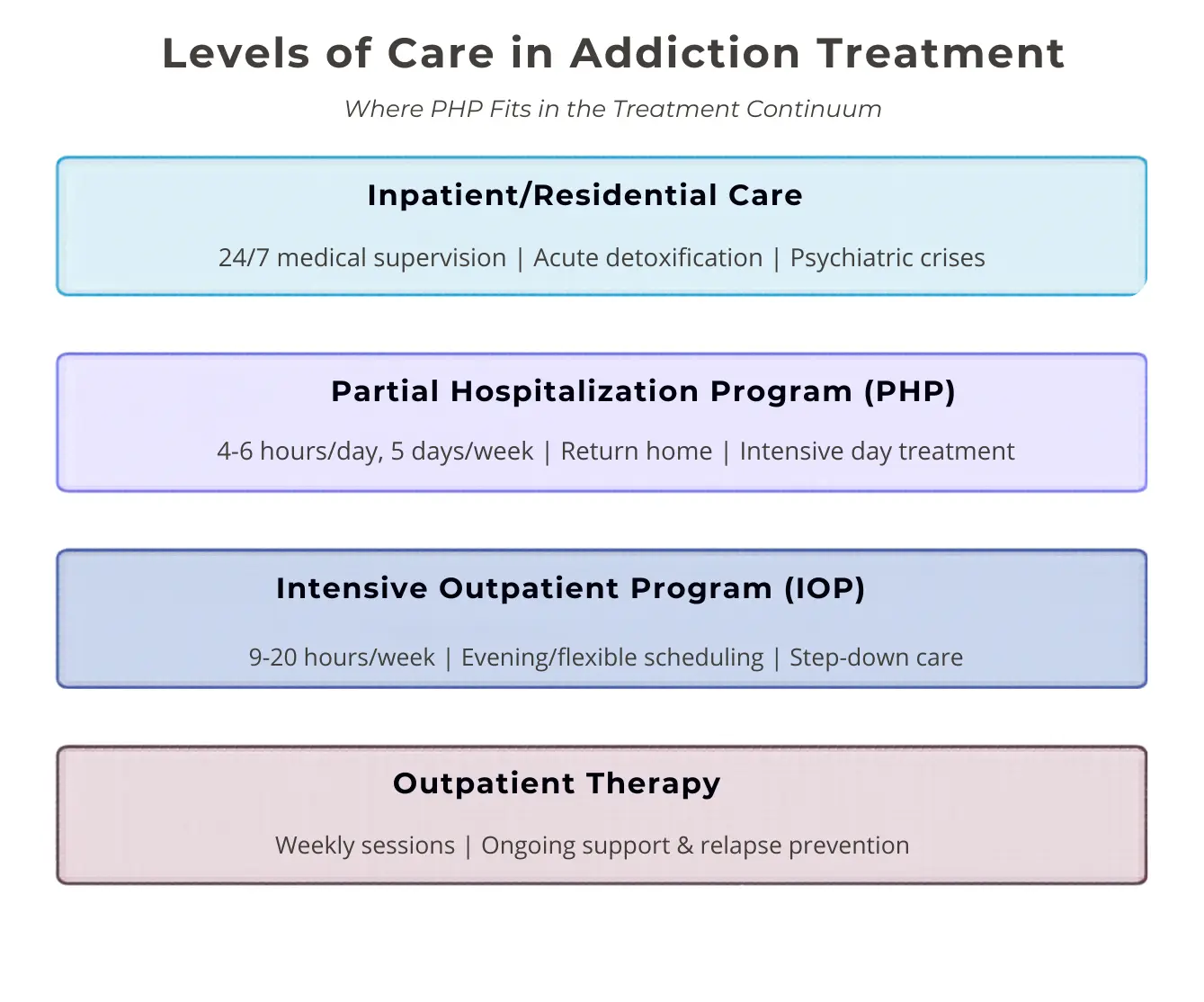
PHP serves as the critical bridge, stepping down from the intensity of residential care while stepping up from traditional outpatient support. It’s where clinical expertise meets real-world application.
How PHP Fits Into Your Recovery Journey
Patients may enter PHP in different ways:
- Direct admission: Coming to PHP as your initial level of care
- Step down: Transitioning from inpatient/residential treatment (most common)
- Step up: Moving from IOP or standard outpatient because you need more structure or have experienced a relapse
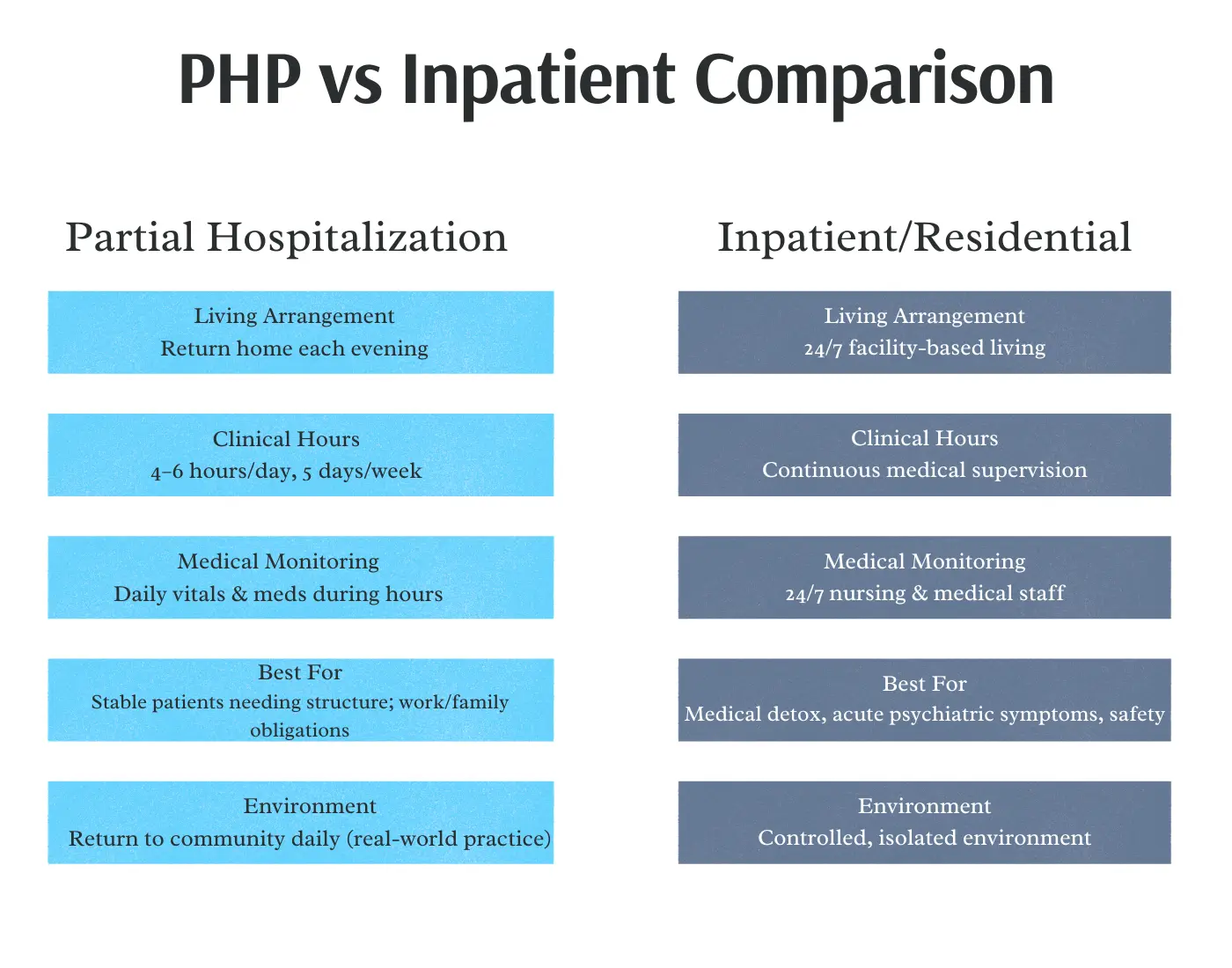
Partial Hospitalization vs. Inpatient: Key Differences
When Inpatient Care Is Necessary
Choose inpatient treatment if: acute medical detoxification is required, psychiatric symptoms create safety risks, you lack a stable home environment, or you’ve relapsed multiple times with outpatient care.
When PHP Is the Right Choice
PHP is appropriate when: you’re medically stable, capable of managing basic self-care, have safe housing and transportation, and need intensive structure to break addiction patterns while maintaining work or family roles.
Partial Hospitalization vs. Intensive Outpatient: Where’s the Line?
Quick Comparison:PHP: 20–30 hours/week | Structured day program | Daily medical oversight IOP (Intensive Outpatient Program): 9–20 hours/week | Evening/flexible scheduling | Weekly check-ins |
The transition from PHP to intensive outpatient care typically happens 2–4 weeks into treatment, once acute withdrawal resolves and emotional stabilization begins. Your clinical team assesses readiness based on symptom improvement, peer interaction, and demonstrated coping skills.
How the Transition Happens
We don’t abruptly shift you from PHP to IOP. Instead, we gradually increase your independent time, reducing daily clinical hours while maintaining evening sessions, then transitioning to 2–3 sessions per week as you demonstrate stability. This gradual step-down approach respects your progress while maintaining accountability and support.
Can You Work During PHP? Balancing Treatment and Responsibilities
One of the most common questions: “Can you work during PHP?” The honest answer is: it depends, and requires honest communication with your treatment team.
Working While in PHP: What’s Realistic
- Part-time or flexible work: Many individuals continue 15–25 hours/week of part-time employment, particularly remote work or evening shifts after treatment
- Full-time work: Generally not compatible with PHP during the first 2–3 weeks; may become possible once stabilized, depending on job flexibility
- Professional responsibilities: Brief appointments, client meetings, or administrative work can sometimes be arranged around PHP hours
- Self-employment: Often more flexible, though treatment commitment must remain non-negotiable
The Time Commitment Reality
When you factor in program hours (typically 8 AM–4 PM), travel time, medical appointments, and evening assignments (journaling, homework, self-care), PHP demands 45–55 hours per week of active participation. That’s essentially a full job. Your treatment is the priority, and your employment (or other roles) must fit around that reality.
| Have a job you want to keep? Discuss work-life balance with your admissions counselor during your clinical assessment. We work with you to find solutions that honor both recovery and responsibility. Call At 732-402-0352 |
Parenting and Caregiving During PHP
Many parents successfully manage PHP by arranging childcare during program hours and investing quality time in parenting after 4 PM. Caregivers for aging parents often find that PHP’s daytime-only model allows them to fulfill both roles. The key: planning and enlisting support.
| Quick Answers from Dr. Norman Chazin “One of the most common concerns I hear is about balancing treatment with work or family roles. My approach is always the same, recovery must be the priority, but with the right structure, many responsibilities can still be maintained in a realistic and healthy way.” |
How Private Addiction Treatment Protects Your Confidentiality
For executives, healthcare professionals, and public figures, discretion is paramount. PHP is designed with privacy in mind:
- Controlled environments: Private clinical spaces, not busy hospital corridors
- HIPAA compliance: Strict federal protections on medical records and communications
- Discreet admissions: Intake appointments scheduled at convenient times; minimal facility footprint
- Confidential peer groups: Small cohorts, often separated from inpatient populations
- Professional support: Staff experienced in treating physicians, attorneys, executives, and other high-responsibility professionals
Your recovery happens privately, professionally, and with dignity.
| New Jersey Privacy Standard: New Jersey law provides additional privacy protections for addiction treatment records beyond federal HIPAA requirements. Legacy Healing NJ adheres to the highest standards in both. |
Learn More: Our Approach To Healing
How Long Is a Partial Hospitalization Program?
The typical duration range for a partial hospitalization program is 14 to 21 days, though this varies based on individual needs. Some facilities may extend programs to 30+ days depending on clinical progress. Factors that influence duration:
- Severity of addiction or psychiatric symptoms
- Presence of co-occurring mental health conditions
- Medical complexity (chronic pain, other medications)
- Treatment engagement and progress in therapy
- Stability of home environment and social support
- Insurance approval and coverage limits
Your treatment plan is individualized. Some individuals transition to IOP after 3 weeks; others benefit from the full 8-week program. Clinical progress, not arbitrary timelines, determines when you’re ready for step-down care.
Who Needs Partial Hospitalization Treatment
PHP is appropriate when multiple factors align. Do any of these resonate?
Clinical Indicators
- Moderate to severe substance use disorder requiring structured detoxification
- Co-occurring psychiatric diagnoses (depression, anxiety, bipolar disorder, PTSD)
- Previous outpatient treatment failures or rapid relapse
- Chronic pain or medical complications requiring daily monitoring
- Suicidal or self-harm thoughts requiring intensive support
Behavioral and Social Indicators
- Difficulty maintaining sobriety without structured supervision
- Limited insight into addiction severity or consequences
- Unstable peer group or triggering living environment (though with safe housing)
- Need for peer support and group accountability
- Ambivalence about recovery requiring motivational intervention
Why Professional Assessment Matters
You cannot self-diagnose your need for a specific level of care. What feels like a “minor problem” may have serious underlying factors; what seems severe might stabilize quickly with intensive outpatient work. A licensed clinician, psychiatrist, addiction medicine physician, or certified addiction counselor, conducts a comprehensive biopsychosocial assessment to match you with the right level of care.
| Uncertain about your needs? A confidential clinical assessment takes 45–60 minutes and provides clarity. No pressure. Just honest guidance. |
The Transition Forward: Step-Down Care After PHP
PHP doesn’t end abruptly. It’s a launching pad for ongoing recovery, and transition planning begins from day one.
Moving From PHP to Intensive Outpatient Program (IOP)
When you’re clinically ready, typically 3–6 weeks in, you don’t suddenly stop treatment. Instead, you transition to IOP, which reduces to 9–20 hours per week while maintaining intensive therapy and medical oversight. This gradual step-down allows you to practice independence within a supported framework.
Ongoing Support Structure
- Individual therapy: Continued work with your therapist (often weekly initially, then bi-weekly)
- Psychiatric care: Regular medication management and monitoring
- Peer support: 12-step meetings, SMART Recovery, or other community groups
- Family involvement: Couples or family therapy as appropriate
- Vocational support: Job coaching or educational planning
- Relapse prevention: Ongoing skills practice and accountability
The Long-Term Vision
Recovery doesn’t end when you leave the program. The research is clear: individuals who engage in aftercare, therapy, peer support, and community connection have significantly better outcomes than those who stop treatment suddenly. PHP equips you with tools and insights; ongoing care helps you apply them to build a sustainable, meaningful life.
| Quick Answers from Dr. Ash Bhatt “Recovery doesn’t end when PHP concludes. What matters most is how we transition patients into the next phase of care. A gradual step-down ensures stability, continuity, and a much lower risk of relapse.” |
Taking the Next Step: A More Structured, Private Path Forward
If you’re reading this, recovery is already on your mind. That awareness is the first courageous step.
A partial hospitalization program offers something powerful: the clinical intensity to address addiction or mental health struggles, combined with the flexibility and autonomy to maintain your responsibilities, relationships, and dignity.
Whether you’re a working professional, a parent, a caregiver, or someone who simply needs structure without disruption, PHP can be designed around your life, not the other way around.
Ready to explore PHP as an option? Contact Legacy Healing NJ today for a confidential clinical assessment. No judgment. No pressure. Just personalized guidance tailored to your unique situation and needs.