



-
 Written By:
Alex Herrera
Written By:
Alex Herrera
-
Edited By:
Christina Holmes
-
Clinically Reviewed By:
Dr. Ash Bhatt, MD, MRO
 Written By:
 Edited By:
 Clinically Reviewed By:
Kratom has become increasingly available at gas stations, smoke shops, and online stores across the United States over the past decade. It’s often marketed as a natural supplement for pain relief, energy, anxiety, mood support, and even opioid withdrawal.
Because it’s sold so openly, many people assume it must be relatively safe.
But what many users don’t realize initially is that kratom interacts directly with opioid receptors in the brain, which means it can create real physical dependence, tolerance, cravings, and withdrawal symptoms over time.
At Legacy Healing NJ, we’re seeing an increasing number of individuals, many of whom started using kratom casually- discover they’ve developed a significant dependency they can’t easily break.
This comprehensive guide will help you understand kratom’s true addiction potential, recognize the signs of dependency, and discover treatment options that work.
Key Takeaways:1. Kratom Is Addictive, Despite Being “Natural” and Legal One of the biggest misconceptions I see is people believing kratom cannot become addictive because it’s marketed as natural. In reality, regular use can absolutely lead to physical and emotional dependence. 2. Kratom Products Are Getting Stronger And More Addictive The newer concentrated kratom extracts and 7-OH products are significantly increasing addiction risk because they are far more potent than traditional kratom powder. 3. Kratom Addiction Is Different From Opioid Addiction, But It’s Still an Addiction I often explain that kratom does carry a lower overdose risk than heroin or prescription opioids, but that does not make it harmless or non-addictive. I’ve worked with individuals who initially turned to kratom hoping to avoid opioids, only to later develop significant psychological and physical dependence on kratom itself. |
Why More People Are Using Kratom Without Understanding the Risks
Just walk into any convenience stores or smoke shops and you’ll find kratom products sold alongside energy drinks, CBD products, and supplements. In fact, powder, capsules, extract shots, and flavored beverages are often displayed without meaningful addiction warnings.
It is the social media that has amplified the trend even further where online communities frequently promote kratom for:
- energy and focus
- anxiety relief
- chronic pain
- emotional stress
- opioid withdrawal
Moreover, the phrase “natural supplement” also creates a false sense of safety for many consumers. “But natural does not automatically mean harmless.”
Is Kratom Addictive? The Short AnswerYes, kratom is addictive. Research from the National Institute on Drug Abuse (NIDA) confirms that the alkaloids in kratom act on the brain’s opioid receptor sites to produce physical and psychological dependence. According to poison control center data, reports involving kratom increased over 30-fold from less than 100 annually in 2010 to 3000+ these days. For example, substances like nicotine, alcohol, and opium are also naturally derived and they all carry addiction potential, similarly, Kratom is also amongst these. |
How Kratom Affects the Brain and Body
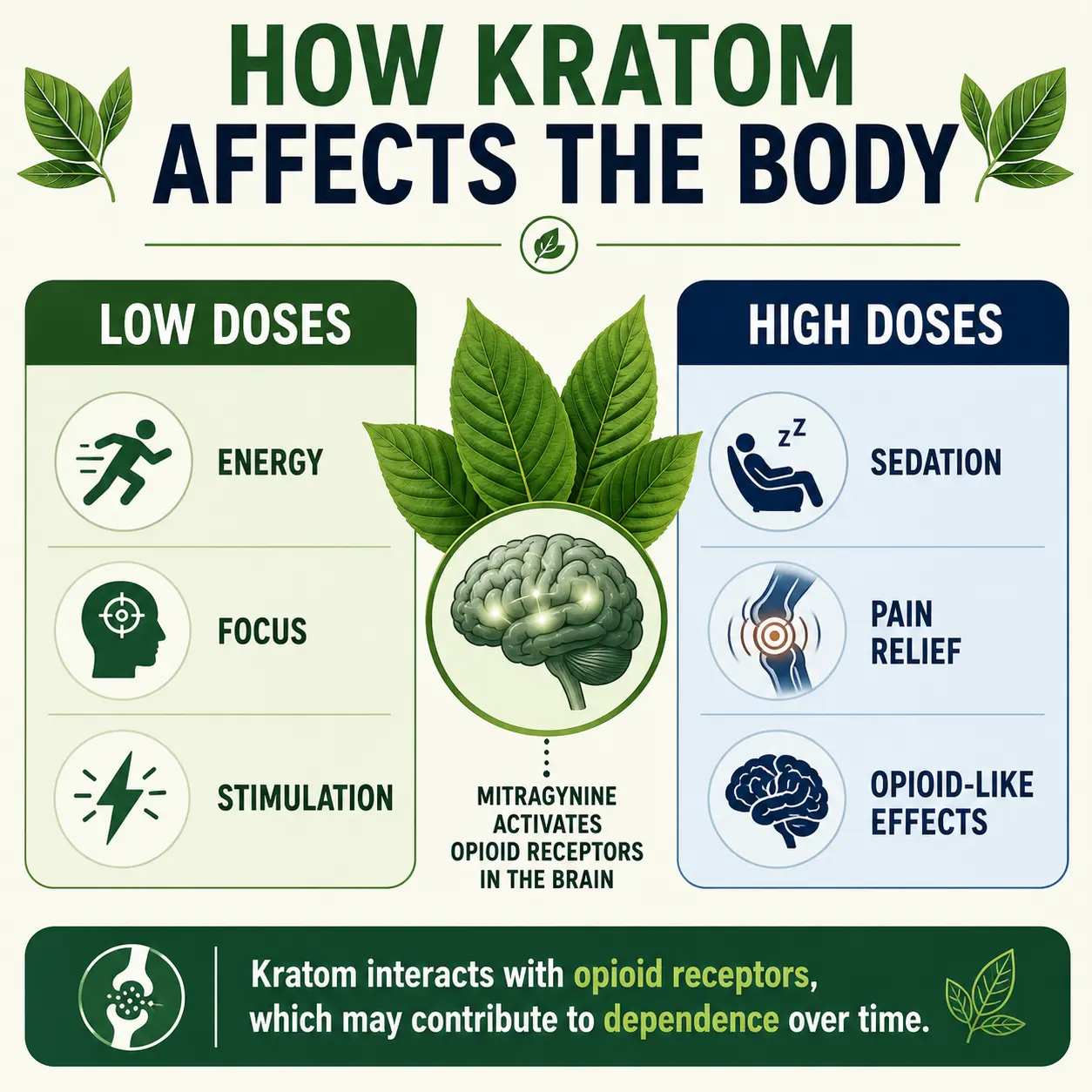
Kratom comes from the leaves of Mitragyna speciosa, a tree native to Southeast Asia. The leaves contain over 40 alkaloid compounds, with two primary ones driving its effects:
- Mitragynine (typically 5-13% in powder)
- 7-hydroxymitragynine (typically 0.5-1.5% in powder, but 10-50x higher in extracts)
These compounds interact with opioid receptors in the brain, which is why kratom can produce opioid-like effects.
The National Institute on Drug Abuse (NIDA) reports that kratom’s alkaloids activate mu-opioid receptors with varying degrees of strength. This opioid-like action is what makes kratom effective for pain and anxiety, and what makes it addictive.
Kratom’s effects are dose-dependent:
Dose | Effect |
| Low doses (2-5g) | Stimulating effects, increased energy, alertness, sociability |
| Moderate doses (5-15g) | Balanced effects, mild euphoria, pain relief, emotional warmth, mild sedation |
| High doses (15-30g+) | Sedating effects, strong pain relief, emotional numbness, sedation |
Over time, the brain adapts to regular exposure. The opioid receptors become less sensitive. Users need more kratom to achieve the same effects. That is how tolerance and kratom dependence begin developing.
 Most kratom addiction doesn’t start with someone thinking, “I’m going to become addicted.” It starts with reasonable goals: pain management, anxiety relief, and energy boost. The path to dependence is gradual and often invisible until quitting becomes difficult.
Perspective From Dr. Phyllis Rodriguez“Many individuals initially start using kratom for understandable reasons like anxiety, chronic stress, or pain management. The problem is that the brain gradually adapts to regular use, and dependency can quietly develop before the person fully realizes it.” |
When Casual Kratom Use Turns Into Dependency
Most kratom addiction doesn’t start with someone thinking, “I’m going to become addicted.” It starts with reasonable goals: pain management, anxiety relief, and energy boost. The path to dependence is gradual and often invisible until quitting becomes difficult.
What Dr. Phyllis Rodriguez Has to Say –“One of the most common things I hear from people struggling with kratom dependence is that they never expected it to become a daily need. Many initially viewed kratom as a safer or more natural option, so the dependency pattern often catches them off guard.” |
Common Signs of Kratom Addiction People Often Ignore
Kratom addiction hides in plain sight because it’s “just a plant.” Users develop denial, telling themselves that plants aren’t addictive, that they can quit whenever they want, or that they’re using it for a legitimate reason so it must be okay. Some of the most common warning signs include:
Physical Signs
- Needing progressively larger doses to achieve the same effect
- Anxiety and restlessness when kratom isn’t available
- Muscle aches and body pain during periods without use
- Sweating and chills that feel like withdrawal
- Insomnia or fragmented sleep that worsens without kratom
- Nausea or digestive issues when doses are reduced
- Inability to start the day without taking kratom first
- Physical relief the moment you take kratom (a sign your body is dependent)
Many people attribute these symptoms to their underlying condition (pain, anxiety) rather than recognizing them as withdrawal.
Emotional and Psychological Signs
- Constant cravings and thinking about kratom throughout the day
- Anxiety or panic when kratom isn’t available or when supplies run low
- Depression and low mood that only improves with kratom use
- Mood swings between relief (when using) and despair (when without)
- Irritability toward people who question your use
- Inability to enjoy activities unless you’ve taken kratom
- Using kratom to regulate emotions rather than addressing the underlying issues
Behavioral Red Flags
- Hiding kratom use from family, friends, or your partner
- Becoming defensive when others express concern about your use
- Failed quit attempts (tried to stop multiple times but couldn’t)
- Spending significant money ($100-300+ monthly on kratom)
- Organizing your day around kratom availability and dosing
- Isolating from people who question your kratom use
- “Stocking up” in fear that you’ll run out
- Using kratom at work or in inappropriate settings
- Difficulty concentrating on work or relationships without it
| The Denial Trap: One of the most dangerous aspects of kratom addiction is how easy it is to deny. Users tell themselves: “It’s just a plant, plants aren’t addictive,” “I can stop whenever I want (but they don’t),” “I’m using it for a good reason, pain management,” “Lots of people use kratom without issues,” “It’s legal, so it can’t be that bad,” “I’ll quit tomorrow (repeated for months).” These rationalizations keep users in denial about their dependency until the problem becomes severe. Recognizing these thoughts is the first step toward accepting that professional help is needed. |
What Kratom Withdrawal Really Feels Like
One of the biggest surprises for people trying to quit kratom is how severe withdrawal can be, since most people expect minimal discomfort thinking that it’s “just a plant.” The reality is that kratom withdrawal symptoms are similar to opioid withdrawal, not quite as severe, but at least uncomfortable and often unbearable enough to drive relapse.
With that said, withdrawal begins within 12 to 24 hours after your last dose. The first few days involve anxiety, irritability, and difficulty sleeping. By days three to five, symptoms peak with severe anxiety, restless legs syndrome, insomnia, body aches, sweating, and intense cravings for kratom.
Most physical symptoms improve by day seven to ten, while, emotional symptoms, depression, anxiety, low motivation, can persist for two to four weeks. Full neurochemical recovery may take four to six weeks or longer, especially for people who used kratom daily for months or years, or who used concentrated extracts.
Why People Relapse
The withdrawal is so uncomfortable that it becomes the primary reason people relapse. They try to quit through sheer willpower, suffer through several days of severe anxiety and insomnia, and on day four or five, it becomes too much. They began taking kratom for relief, but it resets the withdrawal clock and they’re back to day one.
A Common Pattern Dr. Phyllis Rodriguez Sees in Recovery“People often underestimate how emotionally difficult kratom withdrawal can feel and it’s not just physical discomfort, it’s also anxiety, restlessness, irritability, and difficulty in regulating emotions after stopping, especially when kratom has become part of their daily coping routine.” |
Why New 7-OH and Extract Products Are Raising Serious Concerns
The kratom market is evolving toward stronger, more addictive products. Traditional kratom powder is one thing, but newer products like 7-OH kratom and commercial extract shots like “Feel Free” contain 10 to 50 times the alkaloid concentration of regular powder. These concentrated products develop dependence much faster and create more intense withdrawal symptoms.
More so that, single 2-ounce extract shot may contain the alkaloid equivalent of 10 to 20 grams of powder. This is why the addiction landscape is changing, because of more concentrated products rising the addiction rates among people who think they’re using “the same kratom”.
Is Kratom Safer Than Opioids? Exploring the Comparison
People often ask whether kratom is safer than opioids. The answer is nuanced, and it’s important to understand the key differences:
Where Kratom is Safer:
- Much lower overdose death risk (rare vs. tens of thousands annually for opioids)
- No severe respiratory depression like opioids cause
- Can’t be reversed with naloxone/Narcan (not needed as much)
Where Kratom is Just as Dangerous:
- Creates equal physical dependence
- Creates equal psychological dependence
- Produces similar withdrawal symptoms
- Has comparable addiction potential
- Requires professional treatment to quit successfully
Some people use kratom as a bridge off opioids, only to become equally dependent on kratom. They’ve traded one addiction for another without addressing the underlying pain or trauma that drove opioid use.
If someone is trying to get off opioids, kratom might provide short-term relief from acute withdrawal symptoms. But without professional treatment addressing the root causes, chronic pain, trauma, mental health conditions, switching to kratom simply extends the cycle of dependence.
Treatment Options for Kratom Addiction
After all that we have discussed about Kratom, just know that Kratom addiction is treatable. There are treatment as medical detox that help manages physical withdrawal through supportive care, medications for anxiety and sleep, and medical monitoring. Behavioral therapy addresses the emotional dependence and underlying conditions driving use. Intensive outpatient programs (IOP) provide structured treatment while allowing you to maintain work and family commitments.
What Comprehensive Treatment Includes:
- Medical evaluation and assessment of dependence severity
- Medication-assisted withdrawal management (anti-anxiety, sleep aids, antidepressants)
- 24/7 medical monitoring during acute withdrawal (inpatient)
- Individual therapy to address emotional dependence
- Group therapy and peer support
- Treatment for underlying mental health conditions (anxiety, depression, trauma)
- Relapse prevention strategies and coping skills
- Aftercare planning and ongoing support
Most importantly, comprehensive treatment addresses both the kratom dependence and whatever condition kratom was masking, chronic pain, anxiety, depression, trauma. Treating only the kratom addiction without addressing underlying mental health leads to high relapse rates.
When to Seek Professional Help for Kratom Use
You should consider professional assessment if you’ve tried quitting kratom multiple times unsuccessfully, if you’re escalating doses or using more concentrated products, if withdrawal symptoms are severe, or if kratom use is interfering with your finances, relationships, or work. Early intervention requires less intensive treatment and has higher success rates.
The best time to seek help is now, as soon as you recognize a problem. Don’t wait for the situation to worsen or for multiple failed quit attempts. A qualified addiction treatment provider can evaluate your situation, assess for underlying mental health conditions, and recommend the appropriate level of care.
Kratom has become increasingly available at gas stations, smoke shops, and online stores across the United States over the past decade. It’s often marketed as a natural supplement for pain relief, energy, anxiety, mood support, and even opioid withdrawal.
Because it’s sold so openly, many people assume it must be relatively safe.
But what many users don’t realize initially is that kratom interacts directly with opioid receptors in the brain, which means it can create real physical dependence, tolerance, cravings, and withdrawal symptoms over time.
At Legacy Healing NJ, we’re seeing an increasing number of individuals, many of whom started using kratom casually- discover they’ve developed a significant dependency they can’t easily break.
This comprehensive guide will help you understand kratom’s true addiction potential, recognize the signs of dependency, and discover treatment options that work.
Key Takeaways:1. Kratom Is Addictive, Despite Being “Natural” and Legal One of the biggest misconceptions I see is people believing kratom cannot become addictive because it’s marketed as natural. In reality, regular use can absolutely lead to physical and emotional dependence. 2. Kratom Products Are Getting Stronger And More Addictive The newer concentrated kratom extracts and 7-OH products are significantly increasing addiction risk because they are far more potent than traditional kratom powder. 3. Kratom Addiction Is Different From Opioid Addiction, But It’s Still an Addiction I often explain that kratom does carry a lower overdose risk than heroin or prescription opioids, but that does not make it harmless or non-addictive. I’ve worked with individuals who initially turned to kratom hoping to avoid opioids, only to later develop significant psychological and physical dependence on kratom itself. |
Why More People Are Using Kratom Without Understanding the Risks
Just walk into any convenience stores or smoke shops and you’ll find kratom products sold alongside energy drinks, CBD products, and supplements. In fact, powder, capsules, extract shots, and flavored beverages are often displayed without meaningful addiction warnings.
It is the social media that has amplified the trend even further where online communities frequently promote kratom for:
- energy and focus
- anxiety relief
- chronic pain
- emotional stress
- opioid withdrawal
Moreover, the phrase “natural supplement” also creates a false sense of safety for many consumers. “But natural does not automatically mean harmless.”
Is Kratom Addictive? The Short AnswerYes, kratom is addictive. Research from the National Institute on Drug Abuse (NIDA) confirms that the alkaloids in kratom act on the brain’s opioid receptor sites to produce physical and psychological dependence. According to poison control center data, reports involving kratom increased over 30-fold from less than 100 annually in 2010 to 3000+ these days. For example, substances like nicotine, alcohol, and opium are also naturally derived and they all carry addiction potential, similarly, Kratom is also amongst these. |
How Kratom Affects the Brain and Body
Kratom comes from the leaves of Mitragyna speciosa, a tree native to Southeast Asia. The leaves contain over 40 alkaloid compounds, with two primary ones driving its effects:
- Mitragynine (typically 5-13% in powder)
- 7-hydroxymitragynine (typically 0.5-1.5% in powder, but 10-50x higher in extracts)
These compounds interact with opioid receptors in the brain, which is why kratom can produce opioid-like effects.
The National Institute on Drug Abuse (NIDA) reports that kratom’s alkaloids activate mu-opioid receptors with varying degrees of strength. This opioid-like action is what makes kratom effective for pain and anxiety, and what makes it addictive.
Kratom’s effects are dose-dependent:
| Dose | Effect |
| Low doses (2-5g) | Stimulating effects, increased energy, alertness, sociability |
| Moderate doses (5-15g) | Balanced effects, mild euphoria, pain relief, emotional warmth, mild sedation |
| High doses (15-30g+) | Sedating effects, strong pain relief, emotional numbness, sedation |
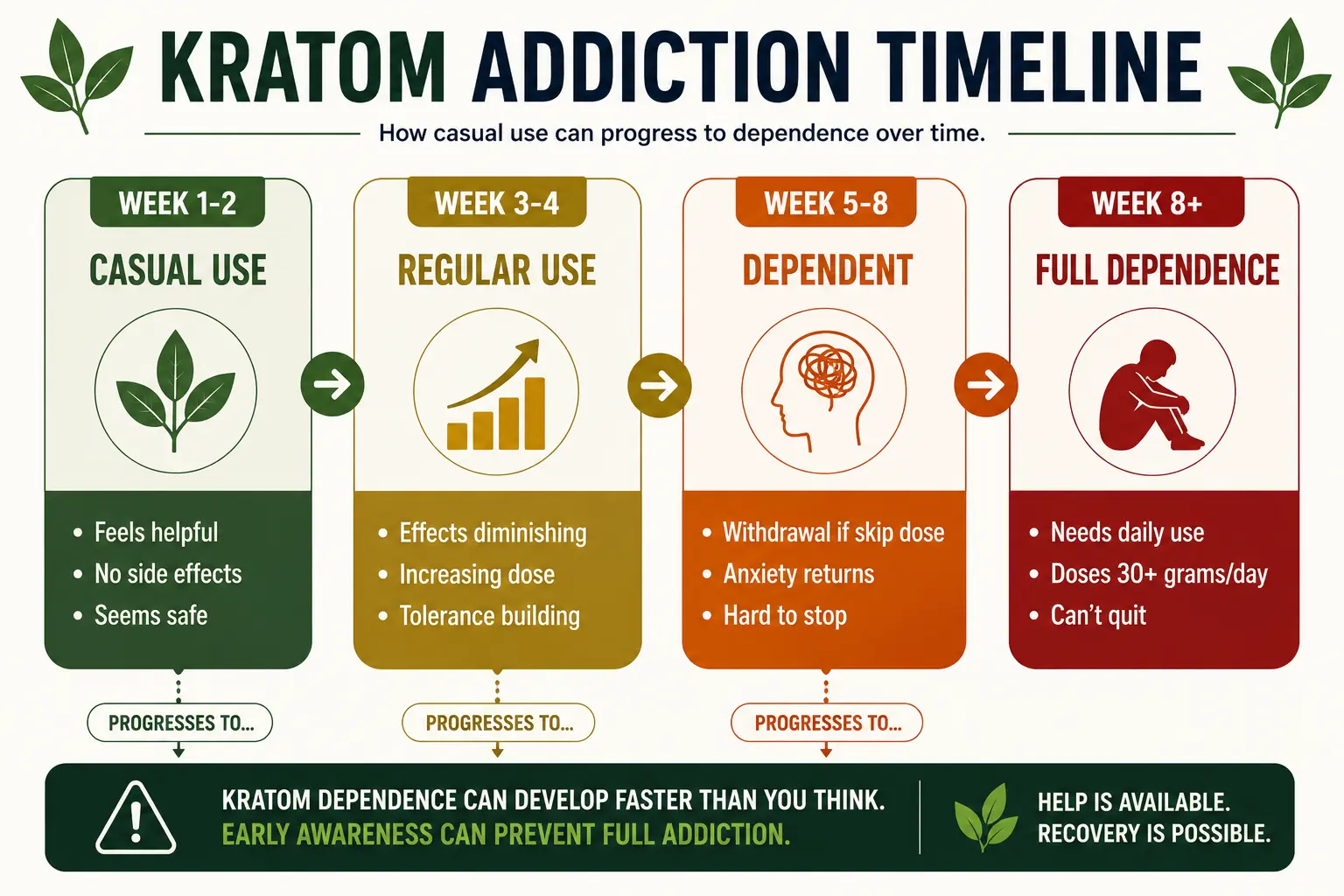
Over time, the brain adapts to regular exposure. The opioid receptors become less sensitive. Users need more kratom to achieve the same effects. That is how tolerance and kratom dependence begin developing.
Perspective From Dr. Phyllis Rodriguez“Many individuals initially start using kratom for understandable reasons like anxiety, chronic stress, or pain management. The problem is that the brain gradually adapts to regular use, and dependency can quietly develop before the person fully realizes it.” |
When Casual Kratom Use Turns Into Dependency
Most kratom addiction doesn’t start with someone thinking, “I’m going to become addicted.” It starts with reasonable goals: pain management, anxiety relief, and energy boost. The path to dependence is gradual and often invisible until quitting becomes difficult.
| What Dr. Phyllis Rodriguez Has to Say – “One of the most common things I hear from people struggling with kratom dependence is that they never expected it to become a daily need. Many initially viewed kratom as a safer or more natural option, so the dependency pattern often catches them off guard.” |
Common Signs of Kratom Addiction People Often Ignore
Kratom addiction hides in plain sight because it’s “just a plant.” Users develop denial, telling themselves that plants aren’t addictive, that they can quit whenever they want, or that they’re using it for a legitimate reason so it must be okay. Some of the most common warning signs include:
Physical Signs
- Needing progressively larger doses to achieve the same effect
- Anxiety and restlessness when kratom isn’t available
- Muscle aches and body pain during periods without use
- Sweating and chills that feel like withdrawal
- Insomnia or fragmented sleep that worsens without kratom
- Nausea or digestive issues when doses are reduced
- Inability to start the day without taking kratom first
- Physical relief the moment you take kratom (a sign your body is dependent)
Many people attribute these symptoms to their underlying condition (pain, anxiety) rather than recognizing them as withdrawal.
Emotional and Psychological Signs
- Constant cravings and thinking about kratom throughout the day
- Anxiety or panic when kratom isn’t available or when supplies run low
- Depression and low mood that only improves with kratom use
- Mood swings between relief (when using) and despair (when without)
- Irritability toward people who question your use
- Inability to enjoy activities unless you’ve taken kratom
- Using kratom to regulate emotions rather than addressing the underlying issues
Behavioral Red Flags
- Hiding kratom use from family, friends, or your partner
- Becoming defensive when others express concern about your use
- Failed quit attempts (tried to stop multiple times but couldn’t)
- Spending significant money ($100-300+ monthly on kratom)
- Organizing your day around kratom availability and dosing
- Isolating from people who question your kratom use
- “Stocking up” in fear that you’ll run out
- Using kratom at work or in inappropriate settings
- Difficulty concentrating on work or relationships without it
| The Denial Trap: One of the most dangerous aspects of kratom addiction is how easy it is to deny. Users tell themselves: “It’s just a plant, plants aren’t addictive,” “I can stop whenever I want (but they don’t),” “I’m using it for a good reason, pain management,” “Lots of people use kratom without issues,” “It’s legal, so it can’t be that bad,” “I’ll quit tomorrow (repeated for months).” These rationalizations keep users in denial about their dependency until the problem becomes severe. Recognizing these thoughts is the first step toward accepting that professional help is needed. |
What Kratom Withdrawal Really Feels Like
One of the biggest surprises for people trying to quit kratom is how severe withdrawal can be, since most people expect minimal discomfort thinking that it’s “just a plant.” The reality is that kratom withdrawal symptoms are similar to opioid withdrawal, not quite as severe, but at least uncomfortable and often unbearable enough to drive relapse.
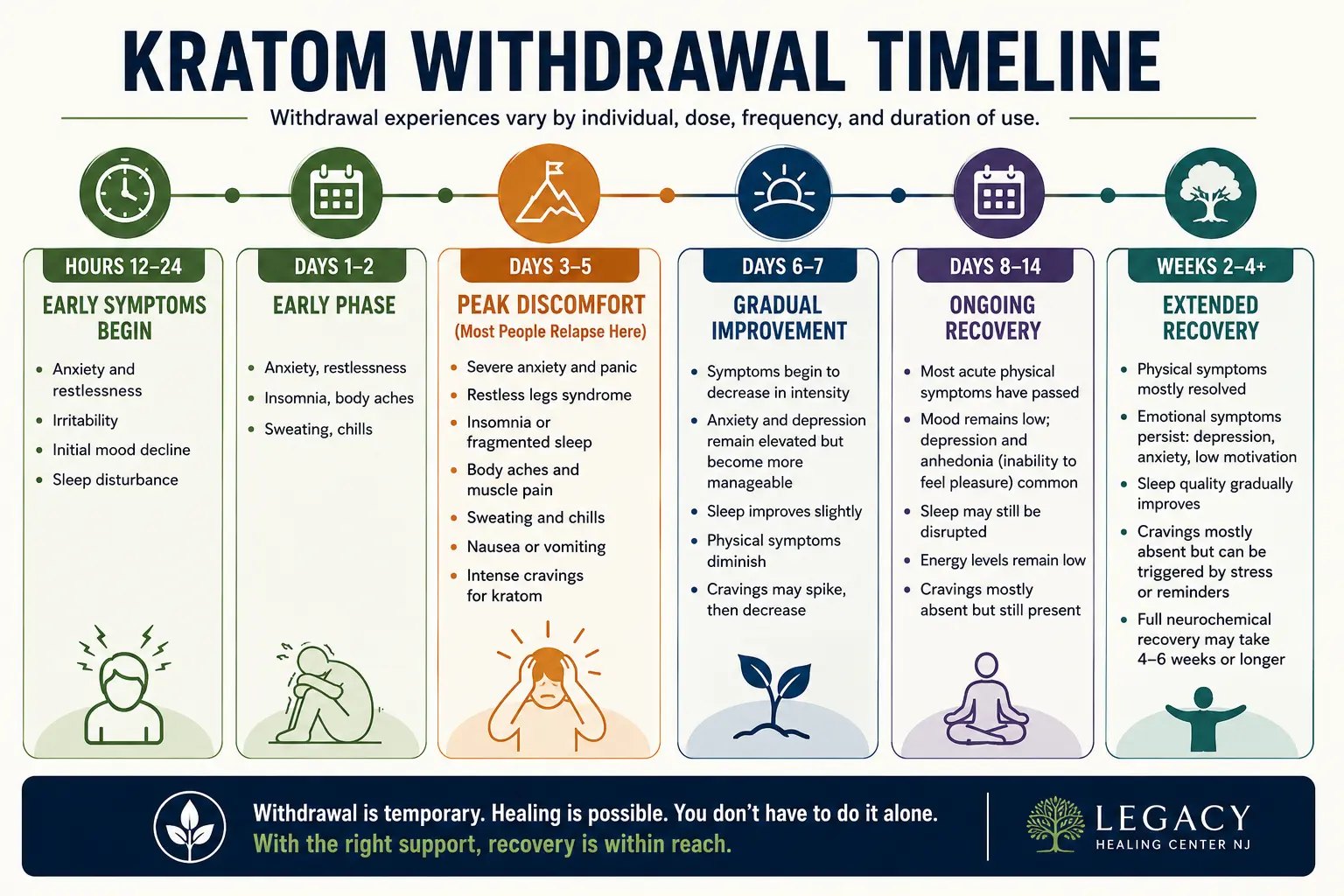
With that said, withdrawal begins within 12 to 24 hours after your last dose. The first few days involve anxiety, irritability, and difficulty sleeping. By days three to five, symptoms peak with severe anxiety, restless legs syndrome, insomnia, body aches, sweating, and intense cravings for kratom.
Most physical symptoms improve by day seven to ten, while, emotional symptoms, depression, anxiety, low motivation, can persist for two to four weeks. Full neurochemical recovery may take four to six weeks or longer, especially for people who used kratom daily for months or years, or who used concentrated extracts.
Why People Relapse
The withdrawal is so uncomfortable that it becomes the primary reason people relapse. They try to quit through sheer willpower, suffer through several days of severe anxiety and insomnia, and on day four or five, it becomes too much. They began taking kratom for relief, but it resets the withdrawal clock and they’re back to day one.
A Common Pattern Dr. Phyllis Rodriguez Sees in Recovery“People often underestimate how emotionally difficult kratom withdrawal can feel and it’s not just physical discomfort, it’s also anxiety, restlessness, irritability, and difficulty in regulating emotions after stopping, especially when kratom has become part of their daily coping routine.” |
Why New 7-OH and Extract Products Are Raising Serious Concerns
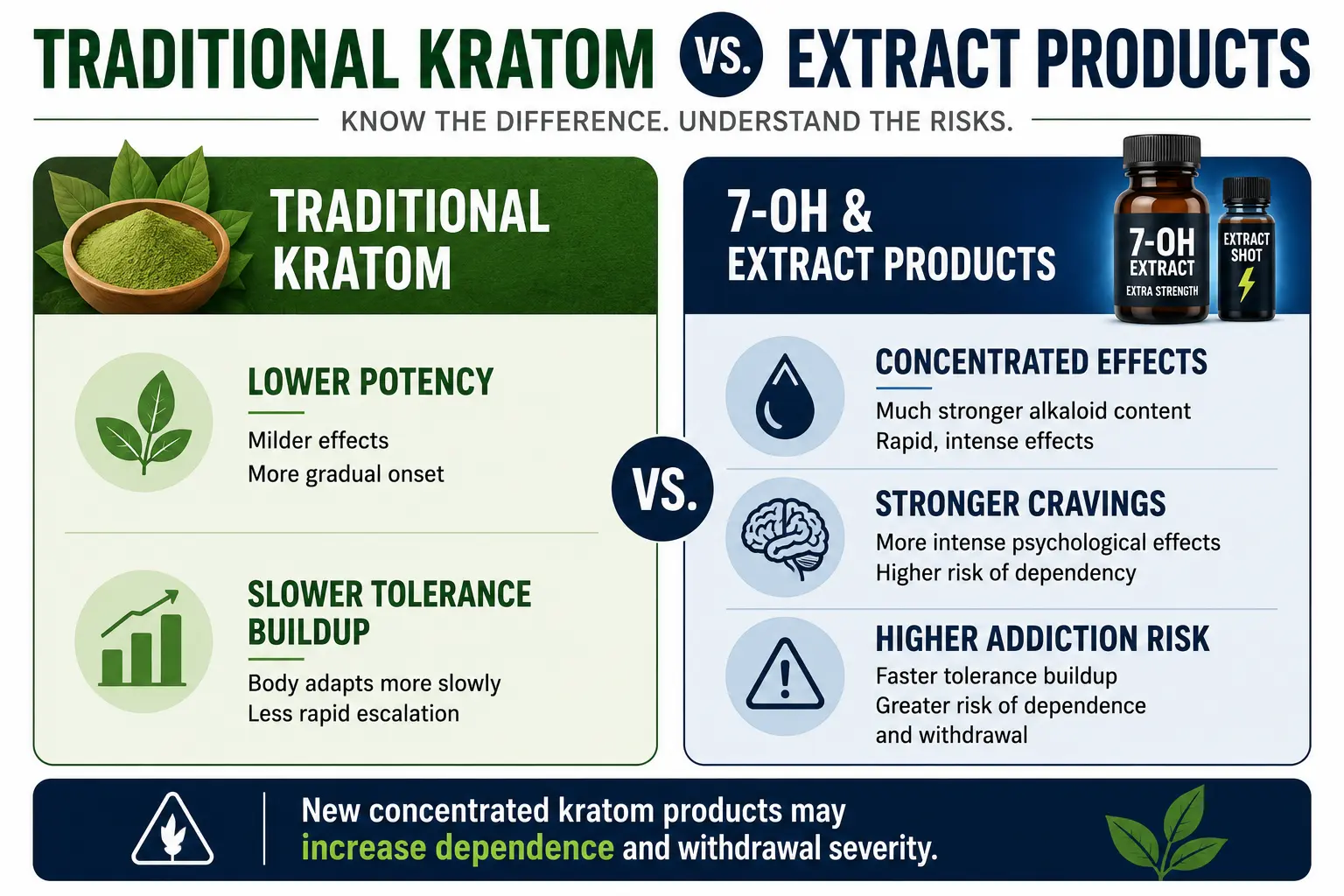
The kratom market is evolving toward stronger, more addictive products. Traditional kratom powder is one thing, but newer products like 7-OH kratom and commercial extract shots like “Feel Free” contain 10 to 50 times the alkaloid concentration of regular powder. These concentrated products develop dependence much faster and create more intense withdrawal symptoms.
More so that, single 2-ounce extract shot may contain the alkaloid equivalent of 10 to 20 grams of powder. This is why the addiction landscape is changing, because of more concentrated products rising the addiction rates among people who think they’re using “the same kratom”.
Is Kratom Safer Than Opioids? Exploring the Comparison
People often ask whether kratom is safer than opioids. The answer is nuanced, and it’s important to understand the key differences:
Where Kratom is Safer:
- Much lower overdose death risk (rare vs. tens of thousands annually for opioids)
- No severe respiratory depression like opioids cause
- Can’t be reversed with naloxone/Narcan (not needed as much)
Where Kratom is Just as Dangerous:
- Creates equal physical dependence
- Creates equal psychological dependence
- Produces similar withdrawal symptoms
- Has comparable addiction potential
- Requires professional treatment to quit successfully
Some people use kratom as a bridge off opioids, only to become equally dependent on kratom. They’ve traded one addiction for another without addressing the underlying pain or trauma that drove opioid use.
If someone is trying to get off opioids, kratom might provide short-term relief from acute withdrawal symptoms. But without professional treatment addressing the root causes, chronic pain, trauma, mental health conditions, switching to kratom simply extends the cycle of dependence.
Treatment Options for Kratom Addiction
After all that we have discussed about Kratom, just know that Kratom addiction is treatable. There are treatment as medical detox that help manages physical withdrawal through supportive care, medications for anxiety and sleep, and medical monitoring. Behavioral therapy addresses the emotional dependence and underlying conditions driving use. Intensive outpatient programs (IOP) provide structured treatment while allowing you to maintain work and family commitments.
What Comprehensive Treatment Includes:
- Medical evaluation and assessment of dependence severity
- Medication-assisted withdrawal management (anti-anxiety, sleep aids, antidepressants)
- 24/7 medical monitoring during acute withdrawal (inpatient)
- Individual therapy to address emotional dependence
- Group therapy and peer support
- Treatment for underlying mental health conditions (anxiety, depression, trauma)
- Relapse prevention strategies and coping skills
- Aftercare planning and ongoing support
Most importantly, comprehensive treatment addresses both the kratom dependence and whatever condition kratom was masking, chronic pain, anxiety, depression, trauma. Treating only the kratom addiction without addressing underlying mental health leads to high relapse rates.
When to Seek Professional Help for Kratom Use
You should consider professional assessment if you’ve tried quitting kratom multiple times unsuccessfully, if you’re escalating doses or using more concentrated products, if withdrawal symptoms are severe, or if kratom use is interfering with your finances, relationships, or work. Early intervention requires less intensive treatment and has higher success rates.
The best time to seek help is now, as soon as you recognize a problem. Don’t wait for the situation to worsen or for multiple failed quit attempts. A qualified addiction treatment provider can evaluate your situation, assess for underlying mental health conditions, and recommend the appropriate level of care.
Get Help Now: Professional Assessment at Legacy Healing NJ
Kratom addiction doesn’t have to control your life. If you or someone you care about is struggling with kratom dependence, professional help is available, and it works.
Our team provides confidential, individualized care designed to help individuals safely navigate withdrawal, understand the emotional patterns behind dependency, and build long-term recovery strategies that support lasting stability.
Seeking help early does not mean failure. In many cases, it is the moment when people begin to regain control before the cycle becomes more overwhelming.
Call Legacy Healing NJ Today
📞 [(516) 928.6392]
Available 24/7 for confidential consultation. Speak with someone who understands kratom addiction.
Kratom addiction doesn’t have to control your life. If you or someone you care about is struggling with kratom dependence, professional help is available, and it works.
Our team provides confidential, individualized care designed to help individuals safely navigate withdrawal, understand the emotional patterns behind dependency, and build long-term recovery strategies that support lasting stability.
Seeking help early does not mean failure. In many cases, it is the moment when people begin to regain control before the cycle becomes more overwhelming.
Call Legacy Healing NJ Today
📞 [(516) 928.6392]
Available 24/7 for confidential consultation. Speak with someone who understands kratom addiction.