



-
 Written By:
Christina Holmes
Written By:
Christina Holmes -
 Edited By:
Phyllis Rodriguez, PMHNP-BC
Edited By:
Phyllis Rodriguez, PMHNP-BC
-
 Clinically Reviewed By:
Dr. Ash Bhatt, MD, MRO
Clinically Reviewed By:
Dr. Ash Bhatt, MD, MRO
Key Takeaways
- Whippets are nitrous oxide, typically inhaled in an illegal environment. Since the feeling you get does not last more than sixty seconds, people keep doing it time and time again, which is part of why this kind of abuse is quite so prevalent.
- Inside the body, nitrous oxide interferes with the vitamin B12. The continued use of nitrous oxide could damage the nerves and spine that doesn’t always show up on a standard B12 blood test.
- The FDA has directly warned consumers against the danger of inhaling nitrous oxide products that are marketed by name brand-like, Galaxy Gas. These warnings include the risk of nerve system injury, blood clot formation, and death.
What Are Whippets?
Whippets are small canisters of nitrous oxide, the same gas used medically for anesthesia and in food production as a whipped cream propellant, inhaled recreationally to produce a brief high. Outside of controlled medical or culinary use, inhaling it directly carries real risks, including interference with vitamin B12 that can lead to lasting nerve damage.
“Whippets,” sometimes spelled “whippits” or “whip-its,” refer to recreational inhalation of nitrous oxide, the same gas found in small pressurized cartridges originally made for whipping cream. “Laughing gas” describes the same substance, a term that comes from the light, giddy feeling it produces.
Nitrous oxide has legitimate uses. Dentists and hospitals use it as a mild anesthetic and pain reliever, administered under professional supervision. The food industry uses it to pressurize whipped cream dispensers. Recreational inhalation, straight from a cartridge, balloon, or tank, is a completely different use of the same chemical, done outside of any clinical or food-safety context.
The high is brief, typically under a minute. That short duration is part of what drives repeated use within a single session, since the effect fades quickly and there’s no ongoing high to sustain. This pattern of frequent, repeated inhalation is closely tied to the health risks covered further down, and it falls under the broader category of inhalant misuse.
Is Medical Nitrous Oxide the Same as Using Whippets?
Chemically, yes, it’s the identical gas. The difference is entirely in how it’s delivered, and that difference is what determines whether it’s safe.
In a dental chair or an operating room, nitrous oxide is never given alone. It’s mixed with oxygen at a controlled ratio, delivered through a mask connected to monitoring equipment, and titrated by a trained provider watching for any drop in oxygen saturation. If something looks off, the provider adjusts the mix or stops it immediately. That oxygen blending is the whole safety mechanism, not a formality. It’s specifically what prevents the gas from starving the brain of oxygen.
A whippet delivers 100% nitrous oxide, straight from a cartridge or balloon, with no oxygen mixed in and no one monitoring the reaction. There’s nothing regulating how much is inhaled, how fast, or how often in a row. That single missing piece, oxygen dilution, is the mechanical reason recreational use carries risks that clinical use is specifically designed around. It’s also why the loss-of-consciousness and asphyxiation risks covered later in this article are a direct consequence of skipping that safeguard, not a separate, unrelated danger.
This is worth being direct about, because “my dentist uses this” is one of the more common reasons people underestimate whippets. The gas being medically approved for supervised use says nothing about what happens when the supervision and the oxygen are both removed.
What Do Whippets Do to the Brain and Body?
Two separate things happen when someone inhales nitrous oxide, and conflating them is part of why the risks get underestimated.
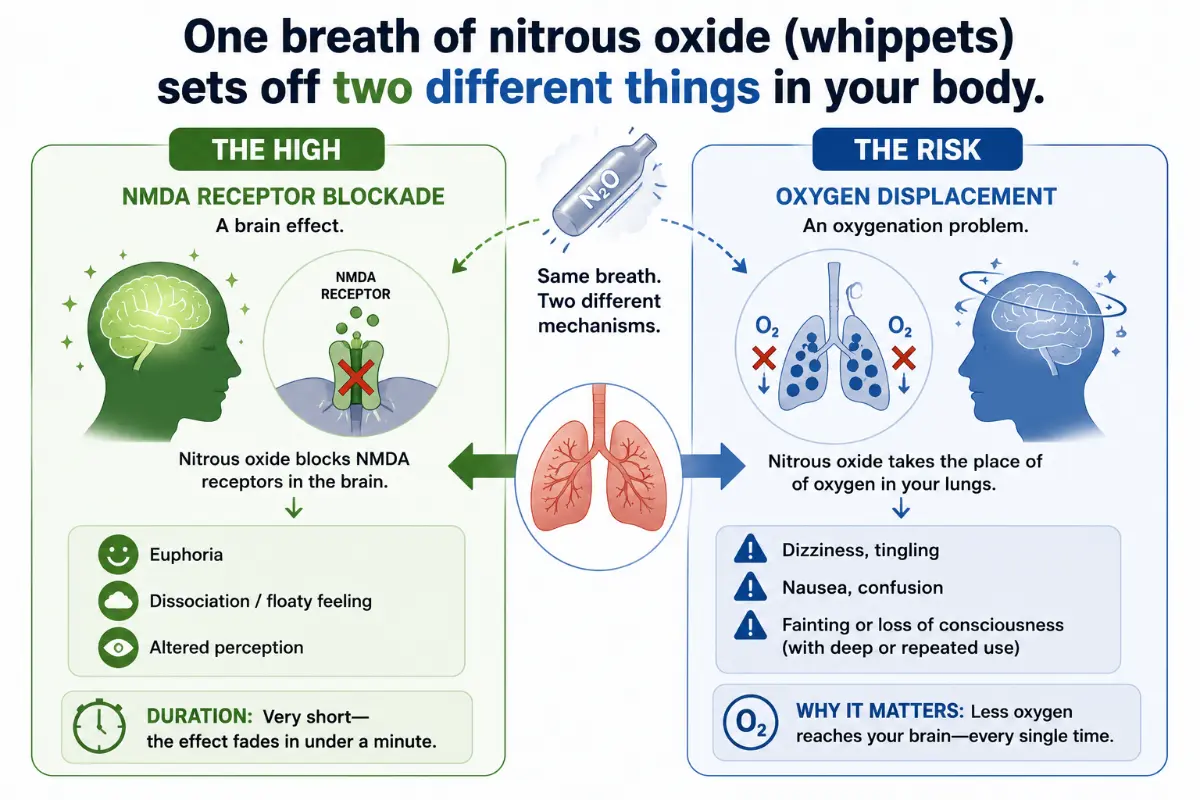
- The euphoric, floaty feeling comes from the gas blocking NMDA receptors in the brain, the same receptor system involved in pain signaling and memory formation. That blockade is what produces the dissociation, the giddiness, and the brief altered perception people are actually chasing. It’s a real pharmacological effect, and it’s also why nitrous oxide has genuine anesthetic value in a clinical setting.
- The dizziness, tingling, drowsiness, and impaired coordination that show up alongside it are a different mechanism entirely: inhaling pure nitrous oxide directly displaces oxygen in the lungs. For those few seconds to a minute, the brain is getting measurably less oxygen than it needs, which is also what’s behind the more concerning effects, like confusion, nausea, fainting, or loss of consciousness, when a hit is deeper or comes in rapid succession.
That distinction matters practically. The high fades in under a minute because the NMDA effect is short-lived, but the oxygen deprivation resets with every single inhalation. Someone taking several hits back-to-back to chase the feeling isn’t just repeating a pleasant sensation; they’re repeating a brief hypoxic event each time, which is a meaningfully different risk profile than, say, redosing a drug that stays in the bloodstream. It’s also the same repeated-exposure pattern that drives the vitamin B12 disruption covered next.
Why Can Whippets Cause Vitamin B12 Problems and Nerve Damage?
This is the risk that gets the least attention, and it’s the one that causes the most lasting harm.
Nitrous oxide chemically reacts with vitamin B12 in the body. Specifically, it oxidizes the cobalt atom at the center of the B12 molecule, which permanently deactivates it. Research published in PMC describes how this inactivated B12 can no longer function as a coenzyme for an enzyme called methionine synthase, an enzyme the body depends on to help build and maintain myelin, the protective sheath around nerve fibers.
Without functioning B12, myelin production breaks down. Over time, this can lead to a condition called subacute combined degeneration, or SCD, a form of nerve and spinal cord damage that specifically affects the pathways responsible for sensation, balance, and coordinated movement.
Symptoms associated with this damage include:
- Numbness or tingling, often starting in the hands or feet
- Muscle weakness
- Loss of sensation
- Poor balance
- Difficulty walking
Here’s what makes this particularly dangerous to overlook: a routine blood test for vitamin B12 doesn’t always catch it. A systematic review cited in PMC research on nitrous oxide-induced spinal cord damage found that B12 levels came back low in only 46 percent of patients who had neurological symptoms caused by nitrous oxide. In other words, more than half the affected patients had a “normal” B12 result despite the vitamin no longer functioning properly in their body. Nitrous oxide can cause a functional B12 deficiency that a standard blood panel simply isn’t built to detect.
Taking B12 supplements doesn’t cancel out this risk. Case reports have documented people developing spinal cord damage from nitrous oxide even while taking oral B12 on their own, since supplementation doesn’t undo the chemical inactivation already caused by repeated exposure.
Clinical Perspective from Dr. Ash Bhatt: A normal B12 result from a blood test does not necessarily mean you don’t have nitrous oxide damage. I have had patients who present with clear numbness or balance problem with a totally normal result because this test only check how much B12 you have in your blood and not how much your body is actually able to use. If you are using whippets regularly and develop any of the symptoms you should inform your doctor directly.
What Are the Warning Signs of Whippet Misuse?
The physical and behavioral signs below aren’t a random checklist. They map directly onto the two things already covered: the neurological damage from B12 disruption, and the compulsive-use pattern that develops around a very short high.
Physical and neurological signs are the visible edge of the nerve damage described earlier. Because nitrous oxide’s effect on B12 is cumulative and doesn’t always show up on a standard blood test, these signs are often the first real indicator that something’s wrong, sometimes before anyone involved has connected them to nitrous oxide at all:
- Numbness or tingling that keeps recurring, rather than a one-off sensation
- Weakness that’s new and doesn’t have an obvious other explanation
- Balance problems or an altered gait
- Coordination that’s noticeably off, even outside of active use
- Memory lapses or a general mental fog that’s out of character
Behavioral signs track the shift from occasional use to something more compulsive. Because a single hit fades in under a minute, someone misusing whippets often needs a lot of cartridges to sustain a session, which tends to leave a more obvious trail than substances that last longer per dose:
- Going through nitrous oxide noticeably faster or more often than before
- Empty canisters or cartridges turning up in places that don’t add up
- Downplaying or getting evasive about how much they’re actually using
- Trying to cut back and finding it harder than expected
- Continuing even after noticing the physical symptoms above
- Mixing nitrous oxide with alcohol or other substances
One item on either list, on its own, doesn’t confirm anything. What matters is whether these are showing up together, and whether they’re getting worse rather than staying isolated.
When Can Whippet Use Become a Medical Emergency?
The emergencies below happen fast, within minutes, which is different from the nerve damage covered earlier that builds up over weeks or months. That speed is exactly why recognizing them in the moment matters more than trying to assess the situation first.
Call 911 immediately if you see:
- Loss of consciousness
- Difficulty breathing
- Seizures
- Severe confusion
- Significant weakness
- Sudden difficulty walking
- Persistent loss of sensation
Two things drive most of these. The first is oxygen displacement: inhaling directly from a balloon or an enclosed space means every breath is pure nitrous oxide instead of air, and the brain can go without adequate oxygen quickly enough to cause loss of consciousness or seizure activity. The second is the gas itself. As it releases from a pressurized canister, it expands and cools dramatically almost instantly, cold enough to cause frostbite-level tissue damage to lips, the mouth, or airway on contact. The FDA has specifically named asphyxiation, blood clots, frostbite, and loss of consciousness among the adverse events tied to inhaling these products.
Clinical Perspective from Dr. Ash Bhatt: People underestimate how fast this can go wrong because the high itself feels harmless. Oxygen deprivation through direct inhalation of nitrous oxide leads to loss of consciousness in seconds, not minutes. If someone is taken aback by inhaling, one should not hesitate to provide them with fresh air and call for an emergency rescue service immediately.
When Does Whippet Use Become a Problem?
Trying nitrous oxide once, or using it occasionally at a party, doesn’t by itself mean addiction. The shift worth paying attention to is less about how often someone uses it and more about whether they’re still choosing to.
Loss of control looks like cravings between sessions, using more than intended once they’ve started, or repeatedly trying and failing to stop or cut back. This is the clearest single indicator, because it means the decision-making has shifted from the person to the pattern.
Escalation shows up as needing more canisters per session than before to get the same effect, or using more frequently over time without a clear reason tied to a specific event or occasion.
Continuing despite consequences is the piece that tends to get missed the longest, because whippets don’t produce the visible intoxication other substances do. This includes using despite physical symptoms like the numbness or balance issues covered above, despite it affecting work, school, or relationships, or combining it with alcohol or other substances even after a bad reaction.
None of these require rock bottom to justify a conversation. When nitrous oxide use becomes difficult to control, or continues despite physical, neurological, or emotional consequences, professional assessment can help determine whether treatment is appropriate. Legacy Healing Center provides inhalant addiction treatment in New Jersey for people struggling with compulsive inhalant use and related substance use concerns.
How Legacy Healing Center New Jersey Can Help
Repeated, compulsive, or harmful nitrous oxide use isn’t something to manage alone, especially given how easily the neurological risks can go unnoticed until symptoms are already underway. At Legacy Healing Center New Jersey we start with an individualized assessment that looks at the full picture, including any co-occurring mental health needs alongside the substance use itself.
If nitrous oxide use has become hard to control, or you’re noticing early physical or behavioral warning signs in yourself or someone you care about, reaching out for an assessment is a reasonable next step, not a decision that commits you to anything beyond that conversation.