



-
 Written By:
Christina Holmes
-
 Edited By:
Phyllis Rodriguez, PMHNP-BC
-
 Clinically Reviewed By:
Dr. Ash Bhatt, MD, MRO
An accidental overdose can happen even when someone has no intention of taking a dangerous amount of alcohol or drugs. A medication mistake, an unexpected interaction between substances, or a change in the body’s tolerance can cause a dose that once seemed manageable to become dangerous. In other situations, someone may unknowingly consume a substance such as fentanyl mixed into an illicit drug.
Understanding what causes an accidental overdose is important because the circumstances are not always obvious. Alcohol, heroin, and fentanyl each carry different risks, and their effects can become more dangerous when other substances are involved. At Legacy Healing NJ, we believe that understanding these risks, recognizing the warning signs, and knowing when to seek help can make a meaningful difference for individuals and their families.
Key Takeaways
- An accidental overdose can happen without someone intending to take too much. Medication errors, unexpected drug interactions, reduced tolerance, and unknown substances can all contribute.
- Alcohol, heroin, and fentanyl affect the body differently, but each can interfere with essential functions. Combining substances or returning to drug use after abstinence can make an overdose more likely.
- Recognizing overdose symptoms and getting emergency medical help immediately can save a life. For opioid overdoses, naloxone can temporarily reverse the effects while emergency care is arranged.
What Is an Accidental Overdose?
An accidental overdose occurs when someone takes or is exposed to more of a substance than their body can safely handle, resulting in harmful or potentially life-threatening effects. It can involve alcohol, prescription medications, illicit drugs, or a combination of substances.
The word accidental describes the circumstances surrounding the exposure. It does not necessarily mean that someone deliberately consumed a large quantity. For example, a person may unintentionally take a second dose of medication because they forgot about the first one. Someone else may experience an overdose after consuming a drug that contains an unexpected substance.
An overdose can affect several parts of the body, depending on what was consumed. Some substances slow activity in the central nervous system, potentially suppressing breathing and heart function. Others can overstimulate the heart and nervous system, causing dangerous changes in heart rate, blood pressure, or body temperature.
It is also important to understand that overdose risk is not determined by quantity alone. Factors such as individual tolerance, the potency of a substance, existing health conditions, and interactions with other drugs can all influence how the body responds.
An accidental overdose is different from an intentional overdose in terms of intent, but both require immediate medical attention.
Why Do Accidental Overdoses Happen?
There is rarely just one explanation for an accidental overdose. Sometimes, it happens because someone takes more of a substance than intended. In other situations, the danger comes from combining substances, losing tolerance after abstinence, or unknowingly consuming a drug with unexpected ingredients.
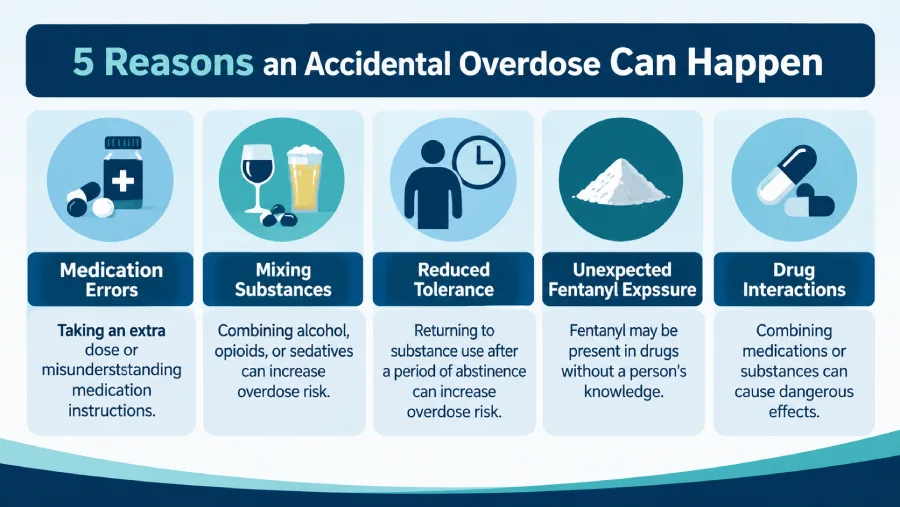
Here are some of the circumstances that can increase the risk.
Taking More of a Substance Than Intended
Medication errors are one possible cause of accidental overdose. Someone may forget that they have already taken a dose and take another, misunderstand the prescribed instructions, or use a medication more frequently than recommended.
This can also happen when different medications contain the same active ingredient. For example, taking multiple products that contain acetaminophen can result in an unintended excessive dose, even when each product is taken according to its individual instructions.
In other cases, a person may misjudge how much alcohol or another substance they have consumed, particularly when drinking over a short period.
Mixing Alcohol With Drugs or Medications
Combining substances can make their effects stronger or less predictable. This is particularly concerning when alcohol is used alongside opioids or benzodiazepines.
Alcohol, opioids, and benzodiazepines can all depress the central nervous system. When taken together, their effects on alertness, coordination, and breathing can become more pronounced.
For example, someone taking an opioid pain medication may not realize that drinking alcohol at the same time can increase the risk of severe sedation and respiratory depression. Breathing may become dangerously slow or stop altogether.
Changes in Drug Tolerance After Abstinence
Tolerance develops when the body becomes accustomed to a substance over time. With repeated use, someone may need increasingly larger amounts to experience effects similar to those they previously felt.
However, tolerance does not necessarily remain the same after someone stops using a substance.
Following detox, addiction treatment, incarceration, hospitalization, or another extended period without opioid use, the body’s tolerance may decrease. If someone returns to heroin or another opioid and takes an amount they previously tolerated, their body may no longer be able to handle it.
This is one reason why overdose risk can increase following a period of abstinence.
Unknowingly Consuming Fentanyl or Other Potent Substances
Someone may believe they are taking heroin, cocaine, or a prescription medication without realizing that the substance contains fentanyl.
Illicitly manufactured fentanyl can be mixed into other drugs or pressed into counterfeit pills. Since the actual ingredients cannot be reliably identified by appearance, someone may have no way of knowing what they are consuming.
This creates a particular risk for people who are not accustomed to opioids and do not expect to be exposed to them.
Unexpected Drug Interactions
Prescription medications, over-the-counter products, alcohol, and illicit substances can interact in ways that increase toxicity.
The risk is not limited to taking two drugs at exactly the same time. Some medications remain active in the body for several hours, so their effects may overlap with substances consumed later.
This is why it is important to tell healthcare providers about all medications and substances being used, including supplements and nonprescription products.
What Is an Accidental Alcohol Overdose?
An accidental alcohol overdose, commonly called alcohol poisoning, occurs when so much alcohol enters the bloodstream that the brain begins to struggle with essential functions such as breathing, heart rate, and temperature regulation.
Alcohol slows activity in the central nervous system. As blood alcohol concentration rises, its effects can progress from impaired judgment and coordination to confusion, unconsciousness, and potentially life-threatening complications.
Unlike an ordinary hangover, alcohol poisoning is a medical emergency.
How Does Alcohol Poisoning Happen?
One common situation involves drinking excessive amounts of alcohol over a short period. When someone consumes alcohol faster than the body can process it, blood alcohol concentration continues to rise.
Another important factor is that alcohol can continue entering the bloodstream even after someone stops drinking. This means a person who appears extremely intoxicated may become less responsive or lose consciousness as their blood alcohol concentration continues to increase.
Individual responses also vary. Body composition, food intake, medications, drinking patterns, and other health factors can influence how alcohol affects someone.
This is why there is no reliable amount that guarantees someone will avoid alcohol poisoning in every circumstance.
Alcohol Poisoning Is Not the Same as a Hangover
Someone experiencing alcohol poisoning may have dangerously slowed breathing, lose consciousness, or develop seizures. Never assume an unconscious person will simply sleep it off. Call 911 immediately.
What Increases the Risk of Alcohol Overdose?
Certain circumstances can make alcohol poisoning more likely:
- Binge drinking: Consuming several alcoholic drinks within a relatively short period can cause blood alcohol concentration to rise rapidly.
- Drinking too quickly: The body cannot eliminate alcohol as quickly as it may be consumed.
- Mixing alcohol with opioids: Both substances can suppress central nervous system activity and interfere with normal breathing.
- Combining alcohol with benzodiazepines: Medications such as alprazolam or diazepam can intensify alcohol’s sedative effects.
- Taking medications that cause drowsiness: Some prescription and over-the-counter medications can increase impairment when combined with alcohol.
Can Alcohol and Other Drugs Cause an Overdose Together?
Yes. Combining alcohol with other substances can result in a more serious overdose than using either substance alone.
This is particularly concerning with opioids because both alcohol and opioids can suppress the brain’s signals responsible for breathing.
Research published in JAMA Network Open examined opioid overdose deaths in the United States between 1999 and 2017. Alcohol was involved in 14.7% of opioid overdose deaths in 2017, while benzodiazepines were involved in 21%.
A separate 2023 study examining unintentional opioid overdose deaths in Illinois found alcohol involvement in more than 30% of the deaths included in its 2017–2020 dataset.
These findings illustrate why alcohol should not be considered harmless when someone is also using opioids or other sedating substances.
If someone becomes difficult to wake, repeatedly vomits, has seizures, or develops slow or irregular breathing after drinking, do not assume they can simply sleep it off. Seek emergency medical assistance immediately.
How Does an Accidental Heroin Overdose Happen?
Heroin is an illicit opioid that affects the central nervous system. It binds to opioid receptors in the brain and other parts of the body, producing effects such as pain relief, sedation, and euphoria.
However, these same effects can interfere with the brain’s ability to regulate breathing. When someone takes more heroin than their body can tolerate, breathing may slow significantly or stop. Without enough oxygen, the brain and other vital organs can become damaged.
How Heroin Affects the Respiratory System
The brainstem contains areas responsible for controlling automatic breathing. Heroin can suppress the activity of these areas, reducing the signals that tell the body when to breathe.
During an overdose, this can lead to respiratory depression. Breathing may become shallow, irregular, or dangerously slow.
If oxygen levels fall, the person may lose consciousness. Without prompt intervention, oxygen deprivation can cause permanent brain injury, cardiac complications, or death.
This is why difficulty breathing or an inability to wake someone after suspected heroin use should always be treated as an emergency.
Why Does Reduced Tolerance Increase Heroin Overdose Risk?
Reduced tolerance is an important factor in accidental heroin overdose, particularly after someone has stopped using opioids.
A person who previously used heroin regularly may have developed tolerance to its effects. However, after detoxification, treatment, incarceration, or another period without opioid use, that tolerance can decline.
Returning to a previously familiar amount may then overwhelm the body’s reduced ability to tolerate the substance.
This risk is particularly important following treatment. Completing detox or spending time away from heroin does not mean the body can safely handle the same amount as before.
A return to substance use should not be treated as a personal failure. It is a situation that calls for timely medical and recovery support, especially because reduced tolerance can make an overdose more likely.
A Previous Dose May No Longer Be Safe
After a period without opioid use, the body’s tolerance can decrease. Returning to a previously familiar amount of heroin or another opioid can overwhelm the body’s reduced tolerance and lead to an overdose.
How Can Other Substances Increase Heroin Overdose Risk?
Heroin becomes particularly dangerous when combined with other substances that suppress the central nervous system.
Alcohol and benzodiazepines can intensify sedation and respiratory depression. Someone may become unconscious more quickly, and their breathing may become dangerously impaired.
There is also another concern: the substance someone believes is heroin may contain fentanyl.
A 2024 study published in JACEP Open examined 168 emergency department patients who reported heroin use or had a documented heroin overdose. Researchers detected fentanyl or a fentanyl analog in 88% of this subgroup, while only 27% had heroin biomarkers detected.
This was an emergency department sample, not a representative estimate of everyone who uses heroin. However, it demonstrates how difficult it can be to know which opioid someone has actually consumed.
Why Are Accidental Fentanyl Overdoses So Dangerous?
Fentanyl is a powerful synthetic opioid used medically to manage severe pain, including pain associated with surgery and advanced cancer. It is also manufactured illegally and distributed through illicit drug markets.
The distinction matters because pharmaceutical fentanyl is produced and administered under medical supervision, whereas illegally manufactured fentanyl can enter the drug supply without reliable information about its contents or strength.
According to the CDC, fentanyl is up to 50 times stronger than heroin and 100 times stronger than morphine. Its potency means that relatively small differences in exposure can have serious consequences.
How Fentanyl Affects the Body
Like heroin, fentanyl binds to opioid receptors in the central nervous system.
It can produce pain relief, sedation, and slowed breathing. However, when someone is exposed to an amount their body cannot tolerate, respiratory depression can become severe.
The person may become extremely drowsy, stop responding to others, or lose consciousness. Their breathing may become slow, shallow, or stop entirely.
Because fentanyl is highly potent, an overdose can develop quickly and requires immediate attention.
Can Someone Accidentally Take Fentanyl Without Knowing It?
Yes. Someone may unknowingly consume fentanyl when it is mixed into another illicit substance or used to manufacture counterfeit prescription pills.
For example, a person may believe they are taking a pill that resembles a prescription pain medication. However, its actual ingredients may be different.
Similarly, someone purchasing heroin may not know whether the substance contains fentanyl or another synthetic opioid.
The appearance of a drug cannot establish what it contains. Counterfeit pills can look similar to legitimate prescription medications, and visual inspection cannot reliably identify fentanyl.
Why Is Fentanyl Contamination a Concern?
The unpredictable nature of the illicit drug supply makes unexpected fentanyl exposure particularly concerning.
A 2025 study published in Annals of Emergency Medicine, based on emergency department patients in New York City, examined fentanyl exposure among people reporting illicit drug use.
Among participants who intended to use opioids but did not believe they were using fentanyl, 90% of those who provided urine samples tested positive for fentanyl. Researchers also detected fentanyl in 24% of samples from participants who intended to use only non-opioid substances.
These findings came from a convenience sample of emergency department patients and should not be interpreted as national prevalence estimates. Nevertheless, they show that people may encounter fentanyl even when they do not expect to use an opioid.
For this reason, an overdose involving fentanyl is not necessarily the result of someone deliberately seeking out the drug. Unintentional exposure is a real possibility, and the risks are particularly serious for people who have little or no opioid tolerance.
What Are the Signs of an Accidental Overdose?
Overdose symptoms vary depending on the substance involved. Some signs overlap, so it is important not to wait for every symptom to appear before seeking emergency help.
Possible signs of an opioid or depressant overdose include:
- Inability to wake up or respond normally.
- Slow, shallow, or irregular breathing.
- Choking, gurgling, or unusual snoring sounds.
- Blue, gray, or otherwise discolored lips and fingernails.
- Very small or pinpoint pupils.
- Loss of consciousness.
Possible signs of alcohol poisoning include:
- Severe confusion or stupor.
- Repeated vomiting.
- Difficulty remaining conscious.
- Seizures.
- Slow or irregular breathing.
- Cold, clammy skin.
- Extremely low body temperature.
Possible signs of stimulant overdose include:
- Severe agitation or confusion.
- Chest pain.
- Rapid or irregular heartbeat.
- Dangerous overheating.
- Seizures.
Not every overdose looks the same. Someone may show only a few warning signs initially, and their condition can deteriorate quickly.
If you suspect an overdose, treat it as an emergency even if you are unsure which substance the person has taken.
What Should You Do If Someone Accidentally Overdoses?
A suspected overdose requires immediate medical attention. Do not wait for someone to recover on their own or assume that sleeping will make the symptoms disappear.
If someone may be experiencing an overdose:
- Call 911 immediately. Explain that you suspect an overdose and follow the emergency dispatcher’s instructions.
- Administer naloxone if opioid exposure is possible. If naloxone is available, use it according to the product instructions. A second dose may be necessary if the person does not respond.
- Help maintain breathing. Follow the dispatcher’s instructions regarding rescue breathing or CPR, as appropriate.
- Place the person on their side if they are unconscious but breathing. This recovery position can help reduce the risk of choking if they vomit.
- Stay with the person. Continue monitoring their breathing and responsiveness until emergency responders arrive.
Naloxone, also known by the brand name Narcan, can reverse the effects of an opioid overdose, including one involving heroin or fentanyl. However, it does not reverse alcohol poisoning or stimulant toxicity.
Even if someone wakes up after receiving naloxone, they still need emergency medical evaluation. The effects of opioids can last longer than naloxone, and overdose symptoms may return.
What Should You Know About New Jersey’s Good Samaritan Protections?
In New Jersey, the 911 Good Samaritan protections are intended to encourage people to seek emergency assistance during an overdose without delaying because of certain fears about legal consequences.
The protections apply under specific legal conditions and are not blanket immunity from every criminal offense. You can review the New Jersey Department of Health’s drug safety guidance for information about calling 911 and overdose response.
New Jersey residents can also access naloxone without a prescription at participating pharmacies. The state’s Stop Overdoses program provides information about naloxone access and overdose prevention.
Can Addiction Treatment Help Reduce the Risk of Another Overdose?
Experiencing an accidental overdose can be frightening for the individual and their family. It may also bring attention to an underlying pattern of substance use that needs professional support.
When alcohol or drug use has become difficult to control, treatment can help address the circumstances contributing to that risk. The appropriate approach depends on the substance involved, medical history, withdrawal risks, previous treatment, and any co-occurring mental health concerns.
Our clinical team can assess an individual’s needs and help determine an appropriate level of care. Depending on the assessment, treatment may involve medically supervised detox, residential treatment, structured outpatient care, individual therapy, and relapse-prevention planning.
Detox can help someone manage withdrawal safely when medical supervision is needed, but it does not address every factor that contributes to substance use. Continued treatment can help individuals understand their triggers, develop healthier coping strategies, and address underlying emotional or psychological concerns.
For people returning to opioid use after abstinence, treatment continuity is particularly important because reduced tolerance can increase overdose risk.
We encourage individuals who are struggling with alcohol or drug use to seek support before another emergency occurs. Our team can help assess their needs, discuss appropriate treatment options, and provide guidance on the next steps toward recovery. Asking for help is not a sign of failure. It can be the beginning of a safer and healthier path forward.