



-
 Written By:
Alex Herrera
Written By:
Alex Herrera
-
 Edited By:
Phyllis Rodriguez, PMHNP-BC
Edited By:
Phyllis Rodriguez, PMHNP-BC
-
 Clinically Reviewed By:
Dr. Ash Bhatt, MD, MRO
Clinically Reviewed By:
Dr. Ash Bhatt, MD, MRO
Late nights start feeling normal after a while. One more email before bed. One more client call from the airport lounge. One more drink to finally quiet the mental noise after a day spent making decisions, solving problems, and carrying pressure most people never see.
For many high-achieving professionals, alcohol does not initially look like a problem. It looks like relief. A way to slow down after operating at full speed all day.
The challenge is that the pattern often develops quietly. Studies published in JAMA Network Open have shown growing concerns around problematic alcohol use among high-pressure professional populations, particularly in environments associated with chronic stress, burnout, and emotional exhaustion.
Key Takeaways
|
The Hidden Link Between Burnout and Alcohol Use
The burnout alcohol cycle professionals experience rarely begins with obvious addiction warning signs. More often, it begins with chronic pressure.
Executives, entrepreneurs, attorneys, physicians, finance professionals, and other high performers often operate in environments where constant availability is expected. Long hours, travel schedules, decision fatigue, and high-stakes responsibilities create an ongoing mental load with very little recovery time in between.
At first, alcohol may simply feel like a reliable way to decompress at the end of the day. A few drinks during dinner after meetings. A nightcap to mentally disconnect before sleep. Drinks during travel can help relieve stress or transition between demanding schedules.
Over time, however, alcohol can slowly become tied to stress relief itself.
The issue is not always quantity in the beginning. It is a dependency on the routine.
Why This Doesn’t Feel Like a Problem
One reason high functioning drinking professionals often go unnoticed is that outward performance still appears intact.
Deadlines are still being met. Meetings are still happening. Revenue is still growing. Responsibilities are still being handled.
There may not be dramatic external consequences. No missed work. No public incidents. No obvious disruption that forces immediate attention.
From the outside, life can look highly successful.
That is what makes this pattern difficult to recognize early.
Many professionals compare themselves to stereotypical images of alcohol addiction and conclude: “That’s not me.”
But functional alcohol use can still quietly affect mental clarity, emotional resilience, sleep quality, stress tolerance, and long-term well-being long before visible consequences appear.
The person often feels exhausted internally while still appearing composed externally.
What Dr. Ash Bhatt, MD Often Sees in High-Performing Professionals“Many professionals I work with don’t identify with traditional images of addiction because they’re still functioning externally. They’re still productive, respected, and meeting expectations. What they often notice first is internal exhaustion, feeling mentally drained, emotionally disconnected, and increasingly dependent on alcohol to transition out of work mode.” |
The Burnout – Alcohol Feedback Loop
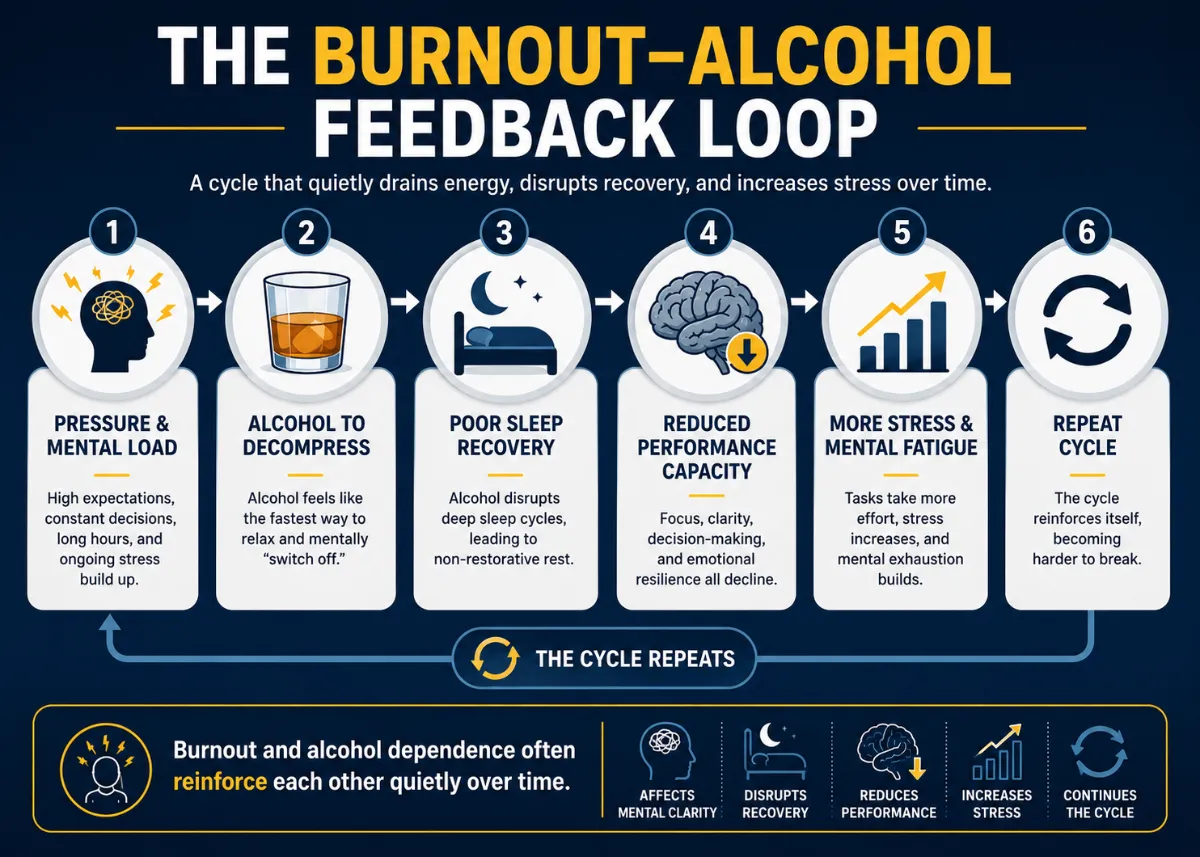
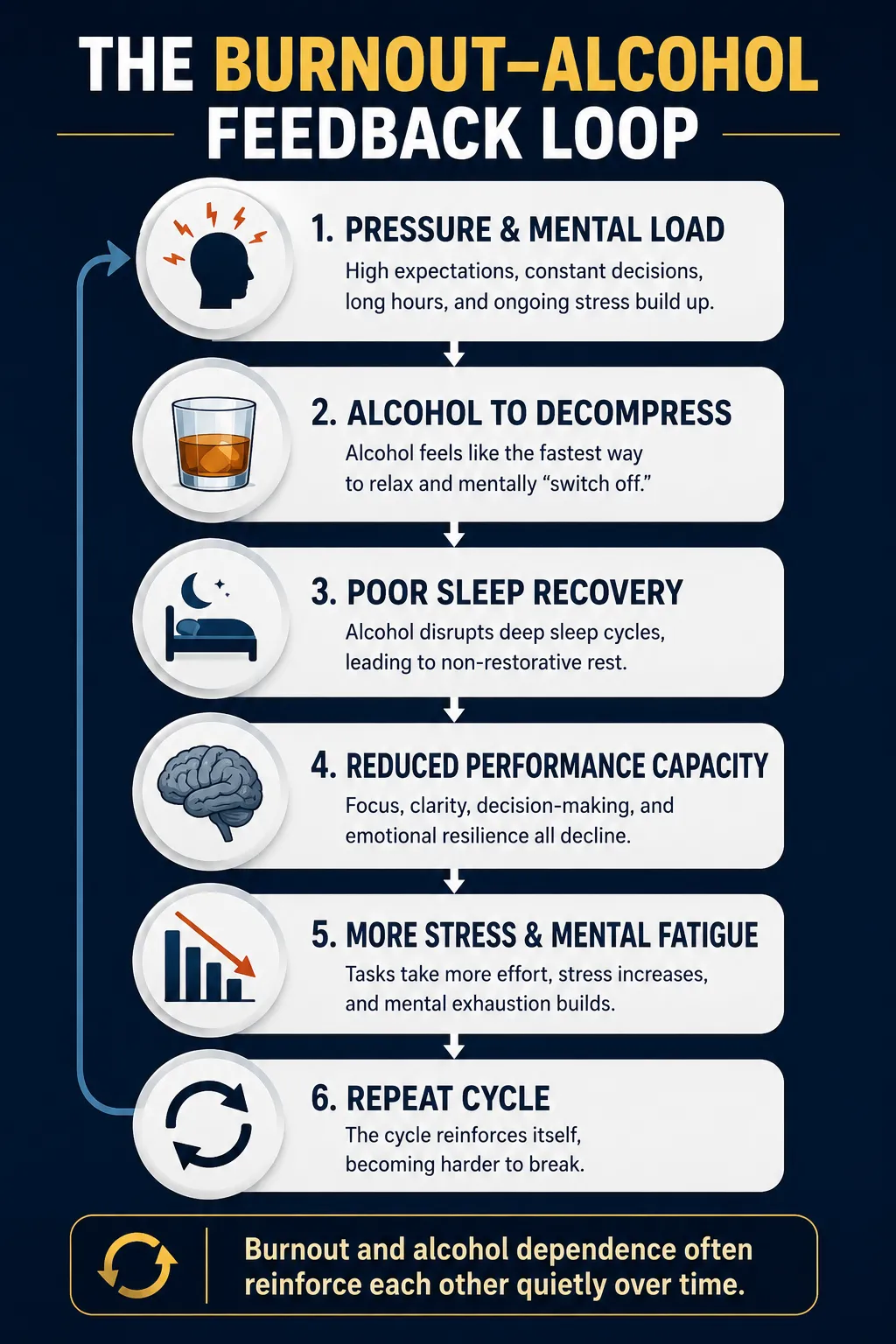
The burnout drinking cycle isn’t random. It’s a structured pattern that feeds itself.
Here’s how it unfolds:
Ongoing Stress and Mental Load
High-performing professionals spend long periods operating under pressure with limited recovery time.
Alcohol Becomes the “Off Switch”
Drinking starts feeling like the fastest way to decompress mentally after work, travel, or stressful situations.
Sleep Quality Quietly Declines
Even when alcohol helps someone fall asleep faster, sleep quality often becomes lighter and less restorative.
The Next Day Requires More Effort
Mental sharpness, patience, focus, and energy gradually require more effort to maintain.
Stress Increases Again
As exhaustion builds, alcohol may become even more appealing at the end of the day, reinforcing the cycle further.
The cycle repeats. Each night, the drink feels more necessary. Each morning, the effort feels more required.
You’re Still Performing, So It Doesn’t Feel Urgent
Here’s the critical distinction: You’re not failing. You’re not in crisis. You’re still meeting expectations.
That is part of what makes functional alcohol dependence so difficult for executives to confront honestly. The absence of immediate consequences creates the illusion that things are still fully under control.
But internally, there may already be signs that maintaining performance requires significantly more effort than it used to.
You may notice:
- increased mental exhaustion
- difficulty shutting your mind off without alcohol
- Reduced patience under pressure
- Needing recovery time that never fully feels sufficient
For many professionals, the concern is not collapse. It is a gradual erosion.
The edge that once felt natural begins taking more energy to maintain.
Subtle Signs That Often Go Unnoticed
These aren’t dramatic symptoms. They’re refinements in a pattern that’s already there.
- Alcohol becomes part of the routine, not a choice. You don’t decide to drink, you reach for a drink. It’s automatic. It’s the expected end to your workday.
- You need it to mentally “switch off.” Work thoughts don’t naturally settle anymore. They require chemical intervention to stop.
- A slight decline in focus or sharpness, especially mid-afternoon. You’re still sharp, but not as sharp as you used to be. Concentration requires more effort.
- Increased reliance during travel or high-stress periods. When pressure spikes, alcohol consumption increases proportionally. You tell yourself it’s temporary, just until things settle.
- Sleep doesn’t feel restorative. You’re sleeping, but you wake still tired. You attribute it to schedule or stress, not to what you’re drinking.
- Minor irritability if you try to skip a drink. When you attempt not to drink, there’s a restlessness, mild anxiety, or irritability you didn’t expect.
- Increasingly private about your drinking. You don’t hide it, but you become less likely to mention how much you’re drinking to friends or family.
These signs don’t feel alarming. They feel normal for someone in a demanding role.
A Common Pattern Dr. Phyllis Rodriguez Sees in Professionals“One pattern I frequently hear from high-performing professionals is that drinking slowly becomes less intentional and more automatic. It stops feeling like a choice and starts feeling like part of the routine for managing pressure, travel, stress, or emotional fatigue. That shift is often more significant than people initially realize.” |
The Real Cost – Loss of Cognitive Edge
The cost of the burnout alcohol cycle isn’t about dramatic health consequences. It’s about cognitive performance.
Slower decision-making is the first and most consequential impact. High-achieving professionals pride themselves on rapid, high-quality decisions. Alcohol disrupts the neural pathways that support decisiveness. Your decisions aren’t bad—they’re slower. You second-guess yourself more. You require more information before committing. In fast-moving environments, speed matters.
Reduced strategic thinking follows. Strategic thinking requires holding multiple variables in mind simultaneously and seeing connections others miss. Sleep deprivation and regular alcohol use both degrade this capability. You can still think strategically, but it requires more effort. The insights come later or are less refined.
Increased emotional reactivity under pressure becomes noticeable to observant people. Your emotional regulation, a hallmark of senior leadership, becomes slightly compromised. You’re not explosive, but you’re more reactive than you used to be. A difficult meeting might irritate you when it wouldn’t have before.
Reduced ability to focus deeply on complex problems. Deep work requires sustained attention. Compromised sleep and alcohol use both degrade sustained attention. You can focus, but for shorter periods before needing a break.
The irony is that you’re using alcohol to manage stress because of a demanding cognitive role, but alcohol is degrading the very cognitive capabilities that make you successful in that role.
You’re slowly solving a problem in a way that creates the problem you’re trying to solve.
Professional Insight From Dr. Phyllis Rodriguez, PMHNP-BC“Many high-achieving professionals don’t initially seek support because they’re still functioning at a high level externally. What they often notice first is mental exhaustion, reduced emotional resilience, and feeling like maintaining performance requires significantly more effort than it once did.” |
Why Most Solutions Don’t Fit High-Level Professionals
Traditional addiction treatment models often feel incompatible with the realities of leadership roles and executive lifestyles.
Many professionals hesitate to seek support because of concerns around:
- Confidentiality
- Public visibility
- Professional reputation
- Rigid schedules
- Stepping away from responsibilities completely
Executive addiction treatment limitations become especially clear when treatment environments fail to reflect the level of privacy, flexibility, and discretion many professionals require.
For some individuals, the fear of career disruption becomes strong enough that they delay seeking help entirely.
A More Discreet, Performance-Focused Approach
A private executive recovery program should be designed around the individual — not the other way around.
At Legacy Healing Center New Jersey, we work with professionals who need confidential, highly personalized care that respects both their recovery goals and professional responsibilities.
Our approach emphasizes:
- Private, discreet treatment environments
- Individualized support plans
- One-on-one clinical attention
- Flexible scheduling when appropriate
- Trauma-informed and dual diagnosis care
- Recovery strategies designed for long-term stability
Many professionals are not looking for a dramatic life reset. They are looking to regain clarity, control, consistency, and mental resilience without compromising their future.
Regaining Control Without Stepping Away From Work
The first reassurance: You can continue working.
You don’t need to announce anything to your organization. You don’t need to take medical leave. You don’t need to slow down or pause your career trajectory. Recovery happens parallel to your responsibilities, not instead of them.
The second reassurance: You don’t need to disappear or disrupt your public identity. Your colleagues won’t know unless you choose to tell them. Your industry relationships won’t be affected. Your momentum doesn’t pause.
The third reassurance: Support adapts to you. When you have a critical week, sessions adjust. When you’re traveling, they accommodate. When you’re in a high-pressure moment, support increases. You’re not fitting into a program; the program is fitting you.
At Legacy Healing Center NJ, we recognize that many executives, entrepreneurs, and professionals need support models that adapt realistically to their schedules and responsibilities while still prioritizing recovery.
This is different from traditional treatment because it honors what you’ve built and what you still need to accomplish. It’s not about stepping away to “get better.” It’s about getting better while you continue being who you are professionally.
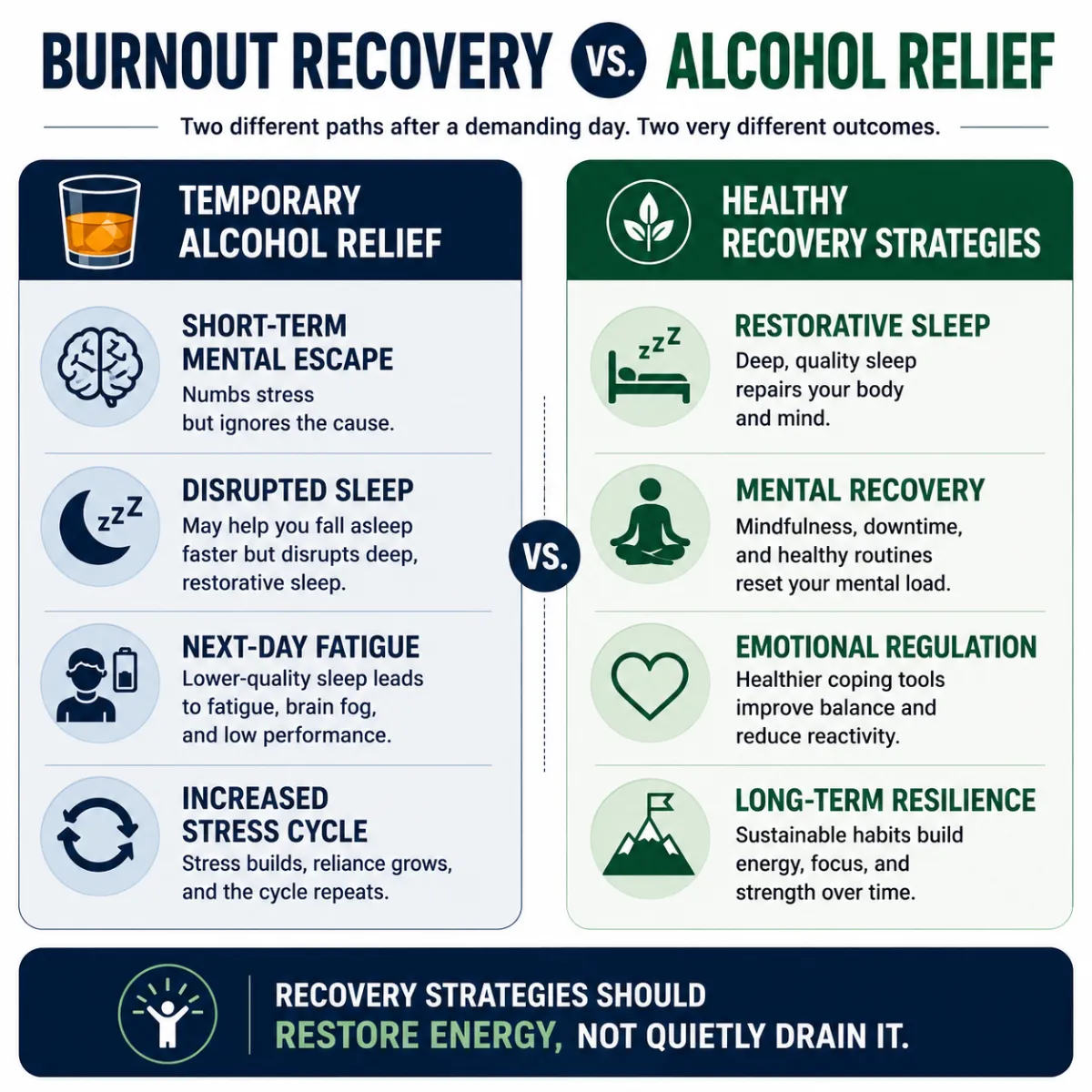
A Better Way to Decompress
Many professionals have spent years training themselves to stay productive, but very little time learning how to recover effectively.
Long-term stress management high performers benefit from often includes healthier decompression strategies that support both mental clarity and nervous system recovery.
Some examples include:
- Structured evening decompression routines
- Sleep optimization and recovery-focused habits
- Reducing constant digital stimulation after work
- Exercise and movement-based stress regulation
- Mindfulness and nervous system recovery strategies
The goal is not perfection. It is creating sustainable recovery patterns that do not rely entirely on alcohol to manage pressure.
When It’s Time to Take a Closer Look
Many professionals wait for a major crisis before evaluating their relationship with alcohol.
Often, the more important signs appear much earlier and far more quietly.
It may be time to seek help alcohol professionals need when:
- Alcohol feels necessary, not optional.
- Work performance requires increasing effort
- Stress recovery feels impossible without drinking
- Sleep quality continues declining
- The pattern has become noticeable internally, even if others have not addressed it
These aren’t crisis indicators. They’re clarity indicators. They suggest that the cost-benefit analysis is shifting, that what you’re gaining from alcohol is becoming smaller than what you’re losing to it.
| According to the Substance Abuse and Mental Health Services Administration (SAMHSA), many individuals delay seeking support because they do not believe their alcohol use has become “serious enough,” even when dependency patterns have already developed. |
A Private Path Forward
Discreet addiction treatment professionals seek is not about stepping away from ambition, leadership, or success. It is about regaining the clarity, control, and mental resilience that ongoing burnout and alcohol dependence can gradually erode over time.
At Legacy Healing Center New Jersey, we provide confidential, individualized care designed for professionals who value privacy, flexibility, and long-term stability. Our programs are built to support recovery in a way that feels structured, personalized, and aligned with how high-performing individuals operate.
For those who recognize this pattern early, change does not need to be disruptive, it can be precise, private, and aligned with the life and career you have worked hard to build.