


-
 Written By:
Christina Holmes
Written By:
Christina Holmes -
 Edited By:
Phyllis Rodriguez, PMHNP-BC
Edited By:
Phyllis Rodriguez, PMHNP-BC
-
 Clinically Reviewed By:
Dr. Ash Bhatt, MD, MRO
Clinically Reviewed By:
Dr. Ash Bhatt, MD, MRO
Key takeaways
- Cocaine withdrawal isn’t the dramatic ordeal alcohol or opioids produce, so patients underestimate it. The crash still wrecks motivation and mood, which is exactly why so many stop treatment in the first two weeks.
- No medication is FDA-approved to treat cocaine use disorder, unlike alcohol or opioids. That means recovery depends almost entirely on behavioral therapy and structure, which is harder to sustain than taking a daily pill.
- New Jersey DMHAS data for CY2021 found that 79.3% of first readmissions occurred within 30 days of discharge. Treatment that doesn’t plan specifically for that window is treatment that’s leaving the hardest stretch unaddressed.
Cocaine abuse treatment in New Jersey is often treated as though it should work the same way opioid or alcohol treatment does. It doesn’t, and the reasons aren’t obvious from the outside. Cocaine doesn’t produce a medically dangerous withdrawal, no approved medication blunts the craving, and the drug’s effect on the brain’s reward system creates associations that can resurface long after someone stops using.
This article walks through why cocaine addiction is genuinely difficult to treat, without suggesting it’s untreatable, and what treatment actually has to account for to hold up over time.
It’s worth saying plainly up front: difficult to treat is not the same thing as impossible to treat. The rest of this article explains the specific mechanisms that make early cocaine recovery fragile, then walks through how treatment is built to address each one.
Why is Cocaine Abuse Treatment Difficult?
This is the core question, and it comes down to several overlapping factors rather than one single obstacle. Each of the following plays a role, often at the same time.
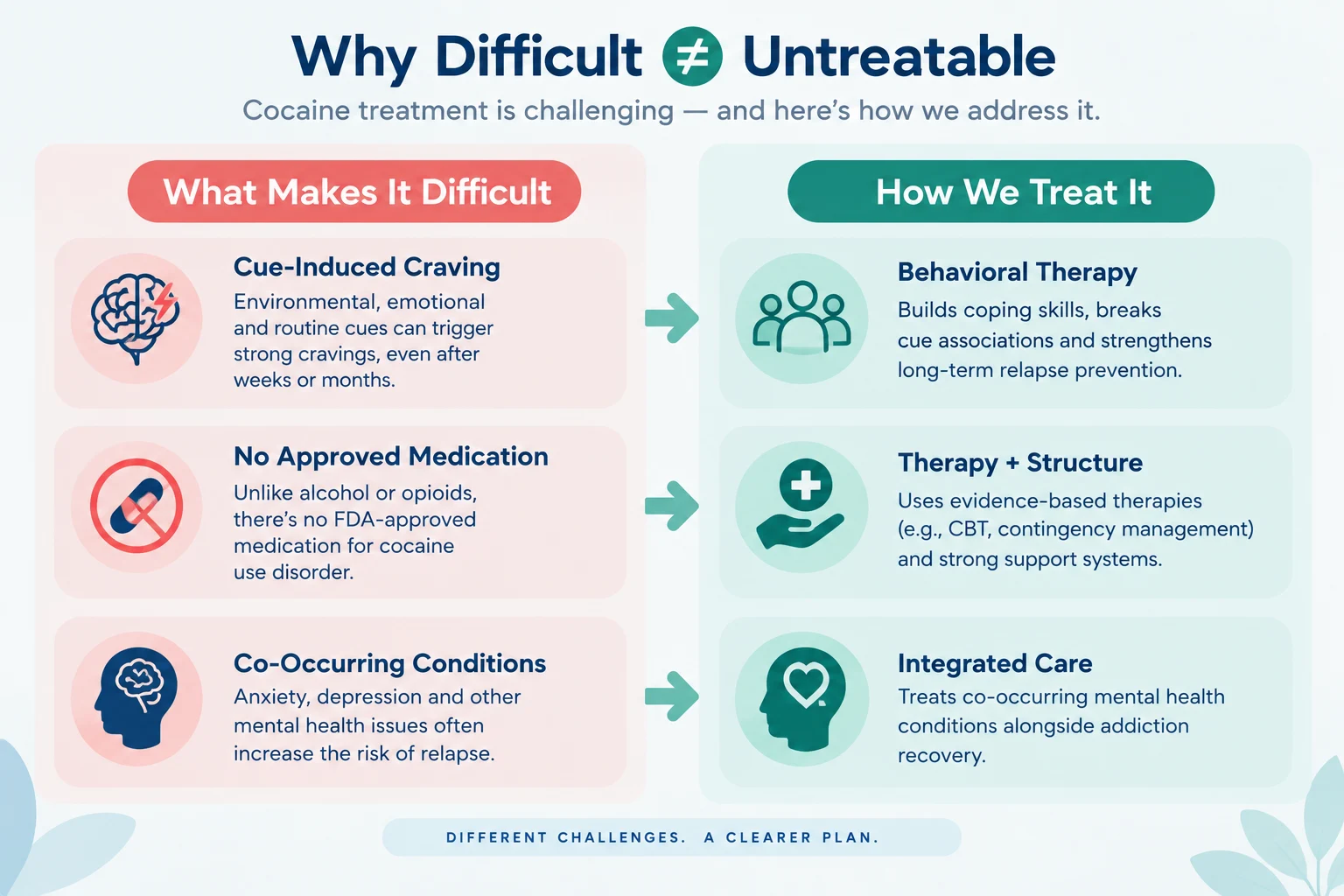
- Cocaine creates powerful reward and craving associations. Repeated cocaine create a habit, it builds specific associations between the drug and particular environments, people, routines, and even emotional states. NIDA’s research on cocaine describes this as activation of the brain’s reward and reinforcement pathways. Cocaine increases dopamine signaling by blocking dopamine reuptake. This activates brain reward pathways and produces an amplified reward signal that can reinforce repeated drug use. Over time, things that were once neutral, start to carry the same pull as the drug itself. This is called cue-induced craving, and it’s one of the more studied mechanisms behind stimulant relapse.
- Cravings can outlast the drug’s actual effects by months. Someone can be completely physically clear of cocaine while still experiencing strong psychological pulls toward it. The high fades in minutes; the learned association between certain cues and the drug doesn’t fade on the same timeline. That gap is exactly why relapse prevention has to be an ongoing part of treatment rather than a topic covered once near discharge.
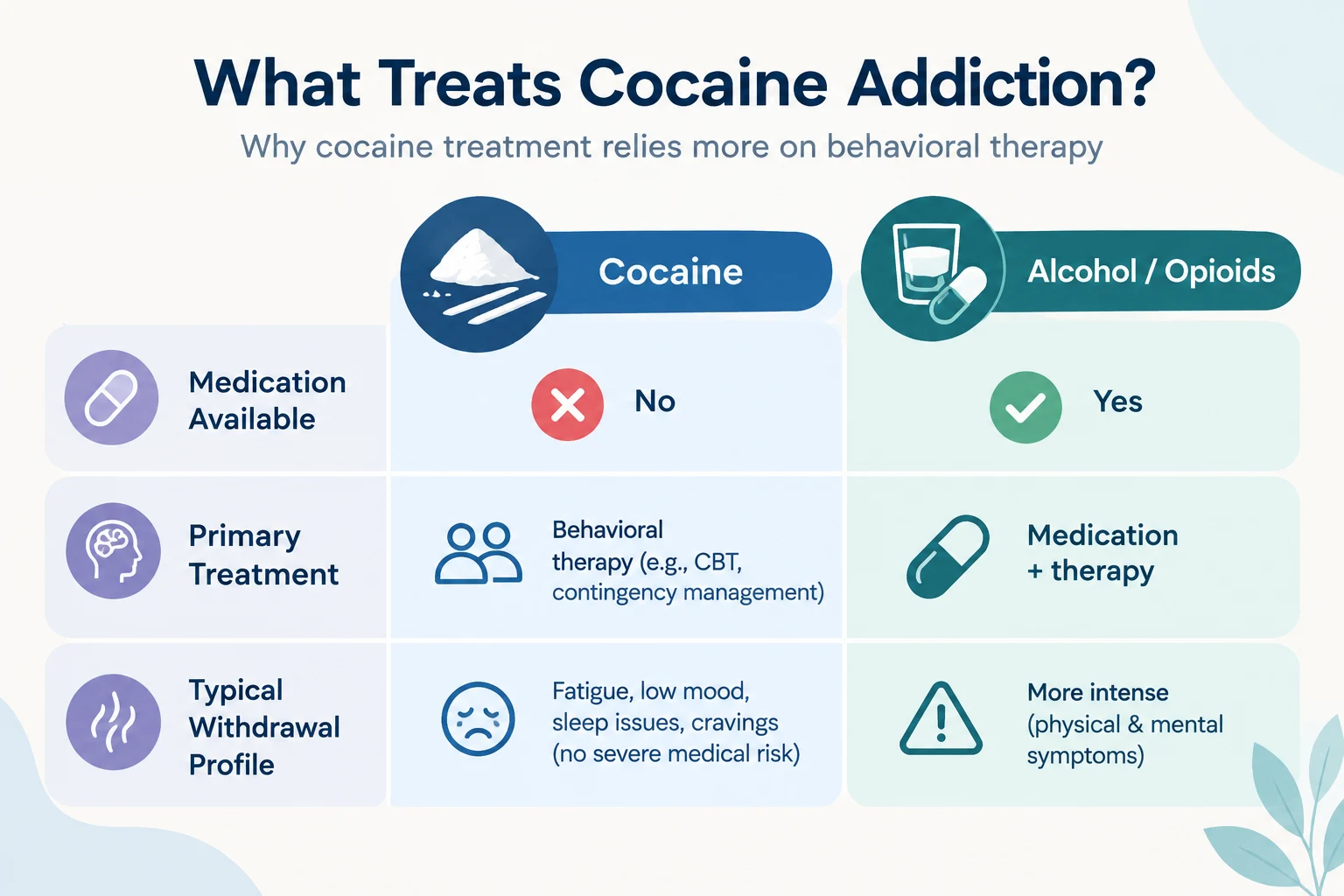
- The withdrawal “crash” complicates early recovery, even without medical danger. Stopping cocaine doesn’t produce the seizure or delirium risk associated with alcohol or benzodiazepine withdrawal. But the crash still brings fatigue, disrupted sleep, increased appetite, low mood, irritability, and a flattened ability to feel pleasure from anything else. Those symptoms don’t threaten someone’s life, but they do threaten their motivation to stay in treatment during exactly the window when motivation matters most.
- No medication is FDA-approved specifically for cocaine use disorder. Alcohol has acamprosate and naltrexone. Opioids have methadone and buprenorphine. Unlike opioid use disorder, for which medications such as methadone and buprenorphine are established treatments, there is currently no FDA-approved medication specifically for cocaine use disorder. It means cocaine treatment has to be almost entirely behavioral, which asks more of the patient and takes longer to show results than a daily prescription would.
Clinical perspective from Dr. Ash Bhatt: Patients sometimes come in expecting a medication to do the heavy lifting, the way it might for opioid or alcohol treatment but cocaine doesn’t work that way. The behavioral work isn’t a backup plan here; it’s the primary treatment, and it takes real engagement from day one.
- Stress, mental health conditions, and other substance use often complicate the picture. Depression, anxiety, trauma-related symptoms, sleep problems, and use of other substances frequently show up alongside cocaine use disorder. This doesn’t mean everyone using cocaine has an underlying psychiatric diagnosis. It means treatment has to actually screen for these factors, because if something driving the cocaine use goes unaddressed, stopping the cocaine alone tends not to hold.
- Cocaine sometimes functions as a coping response, which complicates simply stopping. For some patients, a pattern emerges: stress leads to use, use brings temporary relief, consequences follow, and the original stress is still there, sometimes worse. This cycle doesn’t apply to everyone, but where it’s present, treatment has to identify the specific trigger and reinforcement pattern at work rather than treating the cocaine use as an isolated behavior to eliminate.
- Relapse can be triggered by cues long after someone has stopped using. This is where “difficult to treat” gets misread as “willpower failure.” Returning to an old neighborhood, seeing someone from a using period, even a single message from a former contact can activate the same cue-reactivity described earlier. Research supports an association between these cues and drug-seeking, not inevitability, exposure to a trigger doesn’t guarantee relapse, but it does raise risk in a way that generic advice like “just stay strong” doesn’t address.
What is in Cocaine, and Why Does it Matter for Treatment?
Cocaine is a stimulant made from the leaves of the coca plant, and it reaches users in two main chemical forms. Powder cocaine is the hydrochloride salt, snorted or dissolved for injection. Crack cocaine is the freebase form, created by cooking the powder with baking soda or ammonia so it can be smoked, according to NIDA’s cocaine research overview.
The composition of illicit cocaine can vary, and some seized cocaine samples contain adulterants. DEA’s 2024 Cocaine Signature Program identified levamisole-related compounds as the primary cutting agent among samples in which cutting agents were detected. Illicit cocaine may also be contaminated or mixed with fentanyl. CDC notes that fentanyl can be mixed with cocaine without the person using the drug knowing it, creating an additional overdose risk.
adulterated with fentanyl, which NIDA identifies as a major driver of cocaine-related overdose deaths in recent years. Someone using cocaine today has no reliable way to know what else they’re taking.
The route of use changes how fast and how hard it hits:
- Snorting – Onset in a few minutes, high lasts 15 to 30 minutes
- Smoking (crack) – Onset almost immediate, high lasts only 5 to 10 minutes
- Injecting – Onset nearly instant, intensity is highest, with added infection risk
This unpredictability matters for treatment because faster onset generally means a shorter, more intense high, and a faster crash back down, which is part of why smoked and injected cocaine tend to escalate use more quickly than snorting.
Cocaine Abuse vs. Cocaine Use Disorder: What the ICD-10 Code Actually Means
“Cocaine abuse” is the older clinical term. Current diagnostic language, following DSM-5, generally refers to cocaine use disorder (CUD), a single diagnosis scaled by severity rather than split into separate “abuse” and “dependence” categories. Anyone searching cocaine abuse ICD 10 is usually looking for where that older term still shows up in official coding, and it does. ICD-10-CM, which providers still use for diagnosis coding and insurance billing, hasn’t fully caught up to the DSM-5 shift, it keeps cocaine abuse and cocaine dependence as separate code families under category F14.
The cocaine abuse ICD 10 code is F14.1, cocaine dependence falls under F14.2, and unspecified cocaine use is coded F14.9, with further subcodes distinguishing intoxication, withdrawal, remission, and cocaine-induced psychiatric symptoms. It’s worth being direct here: F14.1 is not a universal stand-in for “cocaine addiction.” Which code applies depends entirely on the clinical documentation and the severity actually present at assessment, a provider determines that, not a checklist.
This distinction affects more than paperwork. The documented severity often shapes what level of care insurance will authorize, which is part of why an accurate initial assessment matters as much as the treatment that follows it.
What Does Cocaine Addiction Therapy Actually Involve?
Effective treatment is built around understanding what’s maintaining a specific person’s cocaine use, not applying a fixed protocol to everyone.
- Assessment and individualized planning come first. A thorough intake looks at use patterns, cravings and known triggers, withdrawal symptoms, physical and mental health, other substance use, social and environmental factors, and any previous treatment or relapse history. The goal isn’t just documenting cocaine use, it’s identifying what’s maintaining it.
- Behavioral therapy carries most of the treatment weight, given the absence of approved medication. Cognitive behavioral therapy (CBT) helps patients recognize the specific situations most likely to trigger use and build alternative responses in advance. Contingency management, which rewards confirmed abstinence through a voucher or incentive system, is specifically flagged in the ASAM/AAAP stimulant use disorder guideline as one of the more strongly evidenced interventions for stimulant use disorder.
The function of this work matters more than the label. Good behavioral treatment moves through a sequence: recognize triggers, build alternative responses, manage cravings directly, shift the reinforcement pattern that was keeping the cycle going, and strengthen behaviors that support staying stopped.
Relapse Prevention Therapy for Cocaine Addiction
Relapse prevention therapy for cocaine addiction is a skills-based process that runs through the entire course of care, not a single conversation before discharge.
Effective relapse prevention plans for cocaine typically include:
- Mapping specific personal triggers, people, places, financial situations, even specific times of year.
- Practicing refusal and exit strategies for high-risk situations before they happen, not after.
- Building a support structure that includes both professional follow-up and peer accountability, such as Narcotic Anonymous meetings.
- Ongoing monitoring for co-occurring depression or anxiety, since untreated symptoms are a common relapse driver.
Clinical perspective from Dr. Ash Bhatt: The first 30 days after leaving a structured program are the ones that decide everything. That’s when accountability drops and old routines come back. A solid relapse prevention plan names exactly who the patient will call, and exactly what they’ll do, in that specific window, not a vague promise to “reach out if things get hard.”
Why Treatment Often Needs to Continue After Detox
Detox and stabilization address the acute crash safely, but they aren’t complete addiction treatment on their own. A more realistic progression looks like: initial stabilization, full assessment, behavioral treatment, active trigger and craving management, relapse prevention work, and continuing care that extends well past discharge.
Not everyone needs residential treatment or medical detox, the right level of care depends on clinical severity, co-occurring conditions, safety, and what support exists at home. But stopping the process at detox, for anyone, tends to leave the mechanisms described earlier, cue reactivity, untreated co-occurring symptoms, unaddressed coping patterns, completely unaddressed.
Cocaine Abuse Treatment in New Jersey: What the Numbers Show
New Jersey recorded 81,217 total substance use treatment admissions in 2024, with cocaine or crack listed as the primary drug in 7,139 of them, about 9% of the statewide total, according to the NJ Division of Mental Health and Addiction Services’ 2024 statewide overview. That figure counts treatment admissions, not unique individuals, someone readmitted twice in a year shows up twice, so it shouldn’t be read as a count of how many New Jersey residents have cocaine use disorder.
The same report shows why relapse prevention needs to be front-loaded rather than gradual. Among clients readmitted statewide, 79.4% returned within 30 days of a previous discharge. Separately, 27% of all 2024 discharges were recorded as “quit or dropped out” rather than completing the intended level of care.
New Jersey treatment data also reflects multiple levels of care in active use, outpatient, intensive outpatient, partial hospitalization, residential, and detox, which reinforces that cocaine treatment in the state isn’t one standardized experience. The right starting point depends on the individual assessment described earlier, not a default program length.
Choosing A Cocaine Abuse Treatment Program
Not every program built for opioid or alcohol treatment translates well to cocaine. A few things are worth confirming before committing to a facility:
- Does the program address the crash phase directly, with medical staff monitoring mood and safety during the first days, rather than assuming there’s nothing to manage medically?
- Is cognitive behavioral therapy or contingency management part of the actual curriculum, not just general counseling?
- Can the facility treat co-occurring mental health conditions at the same time, under the same treatment plan, rather than referring patients elsewhere mid-program?
- What does aftercare look like for the first 30 days after discharge specifically, given how much relapse risk concentrates in that window?
Insurance coverage, location, and length of stay all matter too, but a program that can’t answer those four questions clearly is worth a harder look before enrolling.
When Should Someone Seek Treatment for Cocaine Abuse?
There’s no threshold someone needs to clear before it’s “bad enough” to seek help. Signs worth acting on include repeated unsuccessful attempts to cut back or stop, needing more cocaine for the same effect, continued use despite clear consequences at work, home, or in relationships, and mood symptoms that track closely with use and non-use periods.
When cocaine and alcohol are used together, the body can form cocaethylene, an active metabolite that may prolong and intensify the effects of cocaine and has been associated with increased cardiovascular toxicity. That combination is a medical concern on its own, independent of how someone judges the severity of their use.