



-
 Written By:
Christina Holmes
Written By:
Christina Holmes -
 Edited By:
Phyllis Rodriguez, PMHNP-BC
Edited By:
Phyllis Rodriguez, PMHNP-BC
-
 Clinically Reviewed By:
Dr. Ash Bhatt, MD, MRO
Clinically Reviewed By:
Dr. Ash Bhatt, MD, MRO
Key Takeaways
- No fixed number of days makes someone “addicted” to Percocet. Tolerance can start within days, but addiction is defined by loss of control, so the real question to ask is what’s changed about your relationship with the drug, not how long you’ve taken it.
- A person can be physically dependent on Percocet, meaning they’d feel withdrawal if they stopped, without meeting the clinical criteria for opioid use disorder. Confusing the two is the single most common misunderstanding about opioid addiction.
- Percocet pairs oxycodone with acetaminophen, and MedlinePlus and the FDA both warn that oxycodone is habit-forming with real respiratory depression risk, a danger that has nothing to do with whether someone technically “counts” as addicted yet.
If you’re asking how fast Percocet addiction can happen, you’re probably watching for a warning sign you can trust.
There is no fixed number of days after which everyone becomes addicted to Percocet. However, oxycodone can lead to tolerance and physical dependence relatively quickly, and certain patterns of use can increase the risk of addiction.
This article breaks down what happens in the body and brain during regular Percocet use, why clinicians reject the idea of a fixed timeline, and what behavioral changes matter far more than day counts.
We’ll also cover how tolerance, physical dependence, and opioid use disorder differ, what to do if your own use feels different than it used to, and what to watch for in someone you love.
Can You Get Addicted to Percocet Quickly?
Yes, problematic use can develop faster than people expect, but no clinically reliable timeline applies to everyone. Risk depends on how the medication is taken, prior substance-use history, why someone is taking it, and how difficult it becomes to control.
Percocet combines oxycodone, an opioid, with acetaminophen, a non-opioid pain reliever. Oxycodone is the component responsible for both pain relief and addiction risk, and current labeling identifies Percocet as a Schedule II controlled substance with FDA-recognized warnings for abuse, misuse, and life-threatening respiratory depression. That’s why claims like “you’re addicted after three days” are misleading, they turn a layered clinical process into a countdown that doesn’t exist.
Someone recovering from surgery may notice Percocet working extremely well for pain at first, then feel less relief as their body adapts. Stopping after that adaptation can cause withdrawal, but withdrawal alone doesn’t mean addiction has developed. Concern grows when the purpose of use changes, when someone starts taking Percocet to feel calm, detached, or emotionally numb rather than because they need pain control.
Clinical Insight From Dr Ash Bhatt
Psychological tolerance to Percocet’s euphoric effects tends to build faster than analgesic tolerance to its pain-relieving effects. That mismatch is often why someone starts craving a dose before their pain has actually returned, the brain’s reward response is adapting on a different timeline than the pain-relief response, which is one reason “it’s not working the same anymore” can be an early red flag rather than a purely physical one.
Why Is Percocet Addictive?
Percocet can be addictive because oxycodone acts on brain systems governing pain, reward, and reinforcement. Repeated exposure can trigger neuroadaptation, tolerance, physical dependence, and, in some people, the compulsive use pattern that defines opioid use disorder (OUD).
Not everyone who takes an opioid develops OUD, and it’s inaccurate to treat oxycodone exposure as an automatic sentence. The risk climbs when use drifts from its original purpose. The internal shift often looks something like this: pain relief becomes the reason for the first dose, then “not feeling right without it” becomes the reason for continuing, and eventually “I know it’s causing problems, but I can’t stop” becomes the reality. That shift in motivation and control is far more clinically meaningful than counting days.
How Long Does It Take to Get Physically Dependent on Percocet?
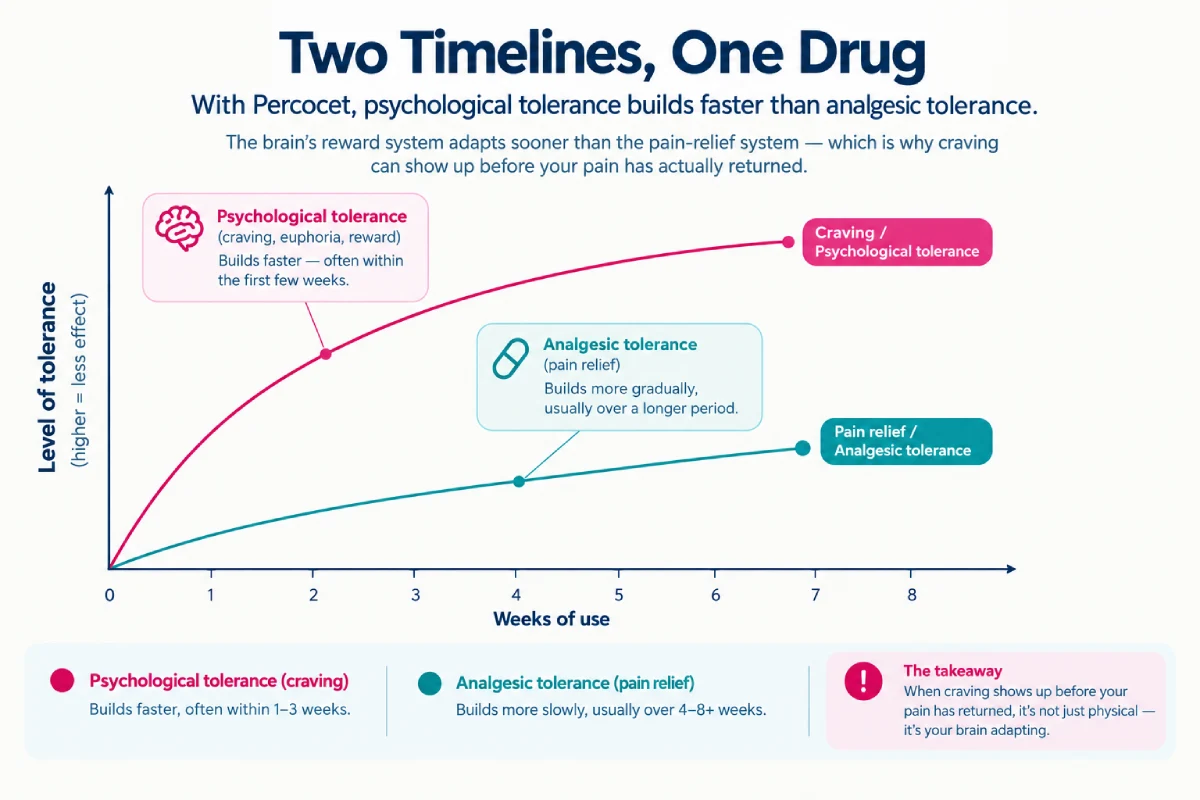
Physical dependence can develop with repeated exposure, but its timing varies and shouldn’t be confused with addiction. Dependence means the body has adapted enough to the opioid that reducing or stopping it triggers withdrawal. Tolerance is a related but separate adaptation, the same dose stops producing the same effect, so more is needed to get there.
These terms are easiest to tell apart side by side:
| Term | What it means | Does it automatically mean addiction? |
| Tolerance | Needing more of the drug to get the same effect | No |
| Physical dependence | Withdrawal occurs when the drug is reduced or stopped | No |
| Opioid use disorder | A diagnosable pattern of impaired control, craving, and consequences | Yes, this is what’s clinically meant by addiction |
CDC guidance is direct on this point: opioid use can lead to tolerance, physical dependence, withdrawal, and OUD, but these are distinct effects, not stages on a single countdown. Duration of use is associated with higher OUD risk over time, but duration alone never establishes a diagnosis.
Someone taking prescribed Percocet who feels withdrawal when they stop may simply be physically dependent, a medical reality managed with a taper, not evidence of addiction. Someone repeatedly taking more than prescribed, craving it, or unable to cut back despite trying warrants an OUD evaluation regardless of whether withdrawal is even part of the picture.
What Makes Percocet Use More Concerning?
The strongest warning signs are shifts in control, motivation, and consequences, not the number of days someone has used Percocet.
A few honest questions reveal more than a timeline ever could:
- Am I taking it more often or in larger amounts than prescribed?
- Do I think about my next dose more than the pain itself?
- Am I using it to relax, escape stress, or feel different, not just to manage pain?
- Have I tried to cut back and been unable to?
- Am I spending increasing time obtaining, using, or recovering from it?
- Have I hidden my use or sought extra prescriptions from more than one source?
- Have I kept using it despite problems at work, home, or in relationships?
These overlap directly with the clinical features CDC describes for OUD, including craving, difficulty controlling use, and use that continues despite social or occupational harm. Nobody needs to check every box before it’s worth talking to someone.
Why Some People Develop Problems Faster Than Others
No single factor determines speed. Risk comes from the interaction of the drug, the pattern of use, and the individual.
Several circumstances deserve particular attention.
- Previous opioid or substance-use problems: A history of opioid use disorder or other substance-use problems can change the risk profile. Someone who has previously experienced compulsive opioid use may be particularly vulnerable to returning to that pattern when exposed to an opioid prescription.
- Using Percocet for reasons other than pain: Taking Percocet specifically for euphoria, emotional relief, anxiety reduction, escape, or a sense of being able to function better can be a more concerning pattern than taking the medication solely as part of an agreed pain-management plan.
- Escalating use: A person may initially follow a prescription but gradually begin taking the medication earlier, more frequently, or in larger amounts because the original effect seems weaker.
- Difficulty controlling use: One of the clearest reasons to seek an assessment is repeated inability to follow a plan that the person genuinely wants to follow. Someone who says, “I intended to take it only when necessary, but I keep taking it anyway,” is describing a clinically important change.
- Mental-health or emotional distress: Pain, anxiety, depression, trauma, insomnia, and other forms of distress can complicate opioid use. In some people, an opioid gradually becomes a way to regulate emotions as well as physical pain.
- Access and opportunity: Having easy access to Percocet can make continued misuse easier.
Clinical Insight From Dr Ash Bhatt: Percocet’s acetaminophen component has its own ceiling most patients never think about. As opioid tolerance builds and someone starts taking extra pills to chase the original effect, they’re also increasing their acetaminophen intake, and exceeding acetaminophen’s daily limit carries a real risk of liver damage, separate from the opioid overdose risk. This is one reason self-directed dose increases with a combination product like Percocet are more dangerous than people realize, even before addiction becomes the central concern.
Can You Become Addicted to Percocet If You Take It as Prescribed?
It’s possible to develop OUD during prescribed opioid therapy, but taking Percocet exactly as directed doesn’t make addiction inevitable. Physical dependence and tolerance can occur during entirely appropriate medical treatment without meeting the criteria for OUD.
Someone who takes Percocet after surgery under supervision, adapts physically, and experiences withdrawal once treatment ends hasn’t necessarily developed an addiction. A different pattern, continuing after pain has resolved because of craving, repeatedly taking more than intended, and continuing despite problems at home or work, raises a genuinely different clinical concern. CDC guidance recommends that clinicians actively monitor for signs of misuse and OUD during opioid therapy, rather than assuming a prescription rules addiction out.
When Does Percocet Use Cross Into Addiction?
Percocet use becomes clinically concerning when there’s a persistent pattern of impaired control, craving, hazardous use, or continued use despite real consequences. Clinicians diagnose OUD against established criteria, not a predetermined number of days.
DSM-5-based assessment looks at behaviors including:
- Taking opioids in larger amounts or for longer than intended
- Repeated unsuccessful attempts to cut down
- Substantial time spent obtaining, using, or recovering from opioids
- Strong craving or urge to use
- Failing responsibilities at work, school, or home because of use
- Continuing despite relationship or social problems
- Giving up important activities because of use
- Using opioids in physically hazardous situations
- Continuing despite known physical or psychological harm
CDC guidance notes that OUD is diagnosed when at least two of these criteria occur within a 12-month period, with severity determined by how many are present. It’s a pattern-based framework, not a date on a calendar, which is exactly why “how many days” doesn’t have a satisfying answer.
A Common Misunderstanding: Withdrawal Does Not Equal Addiction
Withdrawal proves physical adaptation to an opioid. It does not, by itself, prove addiction.
This matters most for people prescribed Percocet after surgery or an injury, who may panic at withdrawal symptoms and assume the worst.
Withdrawal can include restlessness, sweating, gastrointestinal symptoms, muscle aches, and disrupted sleep. CDC guidance/ specifically warns against abrupt discontinuation in physically dependent people, since sudden cessation can trigger significant withdrawal and psychological distress.
For someone worried about addiction, withdrawal is a reason to have a medical conversation, not a self-administered diagnostic test.
What Should You Do If You Think You’re Becoming Addicted to Percocet?
If Percocet use is becoming hard to control, professional evaluation is worthwhile even without certainty about a diagnosis. Nobody needs to wait for a lost job, a damaged relationship, or an overdose before it’s reasonable to ask for help.
For someone currently prescribed the medication, a conversation with the prescribing clinician is a reasonable first step, being candid about cravings, changes in use, or difficulty following the plan as written. For more substantial concern, particularly compulsive use or unprescribed sourcing, an addiction-medicine or behavioral-health evaluation offers a fuller picture.
That kind of assessment typically covers:
- How Percocet use began.
- How the pattern has changed.
- Physical dependence and withdrawal.
- Other substances and medications.
- Pain and other medical conditions.
- Mental health that may influence substance use.
- Home, work, relationship, and financial consequences.
- Whether the clinical criteria for OUD are met.
Does Someone Need Rehab for Percocet Addiction?
Not necessarily. The appropriate level of care depends on the severity and stability of the person’s condition, safety risks, medical needs, and ability to participate successfully in treatment.
Some people may benefit from outpatient addiction treatment, while others may need a more structured environment.
A higher level of care may be considered when opioid use is severe or difficult to control, there is significant medical or psychiatric instability, the home environment is unsafe or unsupportive, or previous attempts at less-intensive treatment have not worked.
The important point is that “rehab” is not the only form of treatment, and avoiding residential treatment does not mean avoiding treatment altogether.
A professional assessment can help determine what level of support is proportionate to the actual problem.
What Family Members Should Look For
Family members do better focusing on changes in control and functioning than trying to “prove” someone is addicted. You may notice that a loved one:
- Becomes unusually preoccupied with getting or taking Percocet
- Takes medication earlier or more often than intended
- Becomes secretive about their use or visits multiple prescribers
- Withdraws from family activities or routines
- Repeatedly promises to cut back but doesn’t
- Experiences withdrawal when medication isn’t available
- Keeps using despite clear consequences
No single sign proves OUD on its own; what matters is the pattern across several of them. CDC recommends clinicians raise suspected OUD without judgment, giving patients room to disclose problems honestly; the same approach tends to work better for families than confrontation.
When Percocet Use Becomes an Immediate Safety Concern
Some Percocet-related situations require urgent medical attention rather than a routine appointment. MedlinePlus warns that oxycodone combination products can cause slowed breathing, long pauses between breaths, or shortness of breath, particularly early in treatment or after a dose increase. That risk compounds significantly when Percocet is combined with alcohol or other sedatives.
If someone is extremely difficult to wake, breathing very slowly, or showing signs of an opioid overdose, call emergency services immediately and use naloxone if it’s available. This is a separate concern from whether someone technically meets criteria for addiction; a person can overdose without having OUD, and someone with OUD isn’t necessarily overdosing at any given moment.
What Does Percocet Addiction Treatment Involve?
Treatment for Percocet addiction is treatment for opioid use disorder, and evidence-based care can include medication, behavioral support, medical monitoring, and recovery services matched to the person’s needs.
- Medically supervised rehab manages withdrawal safely as a starting point when physical dependence is present, though CDC guidance is clear that detox alone, without ongoing medication for OUD, carries increased risk of returning to use and overdose.
- Medication-assisted treatment (MAT) using buprenorphine, methadone, or naltrexone, alongside counseling, is the evidence-based standard for OUD specifically.
- Residential or inpatient treatment offers structured, round-the-clock care when use has significantly disrupted functioning or previous outpatient attempts haven’t held.
- Outpatient rehab treatment allows someone to continue work or family life while attending scheduled therapy and medical check-ins, suited to more stable situations.
- Dual diagnosis treatment addresses co-occurring anxiety, depression, or trauma alongside the substance use, since untreated mental health conditions are a common driver of relapse.
- Aftercare and ongoing support, including counseling and peer support, sustains recovery once the acute phase ends, the risk of returning to use doesn’t disappear when withdrawal symptoms do.
Pain doesn’t disappear just because addiction treatment begins, either. In fact, people with co-occurring pain and OUD need ongoing pain management that weighs benefits against risks, rather than being forced to choose between treating one condition or the other.
Call us 24/7 at 732-402-0352 or fill out our secure contact form.
New Jersey Resources for Percocet and Opioid Concerns
You don’t have to navigate treatment access alone. The New Jersey Division of Mental Health and Addiction Services maintains an official treatment directory and resources for individuals and families.
The state’s ReachNJ Addiction Helpline provides 24/7 assistance and connects callers with treatment and recovery services statewide, regardless of insurance status.
For a mental health or substance-use crisis, the 988 Suicide & Crisis Lifeline is available 24/7, and any suspected overdose is a 911 emergency.