



-
 Written By:
Christina Holmes
Written By:
Christina Holmes -
 Edited By:
Phyllis Rodriguez, PMHNP-BC
Edited By:
Phyllis Rodriguez, PMHNP-BC
-
 Clinically Reviewed By:
Dr. Ash Bhatt, MD, MRO
Clinically Reviewed By:
Dr. Ash Bhatt, MD, MRO
Key Takeaways
- The drug leaving your system and the psychosis resolving are not the same event. I’ve seen patients still paranoid or hallucinating days after their last dose, which catches people off guard every time.
- Heavy or repeated stimulant use, combined with severe sleep loss, is the combination I see most often behind episodes that stretch past a few days. Neither factor alone usually does it.
- If someone can’t tell what’s real, is having suicidal thoughts, or their agitation is escalating, that’s an emergency. I don’t want anyone waiting to see if it passes on its own.
There’s no single timeline. Stimulant psychosis can resolve within hours as the drug clears the body, or it can linger for days, weeks, or longer, depending on the stimulant used, how heavily and how often it was used, sleep loss, other substances involved, and a person’s underlying mental health history. In some cases, symptoms outlast the drug itself.
If you or someone you love has experienced paranoia, hallucinations, or confused thinking after using a stimulant like methamphetamine, cocaine, or Adderall, you’re probably wondering how long this actually lasts and when it crosses into something serious. This article explains what shapes that timeline, why symptoms sometimes stick around after the high is gone, and when it’s time to get help.
How Long Does Stimulant Psychosis Last?
Some episodes fade within hours, as intoxication itself wears off. Others continue well past that point, sometimes for days or weeks, and in a smaller number of cases, months. The drug clearing your bloodstream doesn’t mean your brain returns to baseline on the same schedule.
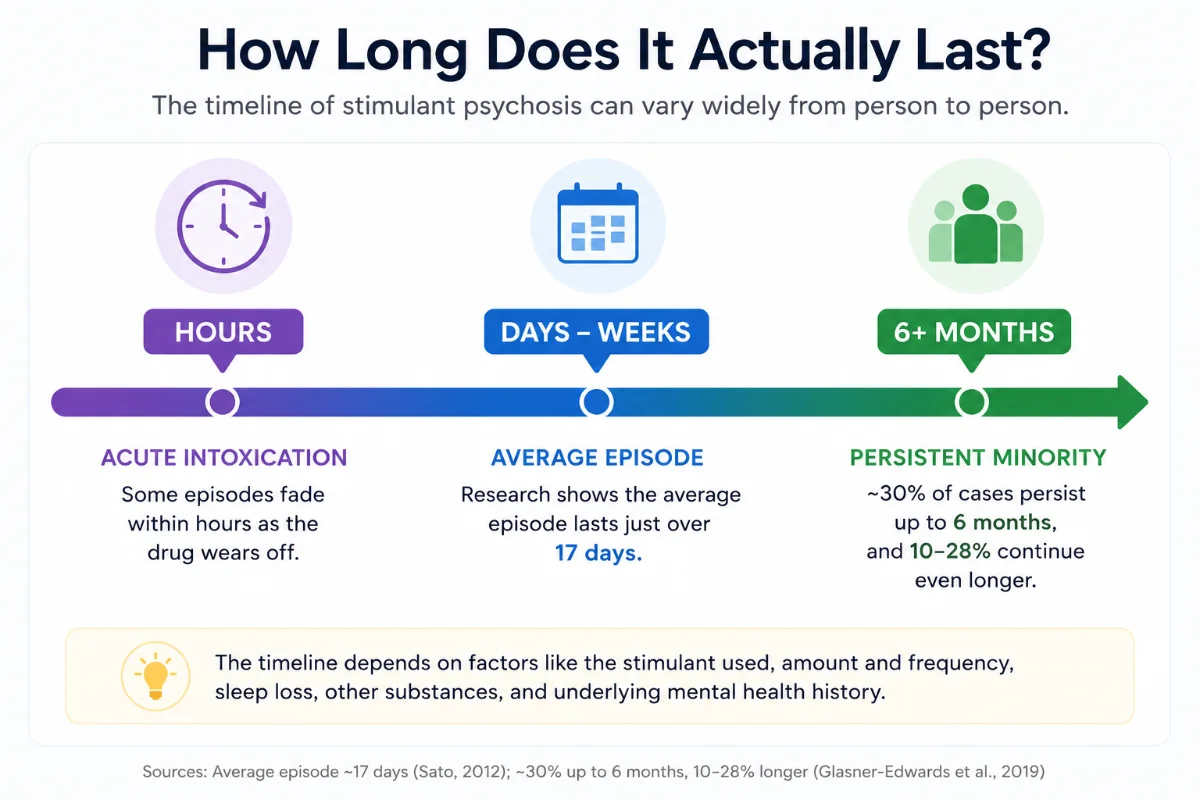
Several factors shape how long an episode lasts:
- The specific stimulant involved
- How much was used, and how often
- Whether use involved a binge pattern
- Severe sleep deprivation
- Use of other substances alongside the stimulant
- A personal history of prior psychotic episodes
- Co-occurring psychiatric conditions
Research on methamphetamine-induced psychosis gives a useful sense of the range. One clinical study found the average psychotic episode among hospitalized patients lasted just over 17 days, while a separate review found that although most symptoms resolve within a month, roughly 30 percent of cases persist up to six months, and 10 to 28 percent continue even longer than that. There’s no fixed countdown clock here. The range itself is the honest answer.
What Symptoms Can Occur During an Episode?
Stimulant psychosis has a fairly recognizable symptom pattern, distinct from the general effects of stimulant use like elevated energy or appetite loss.
- Paranoia
- Hallucinations, most often auditory or visual
- Delusions, including beliefs of being watched, followed, or targeted
- Severe suspiciousness toward people who aren’t actually a threat
- Agitation
- Disorganized thinking or behavior
- Difficulty telling what’s real from what isn’t
In methamphetamine-related cases specifically, one clinical study found persecutory delusions in 82 percent of patients and auditory hallucinations in over 70 percent, making these two of the most consistently reported symptoms across cases.
Why Can Symptoms Continue After Drug Use Stops?
This is the part that confuses people the most, and it’s worth taking seriously rather than dismissing as an intense comedown.
Stimulants like methamphetamine and cocaine work by flooding the brain with dopamine. With heavy or repeated use, the brain’s dopamine system doesn’t simply reset the moment the drug is gone. Researchers describe a kind of sensitization: with each cycle of use, the brain’s dopamine pathways become progressively more reactive, meaning it takes less to trigger the same disrupted signaling that produces paranoia or hallucinations. This is one reason repeated stimulant use is linked to psychotic symptoms recurring more easily over time, even at lower doses.
Severe sleep deprivation compounds this directly. It isn’t just a side effect of stimulant use, it’s a contributing cause of psychosis in its own right. A systematic review of sleep-loss studies found that perceptual distortions typically begin within 24 to 48 hours of no sleep, with complex hallucinations and disordered thinking emerging between 48 and 90 hours, and delusions appearing by 72 hours. Someone binging on a stimulant while also going days without sleep is stacking two separate pathways to psychosis on top of each other, not just one.
Add in the nervous system staying overstimulated well past a stimulant’s active window, ongoing stress, and any existing psychiatric vulnerability, and it becomes clearer why persistent paranoia or hallucinations shouldn’t automatically be waved off as “just the comedown.” Something biological is still actively happening.
Clinical Perspective from Dr. Ash Bhatt: I ask every patient how much sleep they’d had before symptoms started, not just how much they’d used. Because sleep and substance misuse both interact and someone who has not been sleeping since 2-3 days is often dealing with two overlapping causes of psychosis, and treating only the substance use side misses half the picture.
What Can Make an Episode Last Longer?
These are risk factors, not guarantees. Having one or more of them doesn’t mean symptoms will definitely persist, but they do shift the odds.
- Heavy or prolonged stimulant use
- Repeated binge patterns over time
- A previous episode of stimulant-related psychosis
- Severe, sustained lack of sleep
- Using alcohol or other drugs alongside the stimulant
- A co-occurring mental health condition
- A personal or family history of psychotic illness
None of this means a longer episode automatically equals schizophrenia. It means the brain has more to recover from, and recovery on more fronts generally takes more time.
Drug-Induced Psychosis vs. a Primary Psychotic Disorder
Substance-induced psychosis can look nearly identical to schizophrenia-spectrum disorders on the surface, which is exactly why this distinction needs a professional, not a guess.
Clinicians weigh several things when sorting this out: whether symptoms started in close relation to stimulant use, whether any psychotic symptoms existed before that use began, whether symptoms improve once use stops, prior psychiatric history, family history of psychotic disorders, and toxicology findings. The DSM-5 generally points toward a primary psychotic disorder, rather than a substance-induced one, when symptoms persist for more than a month after the drug is fully out of the person’s system.
This isn’t something to sort out with a checklist at home. It requires an actual clinical evaluation, ideally by someone who can also see how the person is doing over time, not just in a single snapshot.
When Do Symptoms Become a Medical Emergency?
Some symptoms need immediate medical attention, not a wait-and-watch approach. Call 911 or go to an emergency room if you see:
- Severe agitation or aggression
- Suicidal thoughts or behavior
- Threats of harm to others
- Inability to distinguish reality from delusion
- Seizures
- Chest pain
- Severe confusion
- Dangerous overheating
- Inability to safely care for oneself
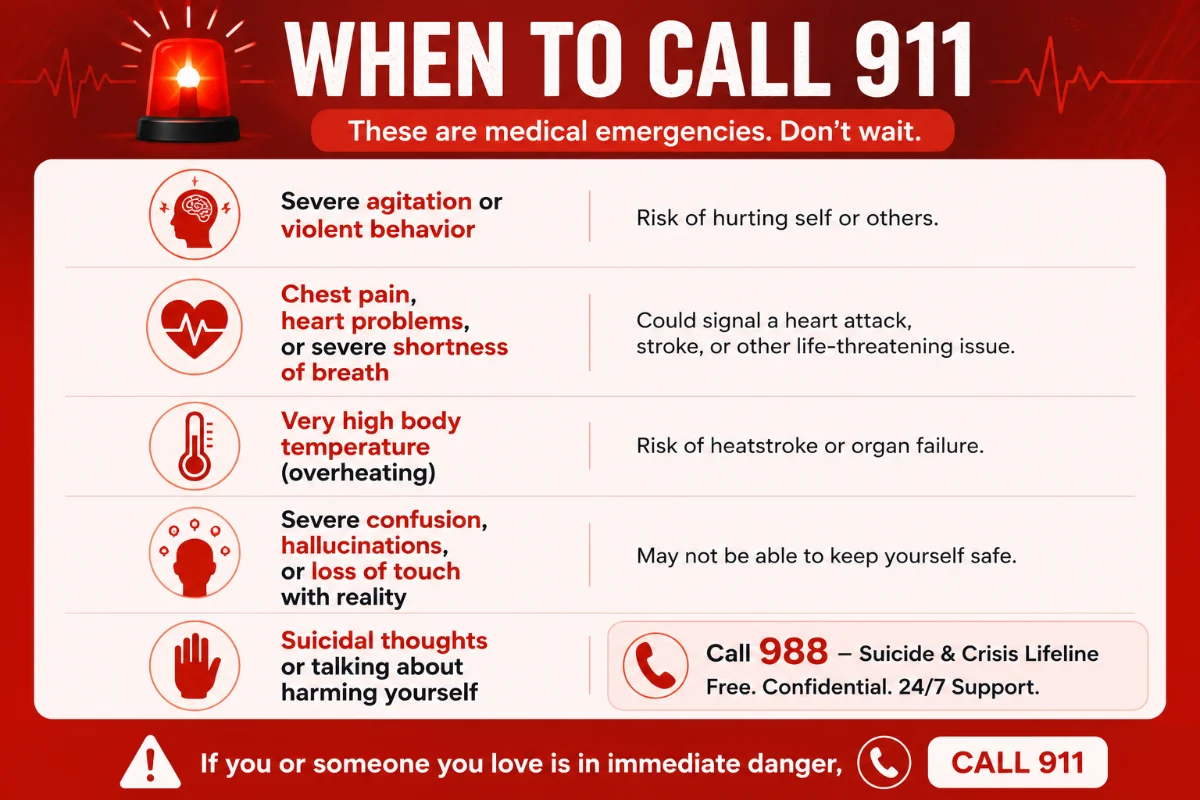
These symptoms matter because they signal the brain and body are under acute strain right now, not because of what they might predict later. Severe agitation combined with an inability to recognize reality raises real safety risk, both for the person experiencing it and anyone nearby. Chest pain and dangerous overheating point to the cardiovascular system being pushed past a safe limit alongside the psychiatric symptoms, which is why this isn’t just a mental health concern in the moment, it’s a medical one too.
If suicidal thoughts are part of what’s happening, the 988 Suicide & Crisis Lifeline is available by call or text, 24/7.
Clinical Perspective from Dr. Ash Bhatt: Often, families will be afraid to call 911 as they are afraid of what might happen to the person taking drugs. Although I can be sympathetic about these fears, when a person is very agitated and also not able to differentiate between reality and hallucinations, this becomes a very real danger not only to themselves but also anyone attempting to assist them. That is exactly the type of situation you don’t want to sit back and wait for a few hours to get a clearer picture!
Can Psychotic Symptoms Return After They Go Away?
Yes. A resolved episode doesn’t mean the door is permanently closed.
Recurrence tends to follow familiar triggers: returning to stimulant use, another heavy or binge episode, significant sleep deprivation, severe stress, or combining stimulants with other substances. A previous psychotic episode also matters clinically in its own right. It suggests the brain has already demonstrated a lower threshold for this response once, which is relevant information for anyone treating a future episode or considering ongoing stimulant use at all.
This is focused specifically on recurrence of psychosis, not a general relapse-prevention plan, though the two are obviously connected for anyone with an ongoing pattern of use.
Which Drugs Are Most Often Associated With Psychotic Symptoms?
Stimulant-induced psychosis is most commonly associated with drugs that significantly increase dopamine activity, including:
- Methamphetamine
- Cocaine
- Prescription amphetamines, including Adderall when misused, taken at high doses, or used in problematic patterns
- Other potent stimulants
Certain medications prescribed for depression can also rarely contribute to hallucinations, paranoia, delusions, or other psychotic symptoms. One notable example is bupropion (Wellbutrin), an antidepressant that affects dopamine and norepinephrine. Published reports have linked bupropion to rare cases of psychosis, including at therapeutic doses, with risk potentially increasing after dose changes or in people with factors such as substance use, bipolar disorder, previous psychosis, or other medications that affect dopamine. A 2024 literature review describes bupropion-induced psychosis as uncommon but clinically recognized.
Other antidepressants, including some SSRIs and SNRIs, may in uncommon circumstances precipitate mania or hypomania, particularly in people with underlying bipolar disorder. When a manic episode becomes severe, hallucinations or delusions can occur. This is clinically different from classic stimulant-induced psychosis, but medications should still be considered when clinicians are determining why new psychotic symptoms developed.
The prevalence varies meaningfully by substance. Cocaine-related psychotic symptoms have been reported in a wide range, with one review citing rates between 48 and 88 percent depending on the study population, while methamphetamine users are estimated to be roughly 11 times more likely to experience psychosis than the general population. For deeper information on either substance specifically, see Methamphetamine Addiction and Cocaine Addiction.
When Does Continued Use Signal a Larger Problem?
Psychotic symptoms are a serious warning sign on their own. Continuing to use stimulants after experiencing them is a different, additional concern.
Watch for:
- Repeated psychotic episodes across separate instances of use
- Continuing to use despite active hallucinations or paranoia
- Difficulty reducing use even when trying to
- Compulsive patterns of use
- Repeated binge cycles
- Worsening physical or mental health
- Problems at work or in relationships tied to use
- Continuing despite serious, visible consequences
When repeated psychiatric complications show up alongside ongoing stimulant use, that combination often points to a broader stimulant use disorder, not just an isolated psychiatric event. That’s a situation where professional assessment matters, and where stimulant addiction treatment in New Jersey can help address both the substance use and the psychiatric symptoms together, rather than treating them as separate problems.
Conclusion
Stimulant psychosis doesn’t run on a fixed clock, and that uncertainty is often the hardest part for the person going through it and the people around them. What matters most isn’t pinpointing an exact number of days. It’s recognizing that persistent or recurring symptoms are a signal worth acting on, not something to quietly wait out.
If psychosis has shown up once, that’s information. If stimulant use continues after that, or symptoms are lingering longer than expected, that’s a reason to involve a professional who can look at the full picture, not just the current episode.
How Legacy Healing Center New Jersey Can Help
Stimulant-related psychosis rarely exists in isolation from the substance use driving it, which is why treatment needs to address both. Legacy Healing Center New Jersey starts with an individualized assessment that looks at the full pattern of use alongside any psychiatric symptoms, then builds a plan that includes both stimulant-focused treatment and psychiatric support where it’s needed, including care for any co-occurring mental health conditions contributing to the picture. If stimulant use and psychotic symptoms have become part of a repeating pattern for you or someone you love, reaching out for an assessment is a reasonable first step.