



-
 Written By:
Christina Holmes
Written By:
Christina Holmes -
 Edited By:
Phyllis Rodriguez, PMHNP-BC
Edited By:
Phyllis Rodriguez, PMHNP-BC
-
 Clinically Reviewed By:
Dr. Ash Bhatt, MD, MRO
Clinically Reviewed By:
Dr. Ash Bhatt, MD, MRO
Key Takeaways
- IOP and PHP aren’t different names for the same level of care. IOP typically runs 9 to 20 hours of treatment a week, while PHP runs 4 to 8 hours a day, often five days a week. That gap in hours is the real clinical distinction.
- Alcohol disrupts the same brain chemistry that regulates mood, which is why depressive symptoms often lift within three to four weeks of real abstinence. If low mood doesn’t improve in that window, it usually needs its own treatment plan.
- Fewer than 1 in 10 people with alcohol use disorder ever receive treatment, according to federal data. Outpatient care exists specifically to remove the two biggest reasons people delay: cost and time away from work or family.
If you’re reading this, you’re probably not looking for a definition. You’re trying to figure out what treatment would actually look like for you, or for someone you care about, and whether it can fit around a job, a family, or a life that doesn’t stop just because drinking has become a problem. That’s what this article is for.
We’ll walk through how outpatient alcohol rehab actually works, what separates an Intensive Outpatient Program (IOP) from a Partial Hospitalization Program (PHP), what happens to your job while you’re in treatment, what it costs, and how alcohol-related depression fits into all of it. The goal is for you to leave this page knowing what to ask, what to expect, and what your next step could realistically be.
How Does Outpatient Alcohol Rehab Work?
Outpatient alcohol rehab isn’t one fixed program; it’s a process that starts with a clinical assessment, not a placement decision made in advance. A licensed clinician reviews drinking patterns, withdrawal risk, mental health history, medical needs, home environment, and daily responsibilities before recommending a level of care.
Several of those factors carry more weight than others. Withdrawal risk matters most, since alcohol withdrawal can become medically dangerous and may require medically supervised detox before outpatient treatment even begins. Co-occurring mental health symptoms, an unstable living situation, and prior treatment history all shape the recommendation as well.
Once a level of care is chosen, treatment begins while the person continues living at home and managing work, school, or family obligations. Sessions address the drinking itself along with triggers, co-occurring conditions, and the daily functioning skills that hold up outside session hours, in line with the framework SAMHSA outlines in its Treatment Improvement Protocol on intensive outpatient care.
Your progress gets checked on a regular schedule. This is where outpatient care becomes genuinely responsive: if you’re doing well, your team can reduce the intensity of treatment; if you’re struggling, they can increase it. Nothing about your starting level is permanent, and our outpatient rehab program in New Jersey is built around exactly that kind of ongoing adjustment rather than a fixed track.
What Does Outpatient Alcohol Treatment Consist of?
Outpatient alcohol treatment combines several clinical components, and which ones apply depends on the person’s diagnosis, history, and progress in treatment. Here’s what typically makes up the treatment itself, and why each piece exists.
- Individual counseling. This is your private space, usually once a week, to talk through what’s actually driving the drinking. It’s not just venting. A good counselor helps you name specific triggers and build a real plan for the next time you face one.
- Group therapy. This tends to surprise people. Sitting in a room with others who understand exactly what you’re going through, without needing to explain yourself, does something individual therapy can’t. It also gives you a live audience for practicing honesty.
- Family involvement. Alcohol use rarely affects just one person. When your home life includes a partner, kids, or parents, bringing them into part of the process can repair trust and reset expectations that got worn down over time.
- Psychoeducation. These sessions teach the practical stuff: what a craving actually is neurologically, how to recognize a relapse building days before it happens, and specific stress-management techniques that hold up under real pressure.
- Medication management. Not everyone needs medication, but for those who do, it can meaningfully reduce cravings or discourage drinking.
- Routine monitoring. Testing sounds punitive, but most people in recovery describe it as a relief. It removes the daily pressure of having to prove yourself through words alone.
| Dr Ash Bhatt Says: On that medication point, Naltrexone and acamprosate work differently, even though both treat alcohol use disorder. Naltrexone blunts the reward tied to drinking, which helps people whose cravings are pleasure-driven. Acamprosate instead calms an overactive nervous system during early abstinence, making it more useful once someone has already stopped drinking and is managing withdrawal-related anxiety. Prescribing one without matching it to the actual drinking pattern is a common, avoidable mismatch. |
What Is Intensive Outpatient Alcohol Treatment (IOP)?
An Intensive Outpatient Program sits above standard outpatient care but well below hospital-based treatment. It suits people who need more structure than weekly counseling provides without requiring medical detox or 24-hour supervision.
IOP typically involves 9 to 20 hours of treatment a week, usually spread across three to five sessions. A full course can run anywhere from two months to a year, depending on how you’re responding. Many programs, including our Intensive Outpatient Program in New Jersey, offer morning or evening session blocks specifically so treatment can wrap around a workday rather than replace it.
IOP tends to be the right fit if:
- Your home environment is safe and reasonably stable
- You’re stepping down from a more intensive program, like inpatient or PHP
- You need to keep working, going to school, or caring for family while in treatment
- You’ve already been through detox and don’t need daily medical supervision
What Is an Alcohol Partial Hospitalization Program (PHP)?
A Partial Hospitalization Program, sometimes called day treatment, sits between inpatient care and IOP. It delivers hospital-level structure during the day while allowing the person to return home or to sober living at night. Think of it as a full treatment day, most days of the week, followed by going home each evening.
PHP typically involves 4 to 8 hours of treatment a day, often five days a week, and commonly continues for around three months. This level fits someone with more severe symptoms, a recent higher level of care behind them, or a mental health condition that needs closer daily attention than IOP allows. At Legacy Healing, the Partial Hospitalization Program is structured as full-day clinical care rather than a scaled-down version of inpatient treatment.
It’s worth saying plainly: needing PHP instead of IOP is not a sign that something has gone wrong. It usually just means you need more contact with your care team right now, and that’s exactly the kind of thing an assessment is meant to catch early.
IOP vs. PHP: Key Differences
The two levels solve a similar problem with different amounts of support. Here’s the practical comparison:
- Weekly time commitment: IOP runs 9 – 20 hours weekly; PHP runs roughly 20 – 40 hours weekly (4 – 8 hours a day).
- Typical duration: IOP can run two months to a year; PHP usually runs closer to three months before stepping down.
- Clinical intensity: PHP includes closer daily monitoring, often for more acute symptoms or dual diagnosis needs.
- Common role: IOP often follows PHP or inpatient care as a step-down, or serves as an entry point for stable cases; PHP often follows inpatient detox directly.
- Who it suits: IOP fits people balancing work or school; PHP fits people needing daily structure with a safe home base.
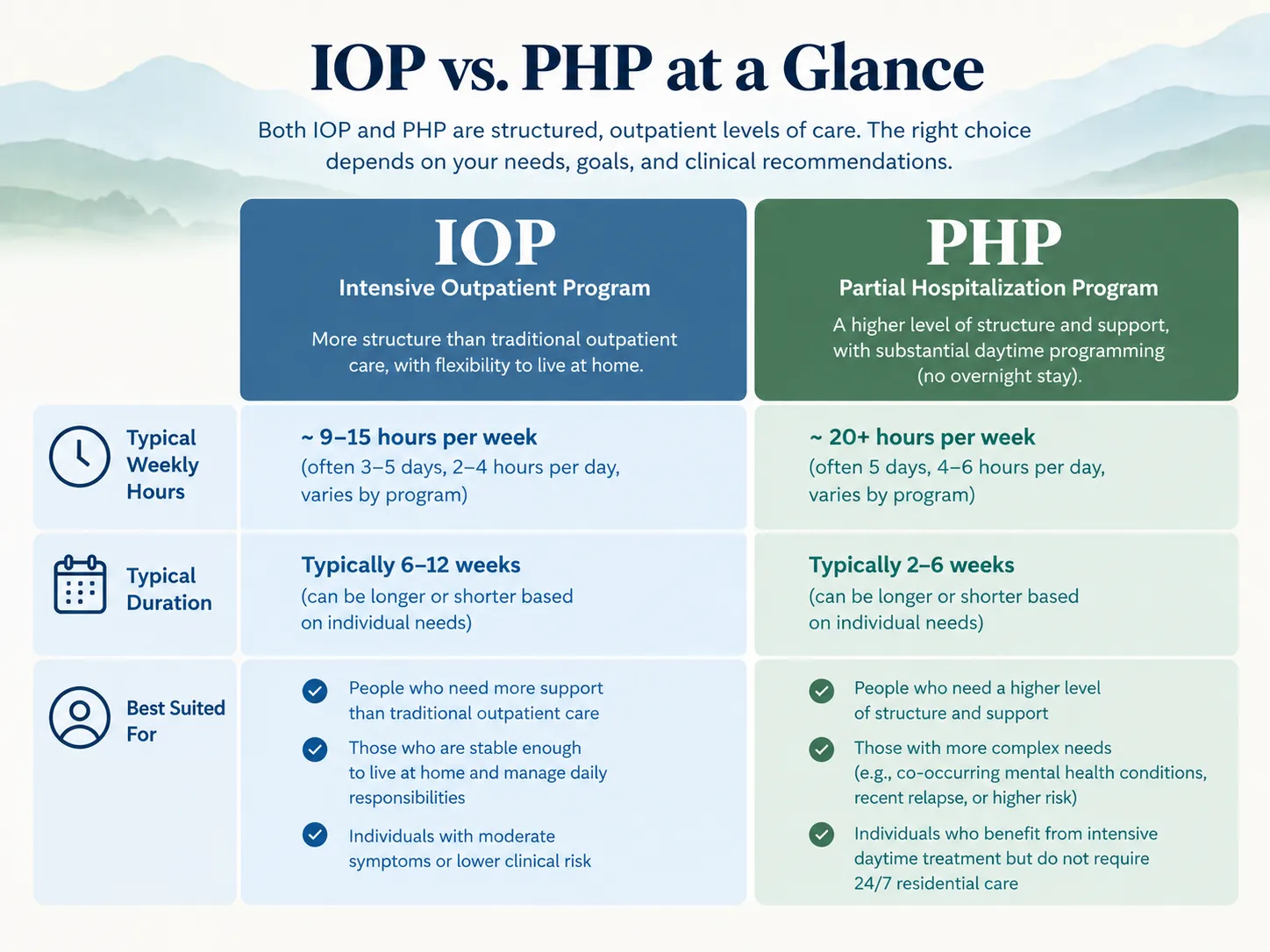
If you’re not sure which one fits, that’s a completely normal place to be, and it’s exactly what the assessment conversation is for. You don’t have to arrive with the answer already worked out.
Can You Work While Attending Outpatient Alcohol Rehab?
This is one of the biggest reasons people delay getting help, so it deserves a real answer, not a vague one.
With IOP, working is usually realistic. Because sessions are often scheduled in the morning or evening, many people keep working a normal job during IOP. It takes some coordination, but it’s genuinely common.
With PHP, full-time work gets harder. Since PHP can take up most of the daytime hours, five days a week, it’s difficult to hold a full-time daytime schedule at the same time. Some people shift to evening or part-time work during PHP, then return to their normal schedule once they step down to IOP.
Here’s what actually protects your job while you sort this out:
- The Family and Medical Leave Act (FMLA) gives eligible employees up to 12 weeks of unpaid, job-protected leave for treatment of a serious health condition, and the U.S. Department of Labor explicitly confirms that substance abuse treatment qualifies when it’s provided by a licensed health care provider. This leave doesn’t have to be taken all at once. You can use it intermittently, in blocks that match your actual treatment schedule, which is exactly how IOP and PHP sessions work.
- Confidentiality is built into the system. Under federal privacy protections for substance use treatment records, your employer doesn’t automatically learn why you’re taking leave. You control what you disclose.
- Talk to HR before treatment starts, not after. A short conversation about needing medical leave, without necessarily naming the reason, gives you time to request FMLA paperwork and avoid scrambling once treatment is already underway.
If you’re worried this question alone is what’s kept you from starting, know that this exact concern is common enough that most treatment programs, including ours, help patients work through it as part of intake.
How Does Alcohol Affect Depression?
Alcohol is a central nervous system depressant, and heavy or prolonged use disrupts the same neurotransmitters, including serotonin and GABA, that regulate mood. That overlap explains why depressive symptoms so often appear alongside heavy drinking rather than as an unrelated, separate problem.
The overlap shows up clearly in the data. Research cited by the National Institute on Alcohol Abuse and Alcoholism finds that among people with major depressive disorder, alcohol use disorder co-occurs in 27% to 40% of cases over a lifetime. Because our dual diagnosis program treats both conditions together, that overlap changes the treatment plan rather than just the diagnosis.
How long does alcohol-induced depression last? According to a clinical review published in NIAAA’s Alcohol Research: Current Reviews, alcohol-induced depressive disorder involves symptoms that appear during or shortly after intoxication or withdrawal and typically remit after three to four weeks of sustained abstinence. If symptoms persist past that window, they’re treated as an independent depressive disorder requiring its own dedicated care.
| Clinical Perspective from Dr Ash Bhatt: Clinically, alcohol-induced depression and major depressive disorder are different by their timing. If low mood started only after heavy drinking began and clears within roughly four weeks of true abstinence, that indicates alcohol-induced pattern. If the symptoms were present before problem drinking started, or they persist well past that four-week window, they usually reflect an independent depressive disorder that needs its own treatment plan alongside alcohol care. |
How Much Does Outpatient Alcohol Rehab Cost?
There’s no single honest number here, because the final out-of-pocket amount most people will pay depends on the level of care, your location, and your insurance coverage. But you shouldn’t have to go in blind, so here’s what the range actually looks like for a standard treatment center.
- IOP at a high-end facility typically costs a well-insured person around $650 per day, or roughly $13,000 to $28,000 for a 6-8 week program.
- PHP generally costs more per day than IOP because of the added hours, often landing in a comparable total range spread over fewer weeks.
- Insurance frequently covers outpatient treatment partially or fully, since it’s classified as a lower level of care than inpatient rehab.
Before you commit to anything, call the number on the back of your insurance card and ask three specific questions or use our treatment and cost calculator:
- Whether outpatient alcohol treatment is covered under your plan,
- What your deductible and copay will be for IOP versus PHP specifically
- Whether you need pre-authorization before starting.
Most treatment centers, including Legacy Healing, will also verify your insurance for you directly if you’d rather not make that call yourself.
Does Outpatient Alcohol Rehab Work?
Yes, and the data backs that up, but the honest answer has a condition attached: it works when the level of care actually matches what you need.
The bigger problem isn’t whether outpatient treatment is effective. It’s that most people never start. Data from the National Survey on Drug Use and Health shows that fewer than 10% of people with past-year alcohol use disorder receive any treatment at all.
Outpatient formats like IOP and PHP exist to lower exactly the barriers that keep people out of care, since neither requires taking weeks away from work or arranging full-time childcare. Effectiveness also depends on honest matching: placing someone with severe, unstable symptoms into IOP when they need PHP or inpatient support sets treatment up to struggle, not because outpatient care doesn’t work, but because it was the wrong level for that person’s risk.
What Happens If Outpatient Rehab Isn’t Enough?
This question comes from a real, understandable fear: starting treatment and then feeling like it isn’t working. Here’s what that actually looks like in practice, and what to do about it.
Watch for these signs that your current level of care might need to change:
- You’re still drinking, or drinking returns after a period of stopping
- Cravings or anxiety feel unmanageable between sessions
- Depression or other symptoms are getting worse, not better
- Your home environment has become less stable or less safe
If you notice any of these, here’s what to actually do:
- Say it out loud to your treatment team at your next session, even if it feels like admitting failure. It isn’t. This is precisely the information they need to adjust your care.
- Ask directly whether stepping up to a more intensive level, like moving from IOP to PHP, makes sense right now.
- Know that this shift is usually fast. Because you’re already in the system with an existing treatment relationship, moving to a higher level of care typically takes days, not weeks.
Needing more support partway through treatment isn’t a sign that you failed or that outpatient care doesn’t work for you. Recovery rarely moves in a straight line, and a program built around regular check-ins exists specifically to catch these shifts early, before they become a full relapse.