


-
 Written By:
Alex Herrera
Written By:
Alex Herrera
-
 Edited By:
Phyllis Rodriguez, PMHNP-BC
Edited By:
Phyllis Rodriguez, PMHNP-BC
-
 Clinically Reviewed By:
Dr. Ash Bhatt, MD, MRO
Clinically Reviewed By:
Dr. Ash Bhatt, MD, MRO
Key Takeaways
- The patient may still have unaddressed feelings of dissatisfaction and the belief that the only effective way was through detox, but the fact is that detox was the first step and the brain is slowly getting back to normal.
- The craving that scares you most is usually the one that passes fastest, because the if you endure the temptation to take the drug, the need for opioid usage gets stronger and quickly decreases after 20 to 30 minutes of waiting.
- Patients often hide cravings out of shame, but we have an approach that encourages the patient not to hide the craving from others as they should confront it. Because that way, the urge to give up is lowered and the risk of relapse is minimized.
If you’re in recovery from opioid use, you already know that finishing detox doesn’t mean the hard part is over. Cravings can show up weeks or even months later, often when you least expect them.
In this article, we’ll break down why opioid cravings happen, how long the craving usually lasts, what triggers them, and scientific evidence that aid in the successful management of these strong cravings.
What Are Opioid Cravings?
Opioid cravings are intense, and people often feel the sudden urge to use opioids again, even after their body no longer physically needs them. They’re different from withdrawal symptoms, which are physical reactions the body shows while it is clearing opioids from its system.
Withdrawal is your body reacting to the absence of a substance. Cravings are your brain’s reward system reacting to a memory of that substance, a distinction that matters because it shapes how each one is treated.
A few things to understand about cravings early on:
- They’re rooted in the brain’s dopamine and reward pathways, not a lack of willpower.
- They can be triggered by emotions, environments, people, or even random sensory cues (a smell, a song, a specific street).
- They can continue well after detox is complete, sometimes for months into recovery.
Why Do Opioid Cravings Happen?
Understanding cravings starts with understanding what opioids actually do to the brain. Opioids flood the brain’s reward circuit with dopamine, and that flood goes far beyond what everyday activities like eating, exercise, or socializing produce. This surge is what creates the euphoric effect people associate with opioid use.
Repeated use trains the brain to expect that flood, and over time, the reward pathway begins to prioritize the drug over nearly everything else. Cravings are not simply “in your head” because they reflect real, measurable changes in brain chemistry and circuitry, and that is part of why the American Psychiatric Association lists craving as one of the diagnostic criteria for opioid use disorder in the DSM-5-TR.
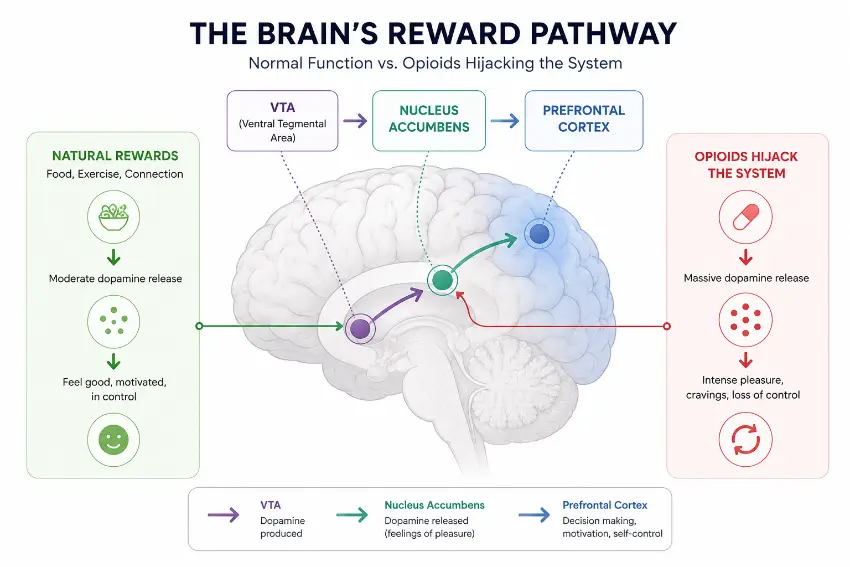
Several distinct forces drive this process, and most people experience some combination of them:
- Dopamine conditioning: The brain learns to associate opioid use with relief or pleasure, and it continues searching for that same payoff long after use has stopped.
- Memory and environmental cues: Places, people, and routines linked to past use can trigger a craving instantly, sometimes years later, because the brain stored those associations alongside the drug’s effects.
- Stress and emotional triggers: Anxiety, grief, anger, and even excitement can activate the same reward pathways that opioids once did, since the brain does not always distinguish between different sources of intense feeling.
- Physical vs. psychological cravings: Physical cravings are tied to residual withdrawal effects still working through the body, while psychological cravings are tied to memory, habit, and emotional need. Most people experience a mix of both, and that is why treatment has to address the body and the mind together.
Clinical Perspective – Dr. Ash Bhatt
I know it’s really frustrating when a craving sneaks up on you completely, with no obvious trigger. What I explain is that the brain doesn’t need a dramatic reason, and sometimes it’s a smell, a familiar street, or even a stressful email. The goal is not to remove the triggering environment entirely, but to develop coping mechanisms when the craving hits, because it’s very hard to really eliminate all sources of triggers.
Why Cravings Often Continue After Detox
Medical detox clears opioids from the body, but it does not reset the brain overnight. The reward pathways reshaped by repeated opioid use take far longer to heal than the physical withdrawal process does, and that is exactly why cravings can persist well past the point where the body feels physically stable.
This delayed healing is largely explained by post-acute withdrawal syndrome, or PAWS. PAWS refers to lingering symptoms, including cravings, that can persist for weeks or months after the acute withdrawal phase ends, and research on opioid-specific PAWS points to symptoms like mood swings, low motivation, and difficulty concentrating that often peak in the first two to three months and can continue for six months to a year in some cases.
A few specific reasons cravings continue beyond detox are worth understanding, because each one calls for a slightly different response:
- Brain chemistry takes months to rebalance. The neural pathways altered by repeated opioid use do not simply switch back once the drug is gone, and instead they gradually recalibrate, with cravings as part of that transition.
- Emotional recovery happens on its own timeline. Processing shame, trauma, or loss connected to addiction is separate work from physical detox, and it often surfaces after the body has already stabilized.
- Leaving a structured setting reintroduces triggers. Treatment environments are designed to limit exposure to the people, places, and stressors tied to past use, and returning to daily life often means facing those triggers again, sometimes for the first time in months.
Common Triggers for Opioid Cravings
Cravings rarely come out of nowhere, even when they feel that way in the moment. Nearly every craving is connected to a trigger, whether or not that trigger is obvious to the person experiencing it at the time. Recognizing your own patterns is one of the most useful things you can do in early recovery, because a person cannot manage what they have not identified.
Triggers generally fall into three categories, and most people find they are more vulnerable to one category than the others.
- Emotional triggers tend to be the hardest to predict because they can build gradually before a craving hits:
- Stress
- Anxiety
- Depression
- Loneliness
- Anger
- Environmental triggers are tied to specific external cues the brain has linked to past use:
- Specific places connected to prior opioid use
- People associated with the addiction
- Drug paraphernalia or visual reminders
- Financial stress, especially when it echoes stress experienced during active use
- Physical triggers often go overlooked, but they matter just as much as emotional or environmental ones:
- Pain, especially untreated or undertreated pain
- Poor sleep
- Fatigue
- Hunger
Identifying which category affects you most is a core part of the relapse prevention planning we build with patients before they leave treatment, since a plan built around a person’s actual triggers works far better than a generic one.
How Long Do Opioid Cravings Last?
Every person’s experience is different and the length of craving can depend on how long the person used opioids, their overall health level, the type of support someone can get etc. That said, recovery progress is mostly a consistent pattern for people
- First few days: Cravings are often mixed in with acute withdrawal symptoms, and that combination makes them feel more intense and harder to separate from physical discomfort.
- First month: Cravings gradually lose their physical aspects and become more about the mind. The causes are mainly different things like stress, feeling bored, or certain situations instead of the need for a bodily function, a bodily function.
- First six months: This is a period of PAWS-associated cravings, and they are usually experienced as coming in waves rather than being present all the time, which is often frustrating when the person thought the situation would have got a steady improvement.
- Long-term recovery: Generally, cravings occur less frequently and take less time to reach their peak, although sometimes a stressful environment or even a high-stress event might trigger them, even after many years.
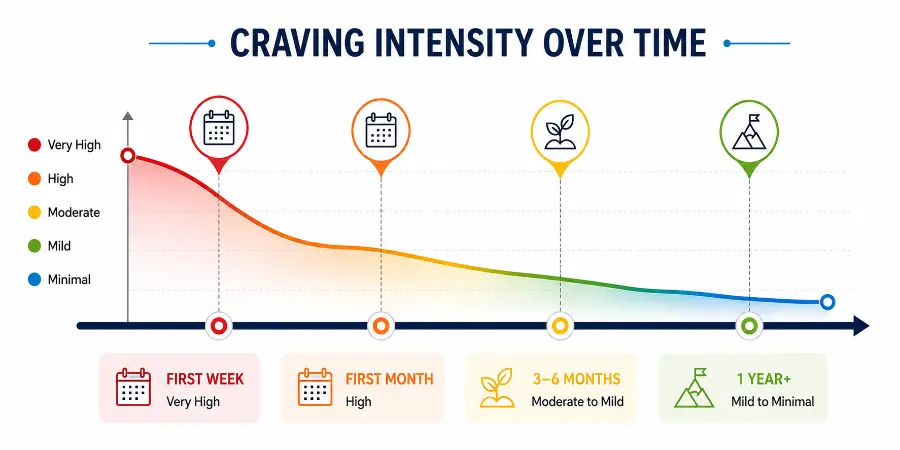
Cravings decrease over time because the brain’s reward system gradually recalibrates as it goes without opioids, and the brain actually relearns the ability to find a reward once again even from such mundane life pleasures.
How to Manage Opioid Cravings
Managing cravings is not about willpower alone, and it is not something a person should have to figure out through trial and error while they are in the middle of one. It comes down to building a toolkit of evidence-based strategies a person can lean on before a craving takes hold, so they already know what to do when one shows up.
- Lifestyle habits build a person’s baseline resilience. These are not quick fixes, but they change how vulnerable someone is to cravings day to day:
- Regular exercise supports natural dopamine regulation, and it has been shown to reduce craving intensity over time.
- Consistent, quality sleep matters because sleep deprivation is one of the most common physical triggers for cravings.
- Balanced nutrition helps stabilize blood sugar and mood, and both of those factors influence craving frequency.
- Staying hydrated is a simple factor that is easy to overlook, but it affects energy and irritability.
- Therapy-based approaches address the root causes behind cravings, not just the symptom itself:
- Cognitive Behavioral Therapy (CBT) helps a person identify the specific thoughts that precede a craving and reframe them before they escalate.
- Dialectical Behavior Therapy (DBT) focuses on emotional regulation, and it is particularly useful for cravings triggered by intense feelings like anger or shame.
- Individual counseling gives a person space to work through personal triggers, like trauma or grief, that group settings may not fully address.
- Group therapy offers peer accountability, and it exposes people to coping strategies that have worked for others in similar situations.
- Recovery support keeps a person connected outside of formal treatment, and that matters because most cravings happen in everyday life, not in a clinical setting:
- Peer support groups provide a community of people who understand cravings firsthand and will not judge someone for having them.
- Sponsors offer a direct, personal line of support a person can reach out to the moment a craving hits.
- Family involvement helps loved ones understand what a person is going through, so they can offer support instead of unintentionally becoming a trigger themselves.
- In-the-moment coping skills matter most while a craving is actively happening, since this is when a person needs something they can use immediately, not something to research:
- Urge surfing means observing the craving without acting on it, letting it rise and fall like a wave instead of fighting it directly.
- Mindfulness practices pull a person’s attention back to the present moment instead of the craving itself.
- Breathing exercises can physically interrupt the stress response that often accompanies a craving.
- Journaling gives a person a way to process the craving afterward and spot patterns over time.
- Calling a support person immediately is often the single most effective step a person can take in the moment.
Clinical Perspective – Dr. Ash Bhatt
I always tell patients that a craving is not a decision, but merely a sensory reaction, and the moment they can separate the feeling from the action, they gain control. The method of urge surfing has proved to be a really effective tool to show the brain that a craving is not something that you must do to get rid of it eventually, and most of the patients feel that it is the case once they give up fighting it and just let it happen.
Can Medication Help Reduce Opioid Cravings?
For many people, medication-assisted treatment plays an important role in reducing the intensity and frequency of cravings. This effect is usually the greatest when people are just starting out in the recovery process, and they often have the most powerful and constant cravings. According to NIDA, FDA-approved medications for opioid use disorder can help reduce cravings without producing the euphoric effects associated with opioid misuse.
Three medications are commonly used, and each one works through a different mechanism:
- Buprenorphine partially activates opioid receptors, and that eases cravings and withdrawal symptoms without producing the full opioid effect that leads to misuse.
- Methadone might be a better option for them if someone has been using opioids for a long time, since it is a slow-acting opioid analgesic that maintains steady opioid receptor occupancy throughout the day, which can help stabilize the person.
- Naltrexone completely stops the effects of the opioid receptors by blocking their activation So even if an person uses the drug, its effects won’t be perceived, and that takes the temptation of relapse out of the equation.
The different ways these drugs work are the reason why there is no one-size-fits-all drug solution, and the best choice should come down to factors like individual’s background, health issues, and the goal of the treatment. In such a decision-making process, it is a must that a person consults their physician since the right amount, frequency, and duration and the necessary follow-ups differ drastically from one person to another and require continuous medical attention.
When Do Cravings Become a Relapse Risk?
Not every single craving will lead someone to relapse and certain situations or combinations of factors may greatly increase one’s risks for relapsing. Getting to the bottom of these risk-indicators early could actually prevent things from getting very bad. According to NIDA, relapse rates for substance use disorders run roughly 40 to 60 percent, and that rate is comparable to other chronic illnesses like hypertension and asthma.
Be mindful of these symptoms because these kinds of warning signals are most likely to appear in a series rather than on isolation basis:
- A person’s craving increases in number or intensity over just a little time.
- An individual starts to lose contact with friends, isolate, or at least the networks of supportive individuals he or she has made during the treatment sessions.
- Therapy sessions or support meetings are occasionally skipped.
- Past drug use gets romanticized, or remembered more positively than it actually was.
- A person reconnects with people tied to previous use, even if the contact feels harmless at first.
- Medication or treatment gets stopped without medical guidance.
Early intervention at this stage is far more effective than waiting until a craving turns into actual use, because it is much easier to adjust a treatment plan than to recover from a relapse.
When Should You Seek Professional Help?
Some cravings are manageable with the coping tools outlined above. Others are a sign that a person needs additional support, and knowing the difference matters. Consider reaching out for professional help if you notice:
- Cravings become more frequent or intense over time, rather than gradually easing.
- A near-relapse situation occurs, where a person came close to using but stopped themselves.
- Multiple relapse episodes happen, which often signal that the current plan needs adjustment.
- Co-occurring mental health symptoms, like depression or anxiety, intensify alongside the cravings.
- Triggers become difficult to manage independently, even with coping strategies already in use.
Reaching out at this point is not a setback, and it does not mean recovery has failed. It is the same kind of proactive step a person would take with any chronic health condition that flares up unexpectedly.
How Legacy Healing Can Help
If cravings are becoming harder to manage on your own, we at Legacy Healing offer a full continuum of care built around long-term recovery, not just detox. Our approach is designed to support you through every stage, from the first days after stopping opioid use through the months when cravings are most likely to resurface.
- We provide medical detox and drug detox for safe, medically supervised withdrawal, and that ensures the physical side of recovery is handled with proper oversight from the start.
- Our residential rehab program offers structured, immersive treatment in an environment designed to limit exposure to everyday triggers while a person builds their coping toolkit.
- We offer medication-assisted treatment when clinically appropriate, and it is always guided by ongoing medical supervision.
- Our individual therapy sessions are tailored to a person’s specific triggers, history, and emotional needs, rather than following a one-size-fits-all approach.
- We build relapse prevention plans with patients before they ever leave treatment, so they walk out with a concrete strategy rather than starting from scratch.
- Our alumni network keeps people connected to a recovery community long after formal treatment ends, and that matters since isolation is one of the biggest relapse risks.
- We provide ongoing aftercare programming for continued, long-term support as cravings evolve over time.
Recovery Doesn’t End at Detox
Cravings are a normal, expected part of opioid recovery, and they are not a sign that something has gone wrong. They tend to lessen in intensity and frequency over time, especially with the right combination of therapy, support, and, when appropriate, medication.
If cravings are becoming difficult to manage on your own, personalized treatment can make a meaningful difference. Contact Legacy Healing today to talk through a treatment plan built around your specific recovery needs.