



-
 Written By:
Alex Herrera
Written By:
Alex Herrera
-
 Edited By:
Phyllis Rodriguez, PMHNP-BC
Edited By:
Phyllis Rodriguez, PMHNP-BC
-
 Clinically Reviewed By:
Dr. Ash Bhatt, MD, MRO
Clinically Reviewed By:
Dr. Ash Bhatt, MD, MRO
In most high-performing professional environments, alcohol is a part of the culture. Client dinners, deal closings, networking receptions. The glass in hand is indistinguishable from a professional tool. For executives, attorneys, physicians, and others managing demanding careers, alcohol use for executives is woven so tightly into professional life that the question of how much is too much becomes genuinely difficult to answer with honesty.
That difficulty is precisely the problem. When professional drinking habits feel like a normal feature of a high-pressure career, the line between functional and dependent can move quietly and without announcement. This guide is for professionals who are willing to look at that line directly, and for those who suspect it may already have been crossed.
Key Takeaways1. Safe alcohol limits are defined by evidence. The NIAAA guidelines, 14 drinks/week for men, 7 for women, are the clinical threshold below which risk is low. Most professional drinking habits in high-pressure careers regularly exceed them. 2. High-functioning alcohol use is a serious clinical presentation. A hidden alcohol problem that maintains professional function is not a mild problem. It is often a more advanced one, concealed by the same structural resources that delayed its recognition. 3. Private rehab for executives delivers clinical excellence and absolute discretion. Professional alcohol recovery does not require choosing between getting help and protecting your career. Our confidential programs are built for professionals whose lives require both. |
Professional Drinking Habits: What’s Normal?
Understanding what constitutes normal professional drinking habits requires separating two things that are often conflated: what is common and what is clinically safe. In professional environments, heavy drinking is common. That does not make it normal in the clinical sense, and it certainly does not make it harmless.
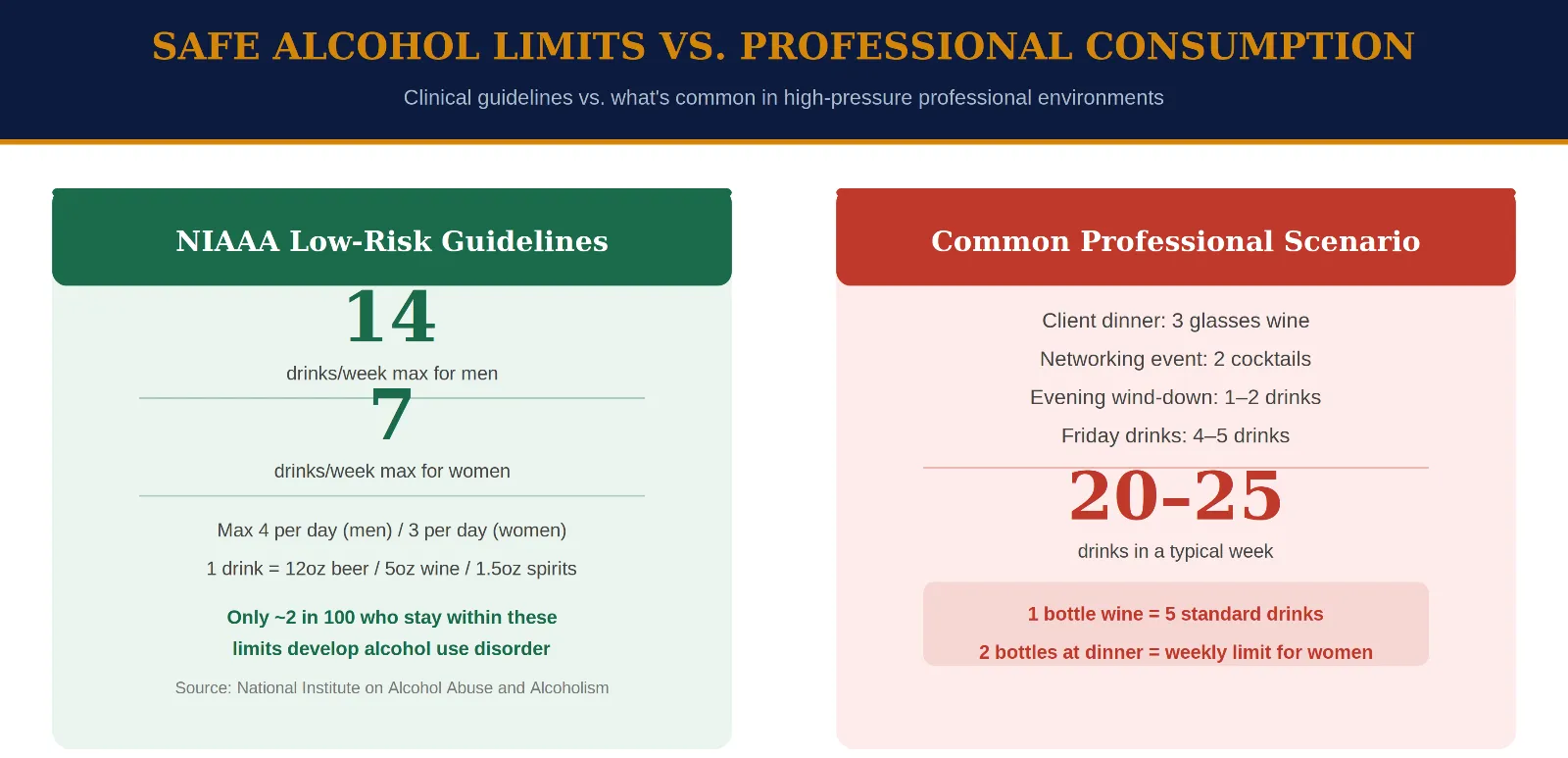
What professionals rarely account for is the cumulative weekly total, the frequency of drinking days, and the degree to which alcohol tolerance signs have changed the subjective experience of consumption. When three drinks feel like one used to, the math of what constitutes a ‘normal’ evening has already changed in a clinically meaningful way.
Safe Alcohol Limits for Professionals
Safe alcohol limits are defined by clinical evidence, not professional capacity. The National Institute on Alcohol Abuse and Alcoholism (NIAAA) defines low-risk drinking as no more than 14 standard drinks per week for men and 7 for women, with no more than 4 on any single day for men and 3 for women. Research shows that only around 2 in 100 people who stay within these limits develop alcohol use disorder. For those who regularly exceed them, risk rises sharply.
What clinical guidelines actually define as ‘moderate’ drinking:For men: no more than 14 standard drinks per week, with no more than 4 on any single day For women: no more than 7 standard drinks per week, with no more than 3 on any single day One standard drink = 14g of pure alcohol: 12oz regular beer (5%), 5oz wine (12%), or 1.5oz spirits (40%) These are upper limits for low-risk drinking, not targets or recommendations Source: National Institute on Alcohol Abuse and Alcoholism (NIAAA) |
Executive alcohol use frequently crosses these thresholds without any single occasion feeling excessive. What matters is the cumulative weekly total, and whether alcohol tolerance signs have changed how those amounts feel. When three drinks feel like one used to, the neurobiological adaptation is already underway.
Hidden Signs of Alcohol Dependence in Professionals
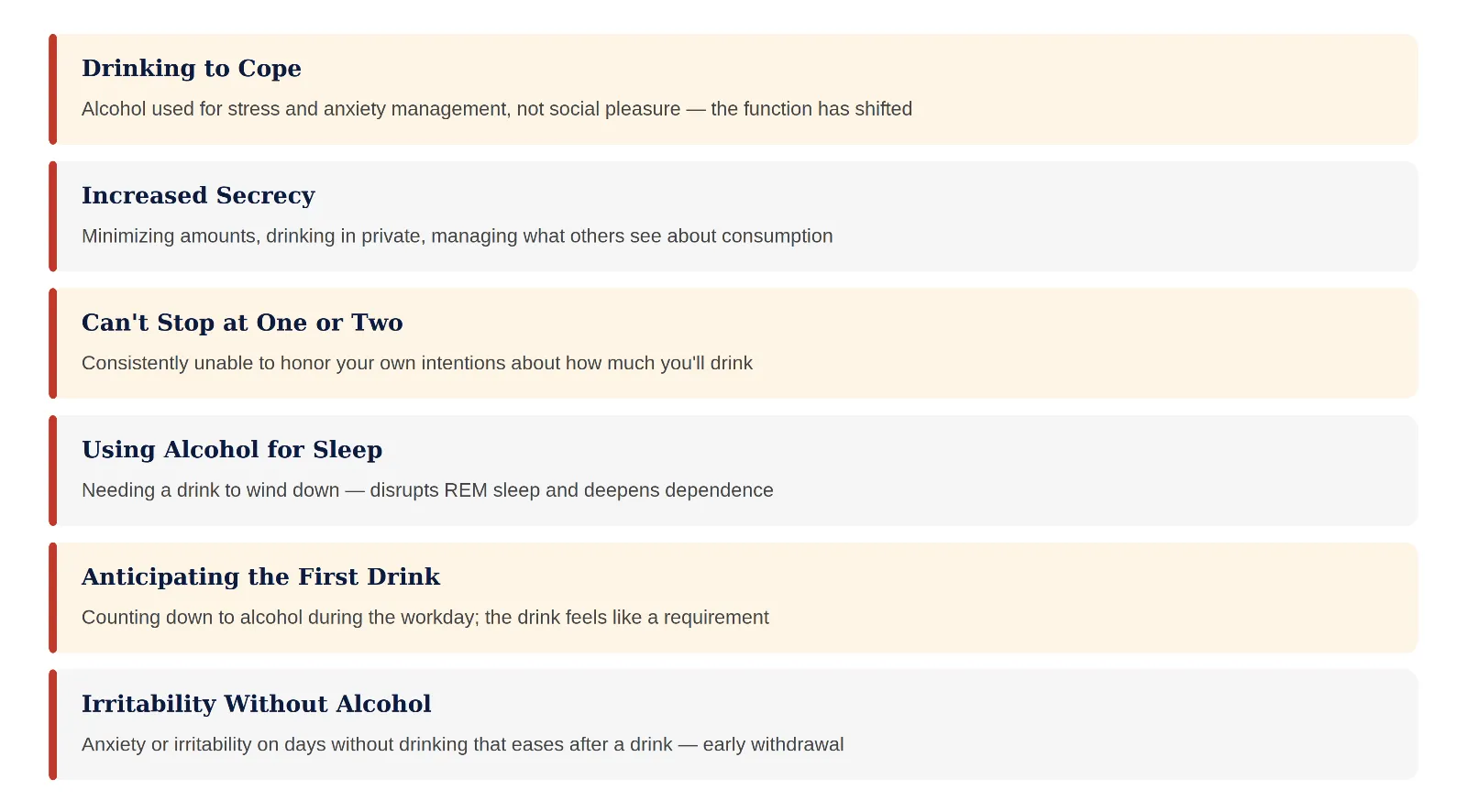
High-functioning alcohol use is defined by its invisibility. Unlike more recognizable presentations of dependence, a hidden alcohol problem in professional life is almost by definition one that the person has become expert at managing and minimizing, from themselves as much as from others. The following signs are what clinicians look for when the surface presentation is one of function.
Alcohol’s Impact on Performance and Health
Alcohol effects on professionals accumulate in ways that undermine the specific capacities that define performance at the highest levels, often long before the dependence becomes visible.
- Cognitive performance: Regular alcohol use impairs working memory, processing speed, and executive function, the precise tools that distinguish high-performance thinking. Research links measurable cognitive decline to consumption levels that most professionals consider unremarkable.
- Sleep and recovery: Alcohol suppresses REM sleep, producing lighter and less restorative rest even after a full night. Professionals who ‘need a drink to wind down’ are not sleeping better, they are accumulating a sleep deficit that the next evening’s drink attempts to address again.
- Emotional regulation: Alcohol worsens baseline anxiety over time as the brain recalibrates upward to compensate for regular chemical suppression. Alcohol and performance have a well-documented inverse relationship: stress drinking professionals feel temporary relief while the underlying anxiety deepens, and the dependence on relief deepens with it.
- Physical health: Elevated cardiovascular risk, immune suppression, liver disease, and increased cancer risk, even at moderate consumption levels, accumulate alongside the professional drinking habits that normalize them.
Why Executives Are at Higher Risk
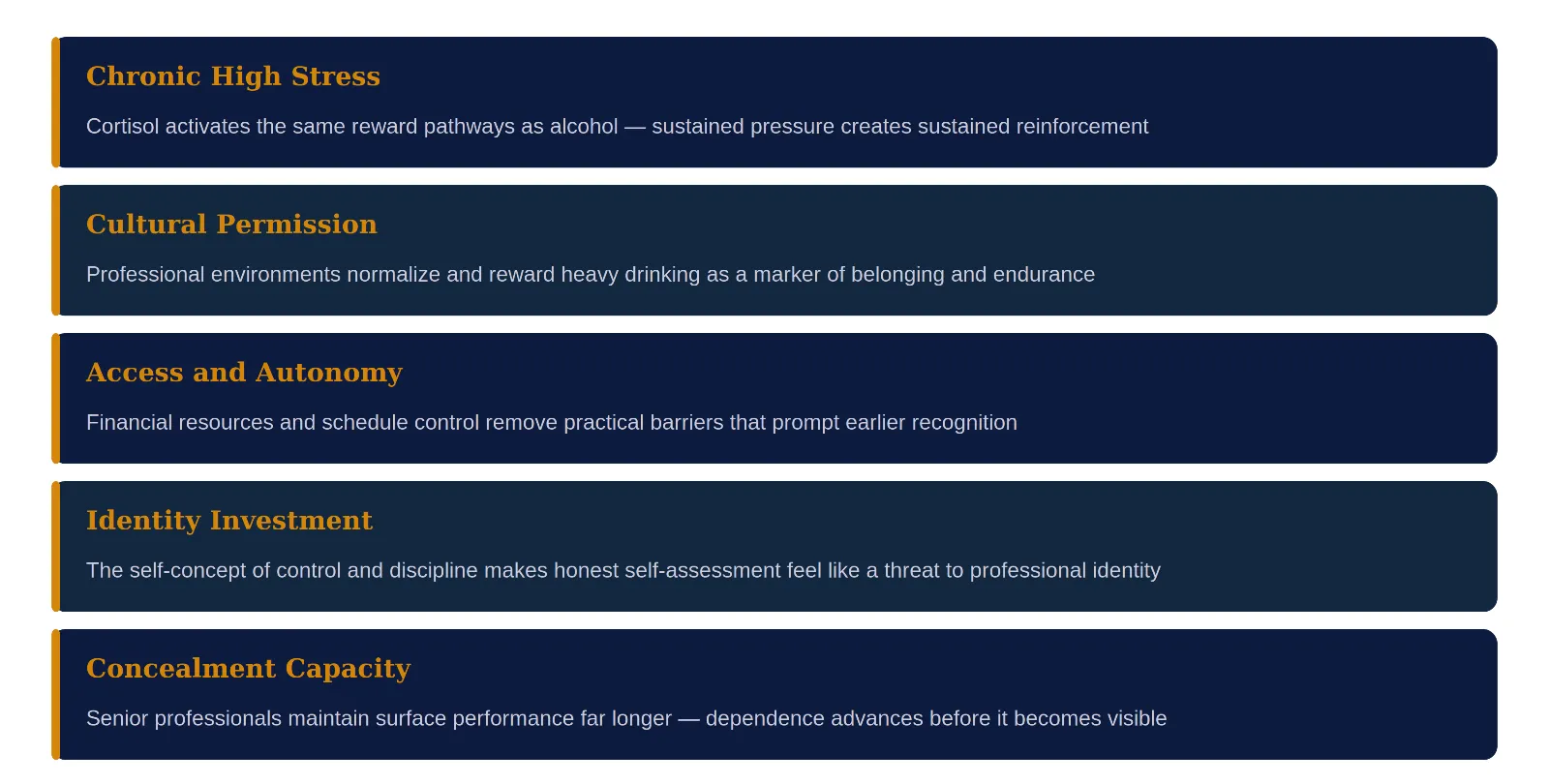
Stress drinking professionals are not simply people under pressure who have made poor choices. They are individuals in environments where multiple, compounding risk factors converge in ways that make alcohol dependence significantly more likely than it would be in less demanding professional contexts.
Self-Assessment Questions for Professionals
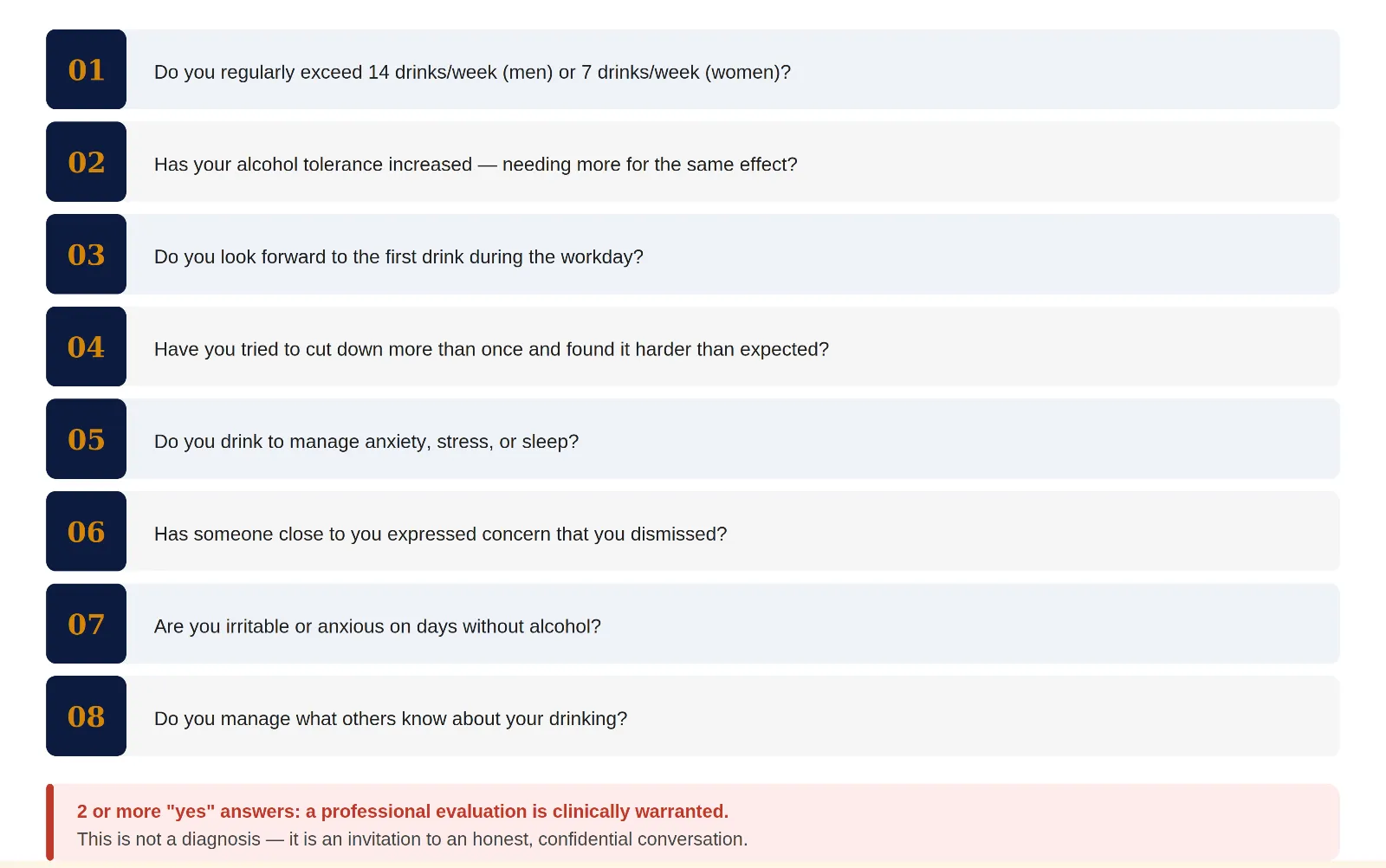
The following alcohol self-assessment is a structured invitation to honesty, the kind of executive alcohol check that allows a genuine evaluation of where your relationship with alcohol actually stands, as opposed to where you would prefer it to be. Answer each question honestly. Notice which ones produce immediate defensiveness.
Regaining Control Without Disrupting Your Career
For most professionals, the fear of treatment is about exposure. The concern that seeking help will compromise professional standing, generate questions that cannot be answered discreetly, or define them in ways that contradict the identity they have spent years building. That fear is understandable, and with the right alcohol treatment program, it is addressable.
Mindful drinking executives use as a first step, deliberately tracking actual consumption against clinical guidelines, works when awareness itself is enough to motivate change. Where it consistently fails, where intentions are repeatedly not honored, that failure is itself clinically significant. It signals that the relationship with alcohol has moved beyond habit into dependence, and that voluntary management alone is unlikely to be sufficient.
We offer a full continuum of care, from outpatient and intensive outpatient programs (IOP) structured around professional schedules, to partial hospitalization (PHP) and full residential luxury rehab alcohol support, all delivered within an environment of absolute discretion. The level of care is matched to the clinical reality, not to the most or least disruptive option.
Regaining Control Without Disrupting Your Career
Private rehab for executives becomes the appropriate clinical recommendation when voluntary management has failed, when physical dependence has developed, or when the personal and professional costs of continued drinking are no longer sustainable.
Signs That Professional Support Is Needed
- Repeated unsuccessful attempts to cut down or stop on your own
- Physical symptoms when not drinking, tremors, sweating, rapid heart rate, or anxiety that eases with a drink
- Drinking that is affecting professional performance or key relationships in ways no longer manageable
- Co-occurring depression, anxiety, or PTSD that alcohol is managing, or making worse
- Polysubstance use that complicates the clinical picture
What Luxury Alcohol Treatment Provides
- Medical detox. For those with physical dependence, physician-supervised withdrawal management is the essential first step, eliminating the medical risks of abrupt cessation.
- Individualized residential treatment. Luxury alcohol treatment built around your clinical picture, professional context, and recovery goals, not a standard program applied uniformly.
- Evidence-based therapy. CBT, motivational enhancement, trauma-focused modalities, and executive-specific programming addressing the stress architecture and performance culture that shape professional alcohol use.
- Dual diagnosis care. Treating co-occurring anxiety, depression, or PTSD alongside alcohol dependence, because addressing one without the other produces incomplete outcomes.
- Absolute confidentiality. Private facilities, protected clinical communications, and full professional and legal guidance for those with licensing concerns.
⚠ Seek immediate support if:You are experiencing tremors, sweating, or rapid heart rate without alcohol, these are signs of physical dependence requiring medical supervision. You are drinking in situations where impairment creates serious professional or safety risk. Thoughts of self-harm are present, alcohol significantly elevates this risk. Our clinical team is available 24/7 for confidential consultation: 732-402-0352 |
Conclusion: Balance, Performance, and Well-Being
Professional alcohol recovery is not the end of a career or a social identity. For the executives, physicians, and professionals who have worked with us, it has often been the beginning of their most productive and most present years, professionally and personally.
The cognitive sharpness, sleep quality, emotional availability, and genuine presence that characterize high performance at its best are impaired by the level of executive alcohol use that many professionals have come to consider normal.
The question this article started with, how much is too much?, has a clinical answer. But the more important question is personal: is your relationship with alcohol serving the life and career you are building? That question deserves an honest answer. We are here for the conversation that follows it.