



-
 Written By:
Christina Holmes
Written By:
Christina Holmes -
 Edited By:
Phyllis Rodriguez, PMHNP-BC
Edited By:
Phyllis Rodriguez, PMHNP-BC
-
 Clinically Reviewed By:
Dr. Ash Bhatt, MD, MRO
Clinically Reviewed By:
Dr. Ash Bhatt, MD, MRO
Key Takeaways
- A partial hospitalization program (PHP) is a non-residential level of care with several hours of treatment a day, including group therapy, individual therapy, psychiatric support and medication management. Clients go home or to supportive housing each evening.
- PHP placement follows a clinical assessment. Medicare’s PHP criteria call for at least 20 hours of therapeutic services per week, no need for 24-hour inpatient care, and an adequate support system outside the program.
- Length varies by program and progress. Legacy Healing Center NJ’s typical course is 30 to 45 days, and reassessment decides when to step down to less intensive care, usually IOP first.
A partial hospitalization program (PHP) is a structured level of addiction and mental health treatment in which a person attends several hours of therapy each day and returns home or to supportive housing at night. Treatment combines group and individual therapy, skills-based education, psychiatric support, medication management when appropriate and ongoing assessment.
This article explains what happens in a partial hospitalization program from start to finish. It covers the initial assessment, a typical treatment day, what happens outside program hours, how long PHP treatment lasts and how step-down planning works.
What Happens When You First Start PHP?
PHP begins with a clinical assessment. The treatment team collects information on:
- substance use history and current use
- mental health symptoms and past diagnoses
- medical history and current medications
- previous treatment and its results
- current functioning at home, work or school
- safety, including any thoughts of self-harm
- living situation and recovery goals
After the assessment, the team determines the appropriate level of care. Wanting more treatment does not automatically qualify a person for PHP. Clinicians evaluate whether the person needs this degree of structure and whether they can stay safe outside the program.
Two frameworks guide this decision. The Medicare Benefit Policy Manual describes PHP patients as people who need at least 20 hours of therapeutic services per week, do not require 24-hour inpatient supervision and have an adequate support system outside the program. For addiction treatment, the ASAM Criteria match patients to a level of care through a multidimensional assessment, so no single diagnosis determines placement.
Clinical Insight from Dr. Ash Bhatt: During the safety review, I ask whether you could face a dangerous withdrawal tonight, whether you are having thoughts of ending your life and whether your home is free of alcohol and drugs. If the answer to any of these is yes, detox, residential or emergency care may need to come before PHP, because safety determines the right starting point.
What Does a Typical Day in PHP Look Like?
Schedules vary by program. Medicare describes psychiatric PHP as usually involving four to eight hours of care per day. At Legacy Healing Center’s Parsippany location, programming runs Monday through Saturday from 9:00 a.m. to 3:30 p.m.
1. Arriving and Checking In
Each day begins with a clinical check-in. A staff member asks about mood, sleep, cravings and any events since the previous session. Medication concerns and withdrawal symptoms are raised at this point, and each client sets a goal for the day, such as participating in group.
2. Group Therapy
Group therapy is the core of PHP therapy. At Legacy’s NJ program, groups typically include 10 to 12 clients, which allows every participant to contribute. Groups may address:
- triggers and cravings
- relapse prevention
- emotional regulation
- trauma
- communication and relationships
- accountability and daily coping strategies
Hearing another client describe a similar trigger often makes it easier to discuss your own.
3. Psychoeducation and Skills Work
Psychoeducation and skills work serve different purposes. Psychoeducation explains what is happening, such as how cravings develop and why anxiety or low mood can drive substance use. Skills work teaches what to do in response.
Sessions draw on CBT and DBT strategies, including distress tolerance, emotional regulation and written relapse prevention planning. Clients practice these skills during the day so they can use them in the evening.
4. Individual Therapy
PHP includes private sessions because group work cannot address every issue. At Legacy’s NJ program, clients typically meet with a therapist once a week. These sessions suit topics that are difficult to raise in a group:
- trauma
- shame and guilt
- family conflict
- depression and anxiety
- the pattern behind substance use
- personal treatment goals
5. Psychiatric Care and Medication Management
Psychiatric care in PHP does not require a daily psychiatrist appointment. The frequency depends on diagnosis, symptoms and medication needs. It may include:
- a psychiatric assessment
- medication review and adjustment when clinically appropriate
- symptom monitoring between appointments
- coordination between the prescriber and the therapist
- treatment of co-occurring conditions
Medication-assisted treatment is also available when it is clinically appropriate.
Clinical Insight from Dr. Ash Bhatt: Because PHP allows me to see patients almost daily, I can identify medication side effects such as sedation, restlessness or sleep changes within days. Please tell your team about everything you take, including over-the-counter products, supplements and any medication not prescribed to you, so adjustments are made safely.
6. Breaks, Meals and Transitions
A schedule from 9:00 a.m. to 3:30 p.m. does not mean six uninterrupted hours of therapy. Programs generally include breaks and a midday meal, and admissions staff can explain how a specific program arranges them.
What Happens Outside PHP Hours?
The main clinical difference between PHP and residential care is the environment a person returns to each evening. Cravings, family stress and old routines are present at home, so the evening is part of treatment. Medicare’s PHP criteria reflect this by requiring an adequate support system outside the program.
Outside program hours, clients are expected to:
- use coping skills when a trigger appears
- take medication on schedule
- keep a regular sleep routine
- set boundaries with family and friends
- avoid high-risk places and people
- arrange transportation for the next morning
- contact the treatment team when something feels wrong
Legacy does not provide transportation to the Parsippany program, so clients should arrange it before the first day.
What Are You Actually Working On During PHP?
PHP treatment is organized around four goals that overlap throughout the program.
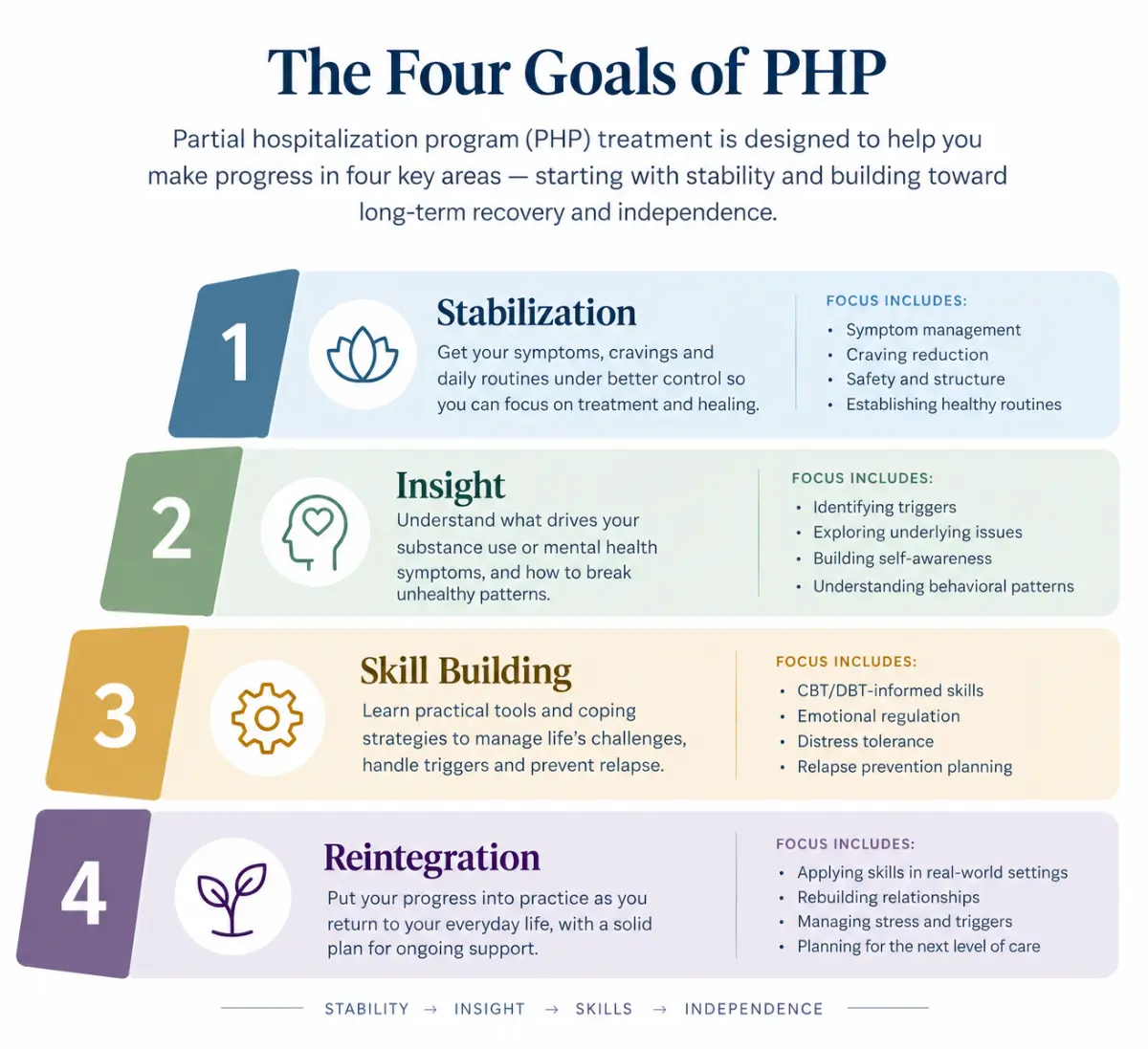
- Stabilization brings cravings, symptoms, sleep and immediate risks under better control.
- Insight identifies what drives substance use or mental health symptoms.
- Skill building teaches what to do when triggers, anxiety, low mood or strong emotions appear.
- Reintegration applies those skills while the person gradually returns to normal responsibilities.
What Is PHP Mental Health Treatment, and How Does PHP Rehab Treat Both?
PHP treats mental health conditions on their own and addiction on its own, which is why people search for both “PHP rehab” and “what is PHP mental health.” For substance use, treatment targets cravings, triggers, relapse prevention and recovery routines. For mental health, it targets anxiety, depression, trauma, mood symptoms and psychiatric medication.
The two conditions often occur together. SAMHSA’s 2024 survey found that 21.2 million U.S. adults had both a mental illness and a substance use disorder, and only 14.5% of them received treatment for both. Treating only the substance use can leave depression or trauma untreated, and the reverse is also true. Legacy’s dual diagnosis program coordinates therapists and psychiatric providers around both conditions.
How Long Is PHP Treatment?
There is no universal PHP timeline. Length depends on:
- daily hours and treatment days per week, which vary by program
- diagnosis and severity
- progress and response to treatment
- insurance authorization
- whether a safe step-down plan is ready
At Legacy Healing Center NJ, a typical course lasts approximately 30 to 45 days. Length is individualized based on clinical needs, progress and insurance authorization, and you can verify your benefits to see what your plan authorizes.
How Do Clinicians Know You Are Ready for Less Intensive Care?
Step-down decisions rest on reassessment. ASAM guidance states that patients should be reassessed regularly to decide whether they remain at the current level, move to a less intensive level or need more support.
Signs that support step-down include fewer acute symptoms, consistent use of coping skills, greater confidence managing triggers and a stable home environment. The usual path runs from PHP to intensive outpatient, then outpatient care and ongoing aftercare. Discharge planning begins early in treatment so that the person leaves PHP with a realistic next level of support.
PHP vs. IOP vs. Residential: Where Does PHP Fit?
| Residential | PHP | IOP | |
| Overnight Stay | Yes | No | No |
| Treatment Intensity | Very high | High | Moderate |
| Daytime Structure | Full | Full or near-full | Part-day |
| Living Arrangement | Facility | Home or sober living | Home or sober living |
| Independence | Lower | Moderate | Higher |
| Typical Role | Stabilization | Intensive day treatment | Step-down and ongoing care |
Who May Be a Good Fit for PHP?
PHP may be considered when a person:
- needs more structure than weekly outpatient therapy
- needs more support than IOP currently provides
- has completed detox or residential care and needs a step-down
- has a significant relapse risk
- has co-occurring mental health concerns
- can stay safe outside the program in a supportive living environment
PHP is not appropriate for everyone. A person who needs 24-hour medical monitoring, acute withdrawal management or emergency psychiatric care may need a higher level of care first.
Can You Work While Attending PHP?
Working full-time is difficult because the Parsippany schedule runs from 9:00 a.m. to 3:30 p.m., Monday through Saturday. Some clients use FMLA, paid leave or reduced hours, and school and childcare require similar planning. IOP may be more compatible when a person needs scheduling flexibility and is clinically stable.