


-
 Written By:
Christina Holmes
Written By:
Christina Holmes -
 Edited By:
Phyllis Rodriguez, PMHNP-BC
Edited By:
Phyllis Rodriguez, PMHNP-BC -
 Clinically Reviewed By:
Dr. Ash Bhatt, MD, MRO
Clinically Reviewed By:
Dr. Ash Bhatt, MD, MRO
Xanax Risks: The 5 Most Dangerous Things to Mix With Alprazolam
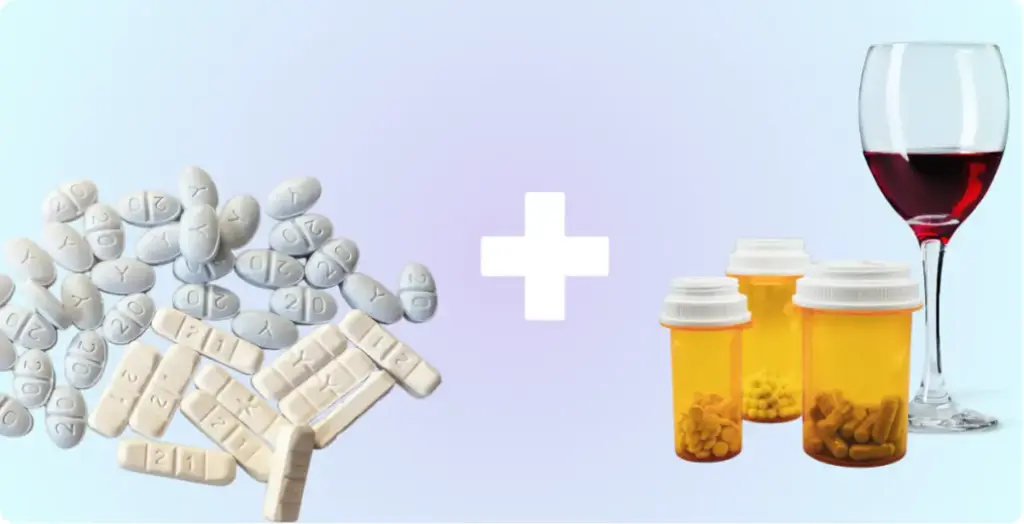
A Xanax prescription can look ordinary. So can a glass of wine with dinner. A hydrocodone tablet after dental surgery. An oxycodone prescription after an injury. An Ambien taken because sleep will not come.
The danger often appears not in any one of those substances, but in what happens when they overlap.
Xanax, the brand name for alprazolam, is a benzodiazepine that slows activity in the central nervous system. That is part of what makes it effective for anxiety and panic. It is also why combining Xanax with other substances that cause sedation can turn ordinary drowsiness into profound impairment, loss of consciousness or, in the most dangerous combinations, respiratory depression and death.
The FDA requires benzodiazepines to carry its most prominent safety warning for risks that include abuse, misuse, addiction, physical dependence and potentially life-threatening withdrawal. The agency specifically warns that combining benzodiazepines with opioids or other central nervous system depressants can cause profound sedation, respiratory depression, coma and death.
For someone taking Xanax regularly, or a family member trying to understand what they are seeing, the more important question is not simply, “Is Xanax dangerous?”
The most important question remains unanswered.
What Happens If I Mix Xanax with Other Substances?
The following five combinations deserve particular attention. They are not presented as a universal mathematical ranking, individual risk changes with dose, tolerance, health conditions, timing and whether the pills actually came from a licensed pharmacy, but each can create a potentially dangerous form of polysubstance exposure.
1. Alcohol and Xanax: Two Depressants, One Dangerous Direction
Mixing Xanax and alcohol is one of the most familiar drug warnings and one of the easiest to underestimate.
A person may think, I only took my prescribed Xanax. I only had two drinks.
The nervous system does not evaluate those decisions separately. Xanax enhances signaling through GABA-A receptors, helping quiet excitatory brain activity. Alcohol also affects GABA-related signaling while influencing other systems in the brain. When combined, the effects on sedation, judgment, coordination and vital brain functions can become greater than either substance produces alone.
The National Institute on Alcohol Abuse and Alcoholism notes that alcohol is involved in roughly one in five overdose deaths involving benzodiazepines and describes alcohol-benzodiazepine effects as additive and potentially synergistic.
That matters because intoxication is only part of the danger.
Someone mixing alcohol and Xanax may experience:
- profound drowsiness or unexpectedly lose consciousness;
- slowed reactions, impaired coordination and a dramatically increased risk of falls, crashes or other injuries;
- memory gaps or complete blackouts during which behavior may continue even though memories are no longer being reliably formed;
- vomiting while heavily sedated, creating an aspiration risk; or
- dangerously impaired breathing, particularly when another depressant such as an opioid is also involved.
Research reviewing driving-related neurocognitive performance has found significant impairment when alcohol and benzodiazepines are combined, including interactions at alcohol concentrations below the U.S. legal driving limit.
There is another problem people frequently miss: timing does not create a reliable safety barrier. Alcohol and medication do not have to be swallowed simultaneously to interact. Xanax can remain active after the obvious calming sensation has faded, and NIAAA specifically warns that alcohol and medications can interact harmfully even when they are not taken at exactly the same time.
If drinking and Xanax use have become routinely connected, Xanax before social events, alcohol to amplify the calming effect, or one substance to counter the aftereffects of the other, that pattern deserves more attention than simply calculating the number of drinks. It may be signaling a developing dependence or substance-use problem.
2. Oxycodone and Xanax: Where Sedation Becomes a Breathing Emergency
If there is one category of medication that changes the Xanax risk equation immediately, it is an opioid. Oxycodone is found in medications including OxyContin, Roxicodone and combination products such as Percocet. It relieves pain through opioid receptors, but those same pathways influence the brainstem systems responsible for breathing.
Xanax suppresses central nervous system activity through a different mechanism. Put the two together, and the concern is not simply that the person will become “extra tired.” The concern is that the brain may become less responsive to the physiological signals that normally keep breathing going.
That is why opioid-benzodiazepine combinations carry an FDA boxed warning. Modern data continue to support the warning. A 2025 retrospective study of more than 182,000 adults with overlapping opioid and benzodiazepine prescriptions found overdose risk varied with prescribing trajectories and increased when opioid or benzodiazepine exposure changed substantially rather than remaining stable.
A 2024 population study likewise found benzodiazepine co-prescribing among people receiving opioid replacement treatment was associated with increased all-cause and drug-related mortality.
For the person taking these drugs, the first signs of danger may not look dramatic. Speech becomes slower. The person repeatedly nods off. They become difficult to wake. Breathing becomes shallow, irregular or unusually slow. At that stage, this is no longer a question about whether someone “took too much Xanax.” It can be an overdose emergency.
The counterfeit-pill problem changes this risk again
There is an additional 2026 reality every discussion of Xanax and oxycodone should acknowledge: a pill obtained outside a licensed pharmacy may not contain what the buyer thinks it contains. CDC warns that illegally manufactured fentanyl is increasingly pressed into counterfeit tablets made to resemble both oxycodone and alprazolam/Xanax.
That means a person who believes they are combining Xanax with an oxycodone tablet may unknowingly be adding illicit fentanyl to the equation. A pill’s logo, shape or imprint is not proof that it came from a pharmaceutical manufacturer.
3. Hydrocodone and Xanax: A Familiar Prescription Can Still Be a High-Risk Combination
Hydrocodone deserves separate attention because it frequently enters people’s lives through an entirely legitimate route: treatment for pain. It is found in medications such as Vicodin and other hydrocodone-containing products. Like oxycodone, hydrocodone is an opioid.
And like oxycodone, it should not be assumed safe with Xanax simply because both medications were originally prescribed. The core problem is the same: hydrocodone can suppress respiration while alprazolam intensifies central nervous system depression. The FDA’s warning about combining opioids and benzodiazepines applies directly to both hydrocodone and oxycodone.
There is no useful rule that says hydrocodone is the “safe opioid” to take with Xanax. Risk depends on multiple variables: opioid exposure, benzodiazepine exposure, age, respiratory health, other medications, alcohol use and the person’s individual tolerance.
The danger also rises when the drug list becomes longer. Imagine someone with chronic back pain who takes hydrocodone during the evening. They also use Xanax for anxiety and trazodone or Ambien because they cannot sleep. A glass of wine gets added because none of the medications seem to be working as well as they once did.
Each decision may have a separate explanation. Clinically, however, the body experiences a stack of sedating substances. That is one of the central lessons of polysubstance overdose: people do not have to be intentionally pursuing an overdose for a dangerous combination to develop.
4. Other Benzodiazepines: Clonazepam, Lorazepam and Diazepam Do Not “Balance Out” Xanax
Taking Xanax with another benzodiazepine, such as clonazepam (Klonopin), lorazepam (Ativan) or diazepam (Valium), can seem less alarming because the medications belong to the same family. That is precisely the reason caution is warranted.
These medications act on the same broad inhibitory GABA system. Combining them can increase sedation, confusion, impaired coordination and memory problems while making it harder to judge how impaired someone actually is.
Different benzodiazepines also behave differently in the body. Alprazolam is relatively short acting compared with some alternatives. Diazepam and its active metabolites can persist much longer. Clonazepam is also comparatively long acting. A person may therefore take another medication because they no longer feel the first one strongly even though pharmacologically active drug remains in the body. This is one reason “I didn’t take them at the same time” is not a reliable measure of safety.
Another concern is tolerance. Someone taking benzodiazepines regularly can become accustomed to feeling sedated and may appear relatively functional at a level of drug exposure that would profoundly impair someone else. Tolerance to some subjective effects does not create protection from every medical danger.
And dependence can develop even when benzodiazepines are taken therapeutically. The FDA warns that physical dependence may occur after regular use for days to weeks and that abrupt discontinuation or overly rapid dose reduction can cause serious withdrawal reactions, including seizures.
That creates an important distinction: Recognizing that your benzodiazepine use has become unsafe does not mean you should suddenly stop taking Xanax on your own.
If you are taking alprazolam or multiple benzodiazepines regularly, medical evaluation and an individualized tapering plan may be necessary.
5. Sleeping Medications: Ambien, Lunesta, Trazodone and Temazepam Are Not All the Same, But Sedation Can Stack
“It’s just my sleep medication” can be a surprisingly dangerous sentence when Xanax is already on board. But sleep medications need to be discussed carefully because they are not one drug class.
- Zolpidem (Ambien) and eszopiclone (Lunesta) are commonly called Z-drugs. They are not benzodiazepines, but they produce sedating effects through related GABA receptor mechanisms.
- Trazodone is an antidepressant commonly prescribed off-label for insomnia. It can produce significant sedation, but it is pharmacologically different from Z-drugs.
- Temazepam (Restoril) is different again: it actually is a benzodiazepine. Taking temazepam with Xanax therefore effectively overlaps this section with the previous one.
Research gives us an important window into why these distinctions matter.
A large population-based cohort study examining more than one million matched episodes of prescription opioid use found that people receiving opioids plus Z-drugs experienced a significantly higher overdose rate than people receiving opioids alone; after adjustment, Z-drug exposure was associated with more than twice the hazard of overdose.
Another U.S. cohort of more than 400,000 older Medicare beneficiaries found that when opioids were also being taken, benzodiazepine hypnotics and Z-drugs were associated with increased mortality compared with low-dose trazodone. That finding does not mean trazodone is harmless with Xanax. It means these drugs should not be treated as interchangeable.
For someone already taking Xanax, the practical issue is sedation burden: adding zolpidem, eszopiclone, trazodone or particularly another benzodiazepine such as temazepam can further impair alertness, coordination and judgment. Adding an opioid or alcohol can make the situation considerably more dangerous.
What Does a Xanax Overdose or Dangerous Drug Interaction Look Like?
One reason Xanax-related emergencies become severe is that profound sedation can look like ordinary sleep. Do not assume someone simply needs to “sleep it off” if they have mixed Xanax with an opioid, alcohol or several sedating medications.
Emergency warning signs include an inability to wake normally, extremely slow or weak breathing, stopped breathing, a limp body, gurgling or choking sounds, or blue/purple discoloration around the lips or nails. SAMHSA advises calling 911 immediately when signs of opioid overdose appear.
If oxycodone, hydrocodone, fentanyl or another opioid may be involved, administer naloxone if it is available and call 911. Naloxone can reverse the opioid component of an overdose, including when opioids were taken with sedatives. It does not reverse Xanax or another benzodiazepine, so emergency medical evaluation is still necessary even if the person wakes after naloxone.
“But My Doctor Prescribed Both.” What Should I Do?
There are situations in which clinicians determine that medications with interacting risks are medically necessary. That is different from assuming the combination is automatically safe.
If you have prescriptions for Xanax plus oxycodone, hydrocodone, another benzodiazepine or a sleeping medication, make sure every prescriber and your pharmacist knows the complete medication list, including alcohol, cannabis, over-the-counter sleep aids and other sedating substances.
Do not increase, decrease or abruptly stop benzodiazepines without medical guidance. For patients taking opioids, FDA guidance also recommends discussing access to naloxone, particularly when benzodiazepines or other central nervous system depressants are being used.
When the Bigger Question Is No Longer “Are These Drugs Safe Together?”
Sometimes an interaction search is really the beginning of a different question. Maybe Xanax is disappearing faster than the prescription says it should. Maybe anxiety rebounds between doses. Maybe alcohol has become necessary to feel relaxed, or Xanax has become necessary after drinking.
Maybe pain medication, anxiety medication and sleeping medication have slowly become part of the same nightly routine. Maybe there have been blackouts, falls, frightening episodes of nodding off or mornings nobody can fully reconstruct.
Or maybe a spouse, partner, colleague or adult child has started asking questions. At that point, debating which drug is “the problem” can miss what is happening. The issue may be the pattern.
Polysubstance use can develop in people from every background, including people with demanding careers, families and no stereotypical image of addiction. A prescription history does not make someone immune to physical dependence or substance use disorder. Neither does professional success.
And seeking an assessment does not automatically mean entering a specific level of treatment. A confidential evaluation can determine whether someone needs medication management, a medically supervised benzodiazepine taper, withdrawal management, treatment for alcohol or opioid use disorder, residential care, outpatient treatment, or another individualized approach.
For executives and professionals concerned about privacy, asking specifically about confidential admissions procedures, communication policies and individualized levels of care can be part of that conversation.
The most important step is not waiting for an overdose to prove that the combination was dangerous.
Help Is Available, But You Must Take the First Step
If something in this article felt uncomfortably familiar, your combination of prescriptions, the way alcohol has entered the picture, the blackouts, the increasing doses, or the growing concern of someone close to you, pay attention to that.
You do not need to wait for an overdose, an emergency room visit, a damaged career, or a frightened family member to confirm that something has become dangerous.
And you do not need to decide today whether you “have an addiction” before asking for help.
What you need is an honest, confidential assessment of what you are taking, how those substances are interacting, and what stopping or changing them safely would look like.
Because the most important question is no longer whether Xanax can become dangerous when mixed with other substances.
It is whether your current pattern is already putting you at risk—and what you can do about it before the consequences make the decision for you.
Medical note: This article is for educational purposes and is not a substitute for individualized medical care. Do not abruptly discontinue Xanax or another benzodiazepine after regular use without medical guidance because withdrawal can be dangerous.
Disclaimer: This content is not a diagnosis or medical advice, it is provided for educational purposes only. If you or a loved one is struggling with substance use, please consult a qualified medical professional.

Dr. Ash Bhatt MD. MRO
Quintuple board-certified physician and certified medical review officer (AAMRO) with 15+ years of experience treating addiction and mental health conditions. Read More…