


 Written By:
 Edited By:
 Clinically Reviewed By:

What Is Xanax Detox in New Jersey?
- Xanax detox is a medically supervised process that helps individuals safely manage benzodiazepine withdrawal to safely quit under the doctor’s supervision. This greatly minimizes the likelihood of experiencing serious side effects such as seizures and heart problems.
- Withdrawal symptoms can include anxiety, insomnia, panic attacks, tremors, and, in severe cases, seizures. This is the reason why undergoing detox from Xanax should be done with a doctor in a hospital setting rather than trying to manage it oneself at home.
- Medical detox programs use individualized tapering protocols, administration of medications that alleviate withdrawal symptoms, and 24-hour monitoring, both of which lead to a safer and more comfortable detox process.
- Detoxification is the first medical intervention that a person undergoes as a part of recovery. Fortunately, many people find that they are very well served by going to treatment that is highly organized and is a continuation of detox, once withdrawal signs have been successfully eliminated.
Withdrawal severity can vary depending on dosage, duration of use, and co-occurring substance use. Individual clinical assessment is the starting point for any safe detox plan.
What Is Xanax Detox?
Xanax detox is the process of getting rid of alprazolam inside your body and treatment of the withdrawal symptoms that come with that.
If you take Xanax for quite a while, the brain ends up making less of its natural calming chemical called GABA, and it adjusts to the continuous presence of the drug. So, when you stop taking Xanax, the nervous system becomes overly excited and the hyperactive state can not be regulated by it alone. Medical detox aims at helping that change in a controlled and secure manner. The goal of medical detox is to help the brain gradually get used to functioning without the drug.
Detox is where the difference between detox and rehab comes in. Detox is mainly concerned with withdrawal’s physical aspect and stabilizing the nervous system while reducing immediate medical risk. Rehabilitation is dealing with the behavioral, psychological, and underlying clinical conditions that led to dependence. They are both essential to recovery over the long run, and each one has its place.
Clinical Perspective – Dr. Phyllis Rodriguez, PMHNP-BC
I don’t think a standard taper fits everyone when doing Xanax detox. Each patient that I see is given a personalized plan that takes into consideration their exact dose, duration of use, medical history, and how their nervous system is reacting at the moment. The clinical oversight during withdrawal is what really separates a safe withdrawal from a medical emergency.
Why Medical Detox for Xanax Can Be Important
Xanax sits in a category of substances where the risks of withdrawal are medically significant. The nervous system instability can escalate quickly and without clear warning, which is why clinical oversight during this process is important for individuals with established dependence, to remove the problem mentioned below:
- Seizure Risk: Seizures are the most dangerous immediate risk from Xanax withdrawal. They may happen between the first and the fourth day after stopping the last dose. Even people without any history of seizures who were taking Xanax at prescribed therapeutic doses have experienced them when quitting. The detoxification process involves administration of anticonvulsant drugs plus the patient being kept under continuous surveillance aimed at minimizing this hazard.
- Rebound Anxiety and Panic: As Xanax is mainly given to treat both anxiety and panic disorders, its withdrawal leads to a very strong counter-effect. If a person discontinues the drug without any professional support, this counter-effect can cause relapse, since the temptation to take a small dose just to help relief may become very strong.
- Psychological Instability: Benzodiazepine withdrawal is known to induce symptoms like hallucinations, disorientation, derealization, and in extreme cases, psychosis. These symptoms require proper medical treatment.
- Sleep Disruption: Strong insomnia that occurs during Xanax withdrawal increases the severity of all other risks. Prolonged lack of sleep not only decreases the brain’s resistance to seizures, but it also leads to poor decision-making and a significant reduction in the ability to cope with the emotional challenges of withdrawal. Addressing sleep as a medical priority is part of structured detox treatment.
- The Dangers of Detoxing Alone: Home detox from Xanax removes the clinical safeguards that exist for good reason. A seizure goes unwitnessed. Symptoms escalate without intervention. The cognitive disruption that accompanies peak withdrawal impairs the individual’s ability to accurately assess their own condition.
Who May Need Medically Supervised Detox?
While medical oversight is appropriate for anyone with benzodiazepine dependence, some individuals require careful clinical management, such as:
- Those with a history of long-term Xanax use, where neurological adaptation is deepest and withdrawal is most complex
- Individuals who have been using Xanax at high doses, where the excitatory rebound during withdrawal is most pronounced
- People who have combined Xanax with alcohol, opioids, or other central nervous system depressants, which significantly compounds withdrawal risk
- Individuals with a history of previous withdrawal complications, including prior seizures or severe psychological symptoms
- Those managing co-occurring anxiety, PTSD, or mood disorders alongside benzodiazepine dependence, where dual diagnosis treatment is an important part of the clinical picture from the outset
Medical detox may help reduce withdrawal complications and improve stabilization.
Xanax Withdrawal Symptoms During Detox
Withdrawal symptoms during Xanax detox follow a recognizable progression, though their intensity and duration vary depending on the individual’s history, dosage, and overall health. Below, we have explained what to expect at each stage so you can prepare for the process ahead.
- Early Symptoms Onset: within 6–12 hours of the last dose
- Rebound anxiety and heightened nervousness
- Insomnia and difficulty staying asleep
- Agitation and physical restlessness
- Sweating, particularly at night
- Headaches and mild sensitivity to light and sound
- Moderate Symptoms Onset: days 1–4, increasing in intensity
- Panic attacks, often more severe than those experienced before starting Xanax
- Tremors and muscle twitching
- Nausea and changes in appetite
- Elevated heart rate and blood pressure
- Heightened sensitivity to sound, light, and touch
- Severe Symptoms Highest risk in days 1–4, particularly with long-term or high-dose use
- Visual and auditory hallucinations
- Severe confusion and disorientation
- Psychosis or disordered thinking
- Grand mal seizures
Severe withdrawal symptoms require immediate medical attention. If seizures, hallucinations, or extreme confusion occur, call 911 or go to the nearest emergency room.
Xanax Detox Timeline
The timeline of Xanax withdrawal follows a recognizable pattern, though individual experiences vary based on dosage, duration of use, and personal physiology.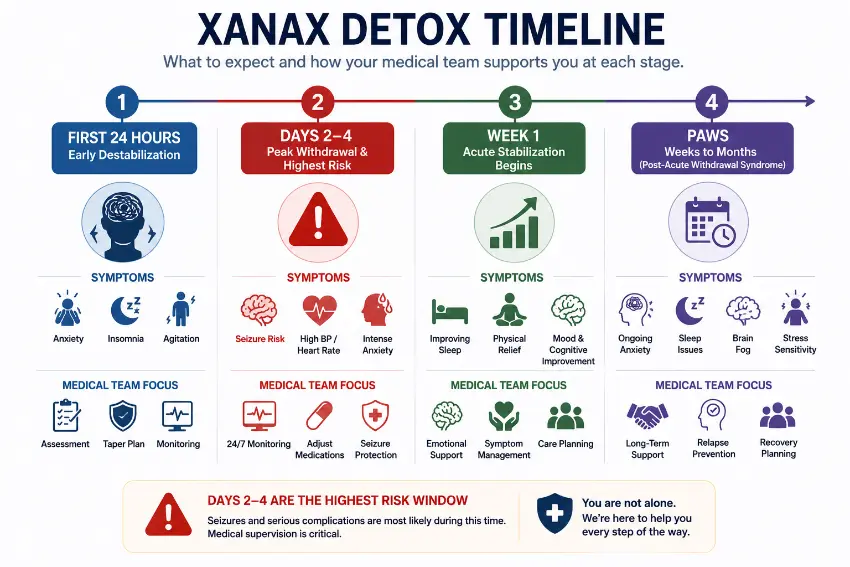
First 24 Hours
Because Xanax has a short half-life of six to twelve hours, the nervous system begins responding to its absence quickly. Rebound anxiety, insomnia, and physical agitation are typically the first signs. During this phase, the clinical team conducts a thorough assessment, establishes the tapering protocol, and begins baseline monitoring of vital signs and neurological status.
Days 2–4
This is the most medically significant phase of Xanax detox when withdrawal symptoms reach their highest intensity. Physician monitoring is continuous during this window, tapering medications are adjusted based on real-time response, and anticonvulsant coverage is maintained where indicated.
Days 2–4 represent the highest risk window for seizures and serious complications. This is the phase where medical supervision is most critical and most consequential.
Week 1
For most individuals, the most dangerous acute phase begins to resolve toward the end of the first week. Physical symptoms start to ease, sleep becomes more manageable, and seizure risk declines. During this phase, the clinical focus shifts toward emotional stabilization and begins to lay the groundwork for the transition to continuing care.
Post-Acute Withdrawal Syndrome (PAWS)
A significant number of individuals who discontinue long-term Xanax use experience PAWS. PAWS symptoms include persistent low-grade anxiety, ongoing sleep disruption, cognitive fog, emotional flatness, and heightened sensitivity to stress. Recognizing PAWS as a distinct clinical phase is important for maintaining momentum and preventing relapse.
Clinical Stabilization Insight — Dr. Phyllis Rodriguez, PMHNP-BC
Even after the acute withdrawal phase has passed, anxiety, sleep disruption, and cognitive symptoms can continue for weeks. I always prepare my patients in New Jersey for this possibility before they complete detox, because walking into the post-acute phase without that context can feel like something has gone wrong. Nothing has gone wrong, the nervous system is still healing, and that process takes time.
What to Expect During Xanax Detox
For individuals beginning Xanax detox in New Jersey, understanding what the process actually involves from day one can help decide to seek help faster in case of any emergency or assistance.
- Medical Assessment: The detox process begins with a comprehensive clinical assessment covering the individual’s Xanax history, current dose, duration of use, any co-occurring substance use, and relevant medical and psychiatric history. This assessment forms the foundation of the individualized treatment plan and determines the appropriate tapering protocol, monitoring intensity, and supportive medications.
- Individualized Taper Planning: There is not a rigid timetable for tapering, but the dose reduction is individualized. In many situations, substitution with a longer acting benzodiazepine (e. g. diazepam) is employed to provide a gentler, more evenly paced taper, with less extreme peaks and valleys of symptomatology. The taper rate is monitored and titrated in response to the individual.
- Physician Monitoring: Vital signs, neurologic status and symptom severity are monitored closely during the entire course of the acute withdrawal phase. A physician is available should there be an increase in severity of symptoms to adjust the protocol as necessary.
- Medication-Assisted Stabilization: Supportive medications follow the taper for predefined Symptom control, anticonvulsants for decreased seizure risk, beta-blockers for stabilization of HR and BP, and targeted sleep support due to severe insomnia that accompanies withdrawal.
- Emotional Support: Throughout the detox process, licensed therapists and clinical staff are there to provide support while in withdrawal, which can help a person through feelings of anxiety, panic, and emotional instability.
- Relapse Prevention Planning: Before discharge from detox, the clinical team together with each person, formulates a clearly defined transition plan, considering the level of care needed, removing potential obstacles to participation, and organizing the support system that will sustain recovery past the acute stage.
How Long Does Xanax Detox Take?
The duration of Xanax detox varies between individuals and is shaped by several clinical factors:
| Factor | How It Affects Detox Duration |
| Dosage | Higher doses require a slower, more gradual taper to avoid dangerous symptom escalation |
| Duration of use | Longer use means deeper neurological adaptation and a more extended stabilization process |
| Co-occurring mental health conditions | Anxiety, PTSD, and mood disorders require concurrent management and may extend the acute phase |
| Individual physiology | Age, metabolism, liver function, and overall health all influence how the body responds to tapering |
| Prior withdrawal history | Previous withdrawal complications may require a more conservative approach and a longer monitoring period |
For most individuals, the acute phase of medically supervised Xanax detox lasts between one and two weeks. The full stabilization process, including the early post-acute phase, often extends beyond that, which is why the transition to continuing care is a planned and supported part of the process rather than an afterthought.
Luxury Xanax Detox in New Jersey
If you want clinical accuracy and real privacy, Legacy Healing Center New Jersey will provide you with a medically supervised Xanax detox session in a recovery-supportive environment.
Complete Confidentiality, From the First Call
Privacy is maintained at all stages from admission to discharge. Care is discreetly coordinated so that there is no overlap between treatment and the lives of the individuals unless they desire it. For the professionals and executives of New Jersey, this is not a mere afterthought, but the very reason why they decide to get help.
A Lower Client-to-Staff Ratio
Physicians and therapists at Legacy Healing Center NJ are not managing large caseloads from a distance. They are available, attentive, and actively adjusting care as withdrawal evolves, which matters most during the peak risk window of days two through four, when clinical responsiveness is most consequential.
Private Accommodations Designed for Recovery
Rest is not a comfort preference during Xanax withdrawal, it is a clinical necessity. Private rooms reduce ambient stress, support neurological stabilization, and give individuals the environment they need to move through the most demanding phase of withdrawal without unnecessary disruption.
Treatment Built Around the Individual
Dosage history, health profile, schedule, and recovery goals all shape the treatment plan, which is reviewed by physicians and adjusted in real time as detox progresses. No standardized protocol, no assumptions, no one-size-fits-all approach.
Integrated Support at Every Stage
Care at Legacy Healing Center New Jersey extends beyond the acute detox phase. From medically supervised withdrawal through PHP, IOP, and integrated dual diagnosis treatment, the clinical team remains involved as recovery progresses — because lasting recovery is built on what comes after detox, not just getting through it.
Continuing Treatment After Detox
Detox addresses the acute phase of Xanax withdrawal. But it does not address the underlying conditions, behavioral patterns, and psychological factors that contributed to dependence in the first place.
The transition from detox to ongoing treatment is one of the most important clinical decisions in the recovery process, and it is one that the Legacy Healing Center New Jersey team plans for from the beginning.
Partial Hospitalization Program (PHP)
PHP provides the highest level of structured outpatient care, with daily clinical programming that addresses the psychological and psychiatric dimensions of recovery while allowing individuals to return home in the evenings. For many people completing Xanax detox in New Jersey, PHP is the appropriate next step — providing intensive support during the vulnerable early weeks of post-acute recovery.
Intensive Outpatient Program (IOP)
IOP offers structured therapeutic programming several days per week, allowing individuals to begin reintegrating into daily life while maintaining the clinical support that early recovery requires. It is often the step that follows PHP, or the appropriate starting point for individuals whose dependence is less severe.
Dual Diagnosis Treatment
Because Xanax is most commonly prescribed for anxiety and panic disorders, dual diagnosis treatment, addressing both the benzodiazepine dependence and the underlying psychiatric condition in an integrated way, is a clinical necessity for most individuals completing detox. Treating the withdrawal without addressing the condition that drove the prescription creates a significant relapse risk that structured dual diagnosis care is designed to prevent.
Therapy, Relapse Prevention, and Long-Term Planning
Evidence-based therapies including CBT and DBT help individuals build the coping strategies and emotional regulation skills that sustained recovery requires. Relapse prevention planning, ongoing psychiatric support, and connection to a community of recovery all form part of the long-term framework that makes the work done during detox count.
Confidential Xanax Detox Support in New Jersey
Taking the first step toward Xanax detox does not require having everything figured out. It requires one honest conversation with a team that understands what you are dealing with and knows how to help.
Our physician-led admissions team is available around the clock to answer questions, verify insurance confidentially, and help you understand exactly what the detox process involves.
Available 24/7. All calls are 100% confidential.