


 Written By:
 Edited By:
 Clinically Reviewed By:

What Are the Risks of Xanax Withdrawal?
- Withdrawal from Xanax can be a serious health risk, even life-threatening. Some side effects of withdrawal risk include seizures, psychosis, and heart problems. These are Mainly risky for those who have taken the drug a long time or at very high doses.
- Each person’s withdrawal symptoms will varies by how much of the drug a person took, how long they were using it, if they have experienced withdrawals before, how healthy they are, and other factors, all influence what withdrawal looks like.
- Detox under medical supervision greatly diminishes the possibility of life-threatening complications. A physician-monitored taper, supportive medications, and structured clinical oversight can make the difference between a manageable process and a medical emergency.
Not everyone experiences severe withdrawal symptoms, but the medical danger increases with higher dose and longer use. Poor health can also add to the risk.
Why Xanax Withdrawal Can Become Dangerous
Xanax belongs to a class of drugs whose withdrawal is medically distinct from most other substances. It works by enhancing GABA activity, which is a primary inhibitory neurotransmitter. When xanax intake becomes regular, the brain gradually reduces its own GABA production and adjusts receptor sensitivity downward, relying on the drug to maintain neurological balance.
Now, when Xanax is reduced or stopped, that balance is abruptly disrupted. The brain’s inhibitory system is suddenly underequipped, and excitatory neurotransmitters flood the nervous system without adequate counterbalance. The result is neurological rebound, resulting in severe anxiety and insomnia, to seizures and psychosis, depending on the individual.
This is the fundamental difference between uncomfortable withdrawal and medically dangerous withdrawal. While the former is distressing but manageable with support, the latter involves a nervous system in genuine crisis, one that requires clinical intervention, not patience.
Clinical Perspective – Phyllis Rodriguez, PMHNP-BC
“The difficulty of benzodiazepine withdrawal stems from how rapidly the nervous system can become destabilized, with a short-acting drug such as Xanax. Since alprazolam is eliminated from the body very fast, there is almost no time gap between the last dose and when withdrawal symptoms start. This quick build-up is what makes Xanax withdrawal different from alcohol or opioids that we deal with clinically. The hazard of seizures is genuine; that’s why I insist that the neurological danger should be under the watch of a medical professional.”
Why Many People Do Not Recognize Xanax Dependence Early
For many people, in particular those who were prescribed Xanax by their doctor, the habit of becoming dependent develops gradually, with no single point that they can identify when the change happened. It is a gradual process, and the one who is developing dependence is unaware of it. The dose that was initially very effective lasts for fewer hours, and anxiety could come back quite strongly even before a new dose is taken. It is quite understandable to mistake this as the original problem getting worse, rather than the person becoming physically dependent on the medication.
When it comes to high-level working individuals, it is even more likely that dependence will be overlooked as they still keep their work going and the idea that dependence has been developed can feel impossible until the withdrawal symptoms makes it undeniable.
Consider recognizing these progression as early as possible matters because the longer dependence is ignored the more complicated will be the process of drug cessation. Sincere clinical assessment at any stage, without hesitation, is always the best move always, and it is never too late to start.
Physical and Psychological Withdrawal Risks
The physical dimension of Xanax withdrawal reflects the nervous system’s attempt to reestablish equilibrium after prolonged suppression. Physical symptoms are at their most intense during the first 1 to 4 days and typically begin to ease within 1 to 2 weeks, though this varies considerably depending on the individual’s history.
- Tremors and muscle instability – involuntary shaking that can range from mild to severe, reflecting the excitatory rebound in the motor system
- Elevated heart rate and blood pressure – cardiovascular stress driven by sympathetic nervous system hyperactivity
- Severe insomnia – a profound inability to rest even when exhausted, as the arousal systems of the brain remain dysregulated
- Sensory hypersensitivity – heightened and often painful responses to sound, light, and touch that can make ordinary environments feel overwhelming
- Nervous system instability – the underlying condition driving all of the above, and the reason physical symptoms can escalate without warning
Psychological and Cognitive Risks
The psychological risks of Xanax withdrawal are frequently underestimated. These symptoms are neurological in origin that reflect a brain recalibrating under significant chemical stress, and respond to proper clinical support.
- Severe anxiety and panic attacks – often more intense than anything experienced before starting Xanax, driven by GABA deficiency and unregulated fear circuitry
- Emotional instability – rapid, unpredictable shifts in mood that bear little relationship to external circumstances
- Derealization and depersonalization – a disturbing sense of detachment from one’s surroundings or sense of self, which can feel profoundly disorienting
- Confusion and cognitive disruption – difficulty processing information, making decisions, or following conversations
- Hallucinations – in severe cases, visual or auditory perceptions that are not real, indicating serious neurological destabilization
- Cognitive fog – a persistent difficulty with concentration, memory, and mental clarity that can outlast the acute withdrawal phase by weeks
Severe Xanax withdrawal symptoms may require medically supervised detox.
Professional monitoring may help reduce withdrawal complications and improve stabilization during recovery.
Can Xanax Withdrawal Cause Seizures?
Yes, seizures are among the most serious and well-documented risks of benzodiazepine withdrawal, and Xanax, because of its short half-life and potency, carries a particularly acute risk profile.
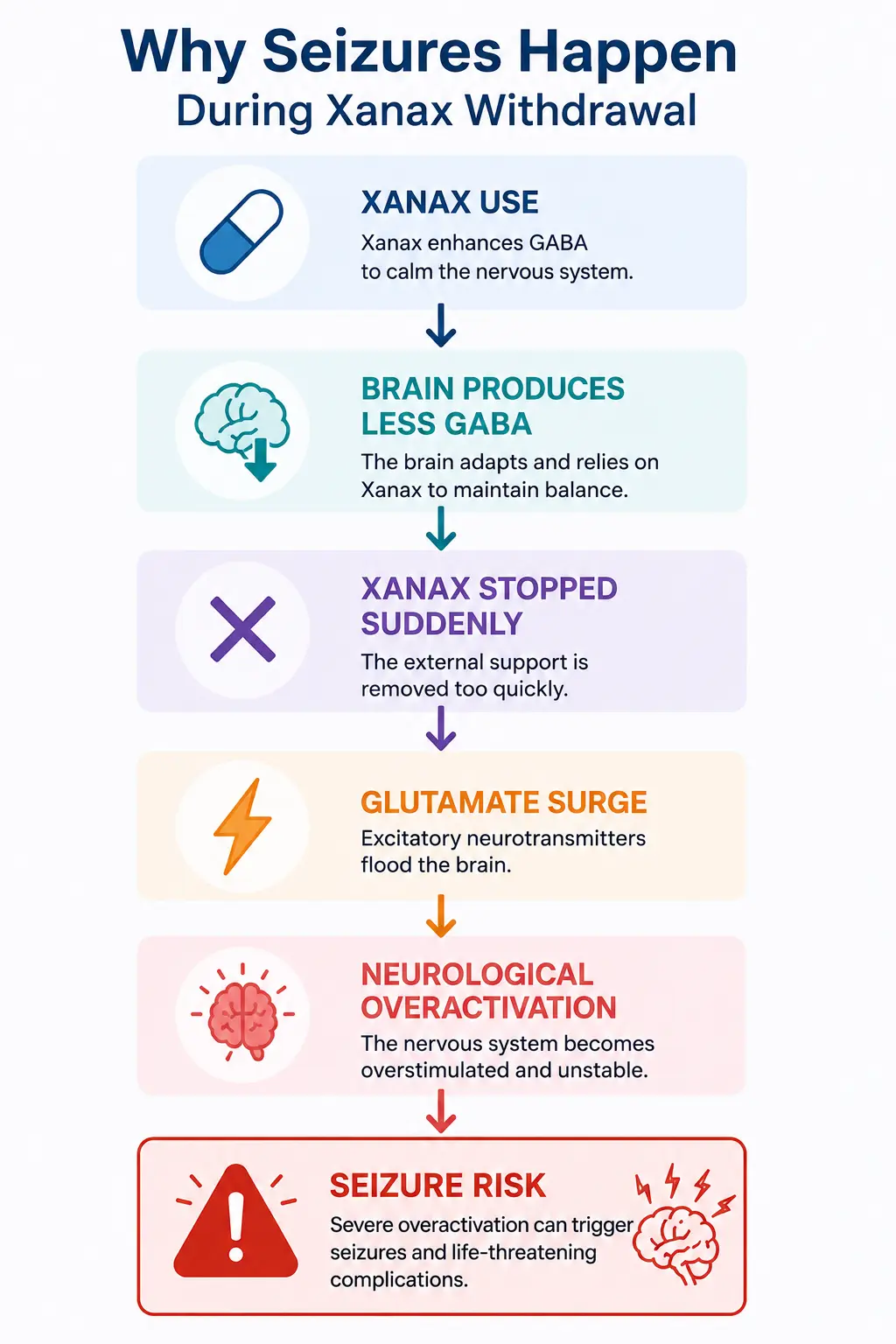
Why Seizures Happen?
When Xanax is abruptly discontinued, the brain’s inhibitory GABA system loses its pharmacological support almost immediately. Excitatory neurotransmitters, primarily glutamate, surge without adequate counterbalance. The result is a state of extreme neurological overactivation. In susceptible individuals, this translates directly into seizure activity.
This is not a gradual process. Because Xanax clears the body so quickly, this shift can happen within hours of the last dose.
When Seizure Risk Peaks?
Seizure risk is highest during the first one to four days after the last dose, the same window when withdrawal symptoms are at their most intense. However, seizures have been reported outside of this window, particularly in individuals with a history of prior withdrawal episodes.
Who Faces Higher Risk?
While seizures can occur in anyone undergoing unsupervised Xanax withdrawal, certain factors elevate the risk significantly:
| Risk Factor | Why It Increases Seizure Risk |
| Long-term Xanax use | Deeper neurological adaptation means more severe rebound |
| High doses | Greater GABA suppression leads to a more intense excitatory surge |
| Concurrent alcohol or opioid use | Multiple depressants compound neurological instability |
| Prior withdrawal attempts | Kindling effect sensitizes the nervous system over time |
| Underlying anxiety or trauma disorders | Pre-existing neurological vulnerability lowers the seizure threshold |
Emergency Warning Signs
Seizures during withdrawal can occur without preceding warning signs. Any convulsive episode, regardless of duration or apparent severity, requires immediate emergency medical attention. Do not wait to see if it resolves on its own.
Important Medical Insight:
Benzodiazepine withdrawal seizures have been documented in individuals with no prior seizure history who were discontinuing therapeutic, prescribed doses of alprazolam. Dose alone does not determine risk. Duration of use, individual neurobiology, and the rate of discontinuation all contribute.
Xanax Withdrawal Timeline and Risk Progression
Understanding how withdrawal risk evolves over time is important for anyone navigating this process, and for anyone supporting someone through it.
First 24 Hours: Early Destabilization
Because of Xanax’s short half-life, the nervous system begins responding to its absence within hours. Rebound anxiety is typically the first sign, a sharp, disproportionate surge of the tension and unease the drug was originally prescribed to address.
Accompanying symptoms at this stage include insomnia, agitation, heightened sensory sensitivity, and the onset of physical restlessness.
Days 2–4: Peak Risk Window
This is the most medically significant phase of Xanax withdrawal. Symptoms reach their highest intensity, seizure vulnerability is at its greatest, and cardiovascular stress, elevated heart rate, and increased blood pressure are most pronounced. For individuals with long-term or high-dose use, hallucinations and psychosis can emerge during this window.
Days 2-4 represent the highest risk window for seizures and serious complications. Medical supervision during this phase is not optional for individuals with significant dependence.
Week 1: Acute Stabilization Begins
For most people, the most dangerous acute phase begins to resolve toward the end of the first week. Physical symptoms start to ease, sleep becomes marginally more manageable, and the risk of seizure declines.
However, fatigue, emotional exhaustion, and cognitive disruption often intensify during this phase, even as the physical picture improves.
Post-Acute Withdrawal Syndrome (PAWS): Weeks to Months
PAWS is a distinct clinical phase characterized by persistent neurological symptoms that can continue for weeks or months.
PAWS symptoms include:
- Low-grade persistent anxiety or episodic panic
- Ongoing sleep disruption
- Cognitive fog and difficulty with concentration
- Emotional flatness or reduced capacity for pleasure
- Heightened sensitivity to stress and environmental stimuli
PAWS is not a sign that recovery has failed. It is the nervous system completing a longer recalibration process, one that structured clinical support can meaningfully ease.
Clinical Insight from Dr. Rodriguez
Even after acute withdrawal symptoms improve, anxiety, sleep disruption, and cognitive fog can persist for weeks. I always prepare my patients for this possibility, because walking into PAWS without that context can feel like something has gone wrong. Nothing has gone wrong, the nervous system is still healing. Structured support during this transition makes a real difference to how manageable that period feels.”
Hidden Risks Most People Overlook
The main health dangers of Xanax withdrawal are seizures, hallucinations, and heart problems. Additionally, there’s a whole range of less obvious risks that are still there and can bring very serious consequences in the end.
Relapse and Overdose Without Awareness
Relapse during or after self-directed withdrawal is a predictable response to a nervous system under extreme stress. When the withdrawal symptoms are at the peak and totally unbearable, the panic, the insomnia, taking the smallest dose to find relief only makes sense at this moment.
The danger is that even a short time of abstinence reduces tolerance significantly, so going back to a dose that was previously tolerated can mean respiratory problems or overdose without realizing it.
Impaired Judgment During Withdrawal
Changes in brain functioning during withdrawal, such as confusion, poor decision-making, and emotional reactivity, can all adversely affect judgment, which the individual may not fully recognize.
The brain under neurological stress does not process information or regulate responses on a normal level, and the people around someone in withdrawal need to understand this as much as the individual.
Emotional Isolation
Emotional isolation is another underappreciated risk; withdrawal intensifies the very symptoms that make connection feel impossible, causing many people to withdraw from support systems at exactly the point they need them most.
Untreated Underlying Anxiety Disorders
Untreated underlying anxiety disorders add further complexity. When Xanax is discontinued, the conditions it was prescribed to manage return, often with amplified intensity, making dual diagnosis treatment a clinical necessity rather than an optional layer of care.
Sleep Deprivation Effects
Last but not least, lack of sleep, which is the most common symptom of a Xanax withdrawal, makes this whole set of risks even worse. It impairs your judgement, it makes your mood unstable, and it lowers the threshold for seizures, so sleep support becomes a potential medical priority and not an afterthought.
When Xanax Withdrawal Becomes a Medical Emergency
Xanax withdrawal exists on a spectrum, while many of these risks are manageable within a structured clinical setting, some of it requires immediate emergency medical intervention.
The following symptoms indicate that the nervous system is in acute crisis, such as:
- Seizures or convulsions of any kind or duration
- Hallucinations – seeing, hearing, or feeling things that are not present
- Psychosis – severely disordered thinking, paranoia, or loss of contact with reality
- Suicidal thoughts or impulses toward self-harm
- Chest pain or severe, sustained heart palpitations
- Difficulty breathing or respiratory distress
- Loss of consciousness or inability to be roused
- Extreme confusion or disorientation that does not resolve within minutes
“Medical detox may help reduce serious withdrawal complications safely.”
Medical Detox and Nervous System Stabilization
Medically supervised detox is the clinically appropriate standard of care for Xanax withdrawal, because many cases can escalate without warning, and the window for intervention is narrow.
Detox for Xanax withdrawal typically involves:
- A physician-monitored tapering protocol designed around the individual’s dose, duration of use, and health profile.
- Anticonvulsant and stabilizing medications to reduce seizure risk and manage cardiovascular stress during peak withdrawal
- Sleep support and symptom management, addressing the specific physical and psychological demands of each phase
- Ongoing psychological support from licensed clinicians throughout the withdrawal process
- Transition planning to the appropriate level of continuing care, whether PHP, IOP, or integrated dual diagnosis treatment
What Makes Xanax Luxury Detox Different
For individuals who require both clinical precision and genuine privacy, the environment in which detox takes place matters. At Legacy Healing Center New Jersey, medically supervised withdrawal is provided within a setting that offers private accommodations, confidential admissions, personalized treatment planning, and lower client-to-staff ratios, allowing for more attentive monitoring throughout.
Confidential Support for Xanax Withdrawal Risks
Xanax withdrawal can be a medical issue; however, if the appropriate medical support is properly organized, the associated risks can be controlled. The initial step is to have an honest discussion with a team that understands the whole situation.
At Legacy Healing Center New Jersey, our physician-led team provides discreet, individualized care from the first call through every stage of recovery. Insurance verification is confidential, takes minutes, and carries no obligation.