


 Written By:
 Edited By:
 Clinically Reviewed By:

Key Takeaways
|
What Are the Symptoms of Xanax Withdrawal?
Xanax withdrawal can begin within hours of the last dose and may range from uncomfortable to medically serious, depending on how long the medication has been used and at what dose.
Common symptoms include:
- Anxiety and panic attacks
- Insomnia and restlessness
- Tremors and sweating
- Nausea and headaches
- In severe cases, seizures and hallucinations
Xanax withdrawal can be life-threatening without medical supervision. It is not recommended to stop suddenly or detox alone.
What Is Xanax Withdrawal?
Xanax (alprazolam) is a quick-acting benzodiazepine. It acts by increasing the level of GABA, the main inhibitory neurotransmitter of the brain. GABA inhibits brain activity, resulting in a relaxed and tranquil feeling, which is why Xanax is used to treat anxiety and panic disorders.
The brain gets used to this action of introducing a drug and as a result, it slowly decreases the natural production of GABA. Also, it adjusts to the presence of the drug. When the person reduces or stops taking Xanax, this adjustment is undone and the nervous system behaves in ways that are beyond the person’s control.
That is what Xanax withdrawal is: more than just losing a feeling of calm, it is the brain harming itself in its effort to regain balance.
Dependence vs. Addiction – An Important Distinction
These two terms are often used interchangeably, but they are clinically different.
| Dependence | Addiction | |
| Definition | A physical adaptation to the drug’s presence | Compulsive use despite harmful consequences |
| How it develops | Can occur with prescribed, therapeutic use | Involves psychological craving and loss of control |
| Who it affects | Anyone using Xanax regularly for weeks or more | A subset of those who are also dependent |
| Treatment implication | Requires medically supervised tapering | Requires tapering plus behavioral and psychiatric support |
Many people who experience Xanax withdrawal did not misuse their medication. Physical dependence is a physiological response, not a moral failing.
Clinical Insight From Dr Rodriguez
Understanding that xanax withdrawal can result in seizures is one of the crucial knowledge points. A seizure risk can even continue even if a person is on the lowest dose possible, and the mechanism that causes this is because alprazolam has a very short duration; the brain’s GABA system can become unbalanced very quickly after the last dose that causes the seizure episodes. This is exactly why I would never suggest stopping Xanax suddenly. A gradual taper administered under medical supervision, and tailored to the individual, is the safest approach.
Common Xanax Withdrawal Symptoms
Symptoms can be different from one person to another based on how much, how long and type of person using the drug. They often follow a pattern where first the symptoms are light and mostly physical discomfort, and in some cases, symptoms require urgent medical help.
Early Symptoms Onset: 6–12 hours after last dose
- Anxiety and increased nervousness
- Inability to fall asleep or stay asleep
- Restlessness and unsettling feeling
- Sweating during the night
- Headaches and slight sensitivity to light and sound
Early symptoms may be confused with anxiety which leads to the prescription of Xanax with the original intention to treat such anxiety. Distinguishing rebound anxiety caused by withdrawal from the re-emergence of an underlying condition is one of the key reasons clinical oversight matters from day one.
Moderate Symptoms Onset: 1–4 days, most intense
- Panic attacks sometimes worsening the severity of those experienced before starting Xanax
- Tremors and muscle twitching
- Nausea, stomach cramps and changes in appetite
- Raised heart rate and blood pressure
- Being very sensitive to sound, light and touch
During this period, the nervous system remains highly alert. Those who have used high doses or for a long time may develop moderate symptoms suddenly that too without any prior signs.
Severe Symptoms Highest risk in days 1–4, particularly with long-term or high-dose use
- Visual and auditory hallucinations
- Feeling confused and lost
- Grand mal seizures
- Psychosis and delusions
- Extreme agitation or aggressive behavior
What Xanax Withdrawal Can Feel Like Emotionally?
The physical symptoms of Xanax withdrawal are well documented, but the emotional experience is less often discussed, and for many people, it is the hardest part.
Because Xanax directly suppresses the brain’s fear and stress response, its absence can feel like the complete unraveling of emotional regulation. Anxiety does not simply return, it surges. Panic can arise without a clear trigger. Sleep deprivation compounds everything, making ordinary tasks feel insurmountable.
| What You May Feel | What Is Actually Happening |
| Overwhelming panic or dread | The brain’s fear response is unregulated without GABA support |
| Sudden mood swings | Neurological hyperarousal destabilizes emotional regulation |
| Social withdrawal and isolation | Sensory overload makes interaction feel genuinely overwhelming |
| Feeling “wired but exhausted” | The nervous system is working hard to reestablish balance |
| Inability to manage ordinary stress | The brain has lost its pharmacological coping buffer |
| Persistent, unexplained terror | A direct neurochemical withdrawal effect, not situational anxiety |
These Feelings Are Not a Sign of Weakness – Dr Rodriguez
Most patients tell me that the time during Xanax withdrawal is the one when they don’t feel like their normal selves. I keep on telling them that these symptoms are not their personal faults but rather signs of how their nervous systems are trying to get back to normal.
Xanax Withdrawal Timeline
Because Xanax has a short half-life of six to twelve hours, symptoms can appear surprisingly quickly after the last dose. While individual timelines vary, the progression typically follows a recognizable pattern.
6–12 Hours – Early Rebound Begins
Rebound anxiety is often the first sign, a sharp return of tension and unease that the medication was originally prescribed to address. Insomnia, restlessness, and mild physical discomfort typically accompany it.
At this stage, symptoms can be easy to dismiss or attribute to general stress, which is part of why early clinical assessment is important.
1–4 Days – Peak Withdrawal
This is the most physically and emotionally demanding phase when symptoms reach their highest intensity, increasing the risk of serious complications like seizures.
Panic attacks, tremors, elevated heart rate, nausea, and profound sleep disruption become common. While individuals with long-term or high-dose use, may experience hallucinations or psychosis.
1–2 Weeks – Physical Stabilization
For most people, acute physical symptoms begin to ease with better sleep, appetite and reduced anxiety.
However, emotional volatility, cognitive fog, and fatigue may persist. The risk of relapse remains elevated as individuals begin to feel well enough to underestimate what they have been through.
Post-Acute Withdrawal Syndrome (PAWS) – Weeks to Months
A significant number of individuals who discontinue long-term benzodiazepine use experience PAWS, a prolonged phase in which psychological symptoms persist long after acute withdrawal resolves.
PAWS symptoms include:
- Persistent low-grade anxiety or episodic panic
- Ongoing sleep disturbances
- Difficulty concentrating or processing information
- Emotional flatness or reduced ability to feel pleasure
- Heightened sensitivity to stress
PAWS can last weeks to months and in some cases longer, particularly after extended high-dose use. Recognizing it as a distinct clinical phase is important for both individuals and their support systems.
Factors That Affect Withdrawal Severity
Two people with similar Xanax histories can have profoundly different withdrawal experiences. Several variables shape how withdrawal unfolds and how long it lasts.
| Factor | How It Affects Withdrawal |
| Dosage and duration | Higher doses and longer use mean deeper neurological adaptation and more difficult withdrawal |
| Polydrug use | Combining Xanax with alcohol or opioids significantly compounds withdrawal risk |
| Co-occurring mental health conditions | Anxiety, depression, and PTSD can intensify symptoms and complicate clinical differentiation |
| Prior withdrawal episodes | Each withdrawal can sensitize the nervous system, making subsequent withdrawals more severe (kindling effect) |
| Individual physiology | Age, metabolism, liver function, and genetics all influence how the body clears Xanax and responds to its absence |
When Xanax Withdrawal Becomes Dangerous
Xanax withdrawal sits in a category that few substances occupy: it can be fatal. Unlike opioid withdrawal, which is rarely life-threatening on its own, benzodiazepine withdrawal carries genuine risk of serious medical complications.
- Seizure Risk: Seizures are the most serious acute risk associated with Xanax withdrawal. They can occur without warning, typically within the first one to four days, carrying a risk of injury, aspiration, and death.
When Xanax is abruptly removed, excitatory neurotransmitters surge without adequate inhibitory counterbalance which causes the nervous system to reach the state of extreme electrical instability, responsible for seizure.
Seizure risk is elevated in long-term or high-dose users, but has also occurred in individuals with no prior seizure history following abrupt discontinuation of therapeutic doses.
- The Danger of Stopping Suddenly
There is no safe way to stop cold turkey from established benzodiazepine dependence outside of a medical setting because the brain’s adjustment process requires time.
Reducing too quickly, skipping doses, or switching medications without guidance can all precipitate dangerous withdrawal effects, many of which may not be immediately recognizable as such.
- Relapse Risk During Withdrawal
When symptoms peak, particularly the panic, dread, and physical discomfort of days one through four, the pull toward taking even a small dose for relief can be overwhelming.
Resuming use after a period of abstinence lowers tolerance, increasing the risk of accidental overdose.
- The Risks of Detoxing Alone
Home detox from Xanax removes the clinical safeguards that exist for good reason.
- A seizure goes unwitnessed
- Symptoms escalate without intervention
- Emotional intensity is faced in isolation, compounding both suffering and relapse risk
The decision to detox alone is often driven by privacy concerns or an underestimation of what withdrawal will involve. These are understandable, but neither reduces the actual risk.
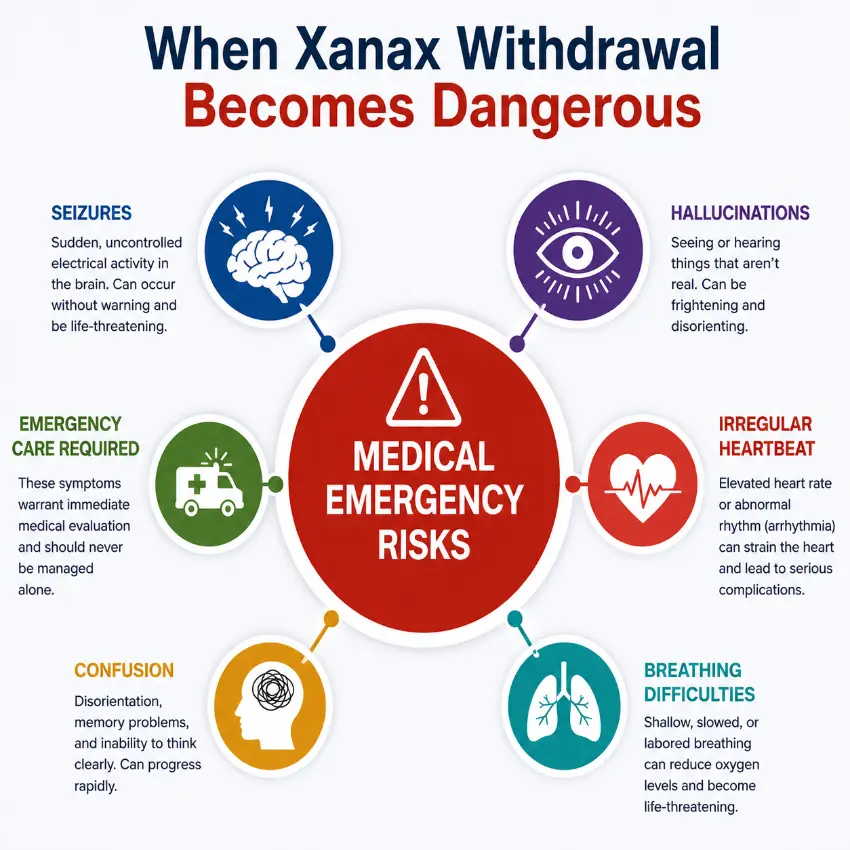
Xanax withdrawal can escalate without warning.
If you or someone you love is experiencing any of these symptoms, seek emergency medical help immediately
Medical Detox for Xanax Withdrawal
Medically supervised detox is the clinically appropriate standard of care for anyone with established benzodiazepine dependence. The goal is not simply to manage discomfort, it is to guide the brain and body through a neurologically complex process as safely and steadily as possible.
Medical detox for Xanax typically involves:
- A physician-monitored tapering protocol calibrated to the individual’s dose, duration of use, and health profile
- Supportive medications to reduce seizure risk, manage insomnia, and stabilize heart rate and blood pressure
- Ongoing psychological support to address the anxiety, panic, and emotional volatility that accompany withdrawal
- An individualized transition plan connecting clients to the right level of ongoing care – PHP, IOP, or continued dual diagnosis treatment
At Legacy Healing Center New Jersey, detox coordination is handled with the same discretion and clinical precision that defines every stage of care. For a detailed look at the detox process specific to Xanax and benzodiazepine dependence, visit our Xanax Detox New Jersey page.
Get Confidential Help for Xanax Withdrawal
Medically, Xanax withdrawal is highly complicated, yet if you have the right support system, it can be handled. The first step is to know what you are up against and get in touch with a professional team that will help you undergo the process safely.
Our physician-led staff at Legacy Healing Center New Jersey offers confidential, personalized care from the first call to your recovery and relapse prevention care.
All calls are 100% confidential. Available 24/7.