


What Are the Signs of Xanax Addiction?
- Xanax addiction can develop gradually, even if initially the drug was prescribed by a doctor and you simply followed the instructions. Since tolerance keeps increasing silently, one might lose sight of the point when a therapeutic use turns into a dependence.
- Common warning signs include increasing tolerance, depending emotionally on Xanax to feel relaxed or be able to function, experiencing withdrawal symptoms between taking the drug, and making behavioral changes like getting your prescriptions filled before you really need to, or staying away from places where you know you won’t be able to get Xanax.
- Many people, mainly high-functioning professionals and those who have been taking prescription drugs for a long time, only realize dependence when it starts to have a visible detrimental effect on their relationships, work, or health, which cannot be blamed on something else.
- Professional clinical assessment can help individuals safely evaluate the severity of dependence and understand what the appropriate next steps look like, without judgment and without disruption to daily life.
It is not true that everybody who takes Xanax will become addicted, but taking it for a long time or at high doses makes it much more likely to the point of being physically dependent and also having withdrawal problems.
What Xanax Addiction Looks Like
Xanax is among the most commonly prescribed drugs in the US for a lot of people, as it genuinely alleviates their anxiety and panic disorders. Though due to its short half-life and quick effect, it has become one of the most addictive substances in its group, and the path from therapeutic use to dependence can be short, subtle, and easy to miss.
To get a real picture of what a Xanax addiction really looks like, you first need to distinguish the three different, although frequently intertwined, clinical situations.
Medical Use | Dependence | Addiction | |
Definition | Xanax taken as prescribed for a diagnosed condition | A physical adaptation where the body requires Xanax to function normally | Compulsive use driven by craving, despite negative consequences |
How it develops | Begins with legitimate clinical need | Can develop within weeks of regular prescribed use | Involves psychological loss of control alongside physical dependence |
Key indicator | Medication manages symptoms effectively | Symptoms return or intensify between doses | Use continues despite clear harm to health, relationships, or functioning |
Treatment need | Ongoing clinical monitoring | Medically supervised tapering | Tapering plus behavioral and psychiatric support |
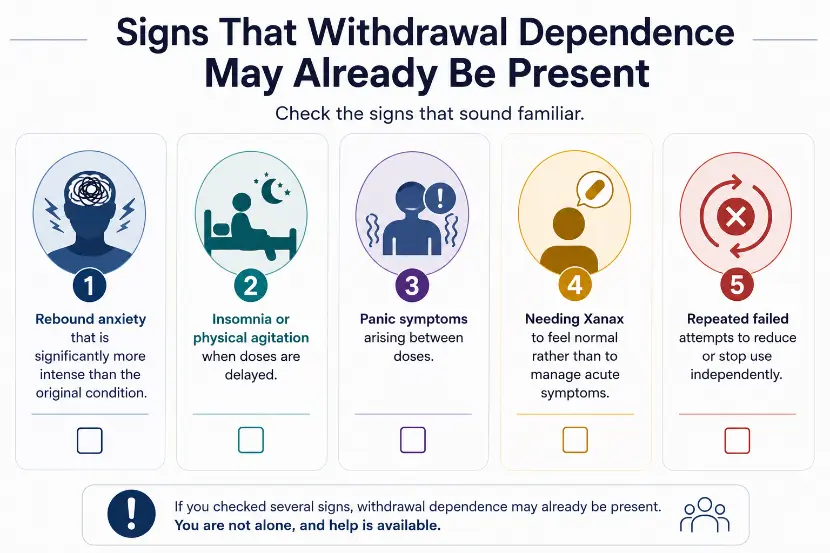
Tolerance is often the first sign that the relationship with Xanax is shifting. The dose that once provided hours of relief begins wearing off faster. Anxiety returns between doses with greater intensity, which feels and is easy to interpret as the original condition worsening rather than evidence of physical dependence developing.
Psychological reliance tends to follow a similar progression. Over time, Xanax can shift from being a tool for managing acute symptoms to being a baseline requirement for feeling calm or functional at all. That shift, from medical use to emotional necessity, is one of the defining features of addiction, and it often develops without the individual fully recognizing it.
Clinical Perspective – Dr. Phyllis Rodriguez, PMHNP-BC“What I see most consistently in my patients is how gradually and convincingly Xanax dependence develops. It is because it is prescribed and because it does really help in beginning. By the time the patient realizes that process they are normally already dependent and then the role of a sincere clinical judgment is imperative. “ |
Early Signs of Xanax Addiction
Xanax addiction often does not give a direct warning. It usually reveals itself through a series of tiny, barely noticeable changes in one’s physical state, emotional condition, and behavior which, when seen separately, are very easy to explain away but collectively make a significant impact. Here are the signs:
1. Physical Warning Signs
- Persistent drowsiness or sedation that goes far beyond the expected relief from the drug
- Unclear, slow speech and a lack of coordination, In particular in the time after a dose
- Forgetfulness and struggling to learn new things
- Feeling of exhaustion that doesn’t get better even after resting, showing the effect of the central nervous system being consistently depressed with regular use
- Experiencing physical symptoms like tremors, sweating, or a fast heartbeat, if the time to take a dose is delayed or missed
2. Emotional and Psychological Signs
- Very strong feelings of anxiety or panic happening in between doses and are even more severe than the original problem.
- Getting very annoyed and not being able to control one’s emotions
- Feeling that Xanax is the only trustworthy way to be calm, focused, or able to carry on
- Having a hard time dealing with stress, uncertainty, or discomfort without hunger for medicine
- Becoming emotionally numb or physically flat and uninterested in things that you used to enjoy or motivate you
3. Behavioral Signs
- Taking higher doses than prescribed, or taking doses more frequently than directed
- Running out of prescriptions earlier than expected and experiencing anxiety about refills
- Visiting multiple doctors or urgent care facilities to obtain additional prescriptions
- Pulling away from social and work contacts
- Concealing Xanax use from family members, colleagues, or healthcare providers
- Using Xanax even though one knows it is negatively affecting health, relationships, or performance.
Why Many High-Functioning Individuals Miss the Signs
If one is a high-functioning, very busy person who is living a stressful life, the signs of Xanax addiction might not be visible to oneself for a long time. It can be so tempting to attribute the first signs of addiction to stress or tiredness in a difficult moment, instead of seeing them as signs of addiction.
The legitimacy of the prescription plays a significant role in this. When a medication has been part of a daily routine for months or years and was recommended by a physician, the idea that it has become a problem feels counterintuitive. The gradual normalization of daily Xanax use means that increasing reliance stops registering as remarkable, until the consequences of trying to go without it make the reality of dependence impossible to ignore.
This is why early identification of this situation is the most successful intervention method because the longer the dependence remains silent, the more medically complicated the withdrawal process will become, and the more likely it is that it will cause disruptions to the professional and personal life the individual has been working hard to protect.
Early intervention may help prevent severe dependence and withdrawal complications.Confidential clinical support may help individuals safely evaluate treatment and detox options. |
When Xanax Dependence Becomes Dangerous
Physical dependence on Xanax is not a clear-cut condition; it varies from person to person, and at some moment for many individuals, it changes from a medical issue to a real threat to life. Knowing when that point is reached and how it appears can be helpful for both the affected person and those around them.
1. Increasing Dose Dependency
The more tolerant a person becomes, the more Xanax they need, to achieve the same effect. This escalation is a brain adjustment to how benzodiazepines have been administered over time and is not a reflection of moral failing or intentional drug misuse. However, this means that the body gets more and more addicted to higher drug levels to maintain normal brain functions, which makes discontinuation highly challenging medically.
2. Withdrawal Symptoms Between Doses
One of the clearest indicators that dependence has become dangerous is the emergence of withdrawal symptoms between scheduled doses. If the person experiences rebound anxiety, insomnia, trembling, or even panic attacks before the next dose and these symptoms disappear after the intake of the drug, then that is interdose withdrawal, a major red flag in clinical practice that the body has become dependent on Xanax to the point that it cannot stabilize itself without it.
3. Combining Xanax with Alcohol or Opioids
The combination of Xanax with alcohol, opioids, or other central nervous system depressants dramatically increases the risk of respiratory depression and overdose. Both types of drugs impair the same nerve systems, and their joint effect is not simply the sum of their separate effects but rather their product. Such combinations cause a large number of deaths related to benzodiazepines and are considered to be one of the most dangerous patterns of increased use of Xanax.
Emotional and Relationship Impact of Xanax Addiction
The clinical dangers of Xanax addiction have been researched extensively, although the emotional and relational damage is more elusive and the main reason why people in most cases are compelled to seek treatment.
Emotional Withdrawal
Xanax helps in blocking anxiety and also other emotional responses. But, if the drug is taken continuously for a long period, one can experience a gradual disappearance of all feelings, like pleasure love etc. And this happens due to, prolonged GABA suppression, and one that gets better through proper therapy and time.
Isolation and Relationship Strain
With the development of dependence on a drug, the natural behavior of isolation comes out automatically. A constant medication supply can become so preoccupying that it almost takes all of a person’s attention. Cycles of taking drugs, feeling relief and rebound, lead to difficulty maintaining relationships with others. Relationships that were once sources of genuine support begin to feel like obligations, and the difference between one’s own feelings and the way a person acts to others becomes larger over time. For family members, such a change can be very emotional as well as puzzling when they do not understand what is happening.
Work and Performance Decline
Cognitive fog, memory lapses, fatigue, and emotional volatility do not stay confined to someone’s personal life, over time, they affect professional performance too. The quality of work, the reliability of follow-through, and the capacity to manage pressure in the way that was once a defining professional strength all begin to decline. For individuals whose sense of identity is closely tied to their professional performance, this is often one of the most distressing dimensions of Xanax dependence.
Reduced Motivation and Engagement
The anhedonia that often accompanies long-term benzodiazepine use, a reduced ability to find meaning or pleasure in previously important activities, extends beyond mood alone. Hobbies, exercise, creative work, and social connections all begin to feel less accessible and less rewarding. What remains is often a narrowing of daily experience around the rhythm of medication use, which in itself deepens the cycle of dependence. These emotional and relational consequences are not permanent, and they are among the first things to begin improving when dependence is addressed with the right clinical support.
Treatment for Xanax Addiction
Treating Xanax addiction requires more than simply stopping the medication. Because of the neurological complexity of benzodiazepine dependence and the genuine medical risks of withdrawal, treatment must be clinically structured, individually tailored, and supported at every stage.
Effective treatment typically includes:
- A physician-monitored tapering protocol designed around the individual’s dose, duration of use, and clinical history, not a standardized schedule applied uniformly
- Medical detox coordination with appropriate monitoring and supportive medications to manage withdrawal safely, including seizure prevention where indicated
- Integrated therapy addressing the underlying anxiety, panic, or mood disorders that Xanax was originally prescribed to treat, through evidence-based approaches including CBT and DBT
- Relapse prevention planning that equips individuals with sustainable coping strategies before discharge, reducing the risk of returning to use during the vulnerable post-detox period
- Transition to the appropriate level of continuing care, whether PHP, IOP, or integrated dual diagnosis treatment, ensuring that progress made during detox is supported and built upon
What Makes Luxury Xanax Treatment Different
Recovery from Xanax dependence is already demanding. The environment in which it happens should be working for you, not adding to the weight of it.
Complete Confidentiality, From the First Call
From admissions to discharge, your privacy is protected at every step. Discreet care coordination means your treatment never has to intersect with your professional or public life unless you choose it to.
A Lower Client-to-Staff Ratio
Our physicians and therapists are available, attentive, and actively adjusting your care as withdrawal evolves.
Private Accommodations Designed for Recovery
Rest is a clinical necessity. Private rooms help you with genuine rest, reduces stress, and offers an environment that supports neurological stabilization rather than disrupting it.
Treatment Built Around You, Not a Template
Your dosage history, your health profile, your schedule, your goals, every element of your treatment plan is built around your specific circumstances, reviewed by physicians, and adjusted in real time as your recovery progresses.
Integrated Support at Every Stage
From medically supervised detox through PHP, IOP, and dual diagnosis treatment, care continues beyond the acute phase, because lasting recovery is built on what comes after withdrawal, not just getting through it.
Confidential Help for Xanax Addiction
At Legacy Healing Center New Jersey, we believe that asking for help should feel like relief, not risk. Every person who reaches out to us is met with discretion, clinical honesty, and a genuine commitment to finding the right path forward.
Whether you are certain you need treatment or simply trying to understand what you are dealing with, our team is here to help you make sense of it. Insurance verification takes minutes. The conversation stays completely private. And the guidance you receive will be honest about what recovery actually involves and what we can genuinely offer you.
The first step does not have to be the hardest one.
Available 24/7. All calls are 100% confidential.

FAQs About Signs of Xanax Addiction
What are the signs of Xanax addiction?
Can someone become addicted to Xanax while taking it as prescribed?
How do you know if dependence has already developed?
What happens when someone stops taking Xanax suddenly?
Is medical detox necessary for Xanax addiction?
Can Xanax addiction be treated confidentially?
Absolutely, particularly those in professional roles or with significant public visibility, confidentiality is the primary factor that determines whether they seek help at all. At Legacy Healing Center New Jersey, our admissions process is discreet, insurance verification is handled privately, and treatment is delivered in an environment where privacy is built into every aspect of care.
Disclaimer: This content is not a diagnosis or medical advice, it is provided for educational purposes only. If you or a loved one is struggling with substance use, please consult a qualified medical professional.
Table of Contents
Most Insurance Policies
Cover Treatment.
Find out what treatment programs you qualify for in less than 2 minutes.
"*" indicates required fields
Ready to Get Help?
One call can change everything. Our experienced admissions team is here to guide you to the right treatment. All calls are 100% confidential.


Written By:
Edited By:
Clinically Reviewed By: